

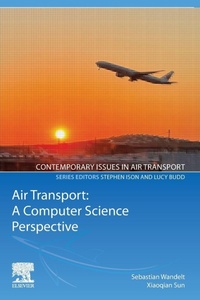
Air Transport: A Computer Science Perspective
Published on 28. October 2025
Book
Paperback/Softback
454 pages
978-0-443-45150-8 (ISBN)
Description
Air Transport: A Computer Science Perspective examines the integration of computer science principles in air transportation, bridging the gap between theory and real-world applications. It delves into automation, problem solving, and innovative aviation technologies. Authored by a seasoned team of a computer scientist and an airspace engineer, it offers a unique blend of expertise that highlights practical algorithms, data structures, and optimization techniques essential for flight operations and autonomous systems. Readers will learn about the latest regulations, ensuring they are well-equipped to navigate the evolving air transport landscape.
Structured in five parts, the book begins with foundational concepts like computational complexity and intelligence. It then explores airline operations, including network design, flight scheduling, fleet assignment, and aircraft routing. The exploration continues with airport operations, focusing on gate assignment, ground vehicle allocation, and delay prediction. In the realm of air traffic flow management, readers will discover trajectory optimization, airspace sectorization, and network resilience assessment. The final section summarizes key insights and future trends.
This book is an invaluable resource for transportation engineers, computer scientists, and professionals in data science, software engineering, and aviation research. It is ideal for students in aerospace engineering, computer science, and data science programs, emphasizing practical applications that drive innovation and efficiency in the air transport sector.
Structured in five parts, the book begins with foundational concepts like computational complexity and intelligence. It then explores airline operations, including network design, flight scheduling, fleet assignment, and aircraft routing. The exploration continues with airport operations, focusing on gate assignment, ground vehicle allocation, and delay prediction. In the realm of air traffic flow management, readers will discover trajectory optimization, airspace sectorization, and network resilience assessment. The final section summarizes key insights and future trends.
This book is an invaluable resource for transportation engineers, computer scientists, and professionals in data science, software engineering, and aviation research. It is ideal for students in aerospace engineering, computer science, and data science programs, emphasizing practical applications that drive innovation and efficiency in the air transport sector.
More details
Series
Language
English
Place of publication
Philadelphia
United States
Target group
Professional and scholarly
Dimensions
Height: 229 mm
Width: 152 mm
Weight
450 gr
ISBN-13
978-0-443-45150-8 (9780443451508)
Copyright in bibliographic data and cover images is held by Nielsen Book Services Limited or by the publishers or by their respective licensors: all rights reserved.
Schweitzer Classification
Other editions
Additional editions
Sebastian Wandelt | Xiaoqian Sun
Air Transport: A Computer Science Perspective
E-Book
10/2025
Elsevier
€125.99
Available for download
Persons
Sebastian Wandelt is a professor at Beihang University. He has a PhD in computer science. His work is broadly on the design and evaluation of algorithms and data management techniques in transportation, with a focus the underlying computational challenges. In addition, he has an interest in the optimization of complex systems. The results of his research are published in leading transportation journals such as Transportation Science, Transportation Research Part A/B/C/D/E, European Journal of Operational Research, Computers & Operations Research, and IEEE Transactions on Intelligent Transportation Systems. He is an associate editor of Transportation Research Part A: Policy and Practice.
Xiaoqian Sun is a professor at Beihang University. She has a PhD in airspace engineering. Her research interests are mostly in air transportation-related optimization as well as transport policy. Her research has been published in journals such as Transportation Research Part A/B/C/D/E, Journal of Transport Geography, Transport Policy, Journal of Air Transport Management, Networks and Spatial Economics, and Transportmetrica A/B. She is a Theodore von Karman fellow of RWTH Aachen, a TU Dresden fellow, and a Vice President of the Air Transport Research Society. She is the Co-EIC of the Journal of the Air Transport Research Society, an Associate Editor for the Journal of Air Transport Management as well as for the IEEE Transactions on Intelligent Transportation Systems. She is on the editorial board of various transportation journals, such as Transportation Research Part D as well as Research in Transportation Business & Management.
Xiaoqian Sun is a professor at Beihang University. She has a PhD in airspace engineering. Her research interests are mostly in air transportation-related optimization as well as transport policy. Her research has been published in journals such as Transportation Research Part A/B/C/D/E, Journal of Transport Geography, Transport Policy, Journal of Air Transport Management, Networks and Spatial Economics, and Transportmetrica A/B. She is a Theodore von Karman fellow of RWTH Aachen, a TU Dresden fellow, and a Vice President of the Air Transport Research Society. She is the Co-EIC of the Journal of the Air Transport Research Society, an Associate Editor for the Journal of Air Transport Management as well as for the IEEE Transactions on Intelligent Transportation Systems. She is on the editorial board of various transportation journals, such as Transportation Research Part D as well as Research in Transportation Business & Management.
Content
PART 1 Foundations
1. Introduction
2. Computational Complexity
3. Computational Intelligence
PART 2 Airlines Operations
4. Network Design
5. Flight Scheduling
6. Fleet Assignment
7. Aircraft Routing
8. Crew scheduling
PART 3 Airport Operations
9. Gate Assignment
10. Ground Vehicle Allocation
11. Delay Prediction
PART 4 Air Traffic Flow Management
12. Trajectory Optimization
13. Airspace Sectorization
14. Network Resilience Assessment
PART 5 Conclusions
15. Summary and Outlook
1. Introduction
2. Computational Complexity
3. Computational Intelligence
PART 2 Airlines Operations
4. Network Design
5. Flight Scheduling
6. Fleet Assignment
7. Aircraft Routing
8. Crew scheduling
PART 3 Airport Operations
9. Gate Assignment
10. Ground Vehicle Allocation
11. Delay Prediction
PART 4 Air Traffic Flow Management
12. Trajectory Optimization
13. Airspace Sectorization
14. Network Resilience Assessment
PART 5 Conclusions
15. Summary and Outlook