

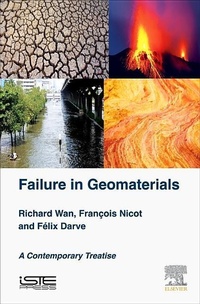
Failure in Geomaterials
A Contemporary Treatise
Published on 22. July 2017
Book
Hardback
222 pages
978-1-78548-009-6 (ISBN)
Description
Failure in Geomaterials offers a unified view of material failure as an instability of deformation modes framed within the theory of bifurcation.
Using mathematical rigor, logic, physical reasoning and basic principles of mechanics, the authors develop the fundamentals of failure in geomaterials based on the second-order work criterion. Various forms of rupture modes and material instabilities in granular materials are explored both analytically and numerically with lab experimental observations on sand as a backdrop. The authors provide a clear picture of inelastic deformations and failure of geomaterials under various loading conditions.
A unique feature of the book is the systematic application of the developed theory to the failure analysis of some selected engineering problems such as soil nailing, landslides, energy resource extraction, and internal erosion in soils.
Using mathematical rigor, logic, physical reasoning and basic principles of mechanics, the authors develop the fundamentals of failure in geomaterials based on the second-order work criterion. Various forms of rupture modes and material instabilities in granular materials are explored both analytically and numerically with lab experimental observations on sand as a backdrop. The authors provide a clear picture of inelastic deformations and failure of geomaterials under various loading conditions.
A unique feature of the book is the systematic application of the developed theory to the failure analysis of some selected engineering problems such as soil nailing, landslides, energy resource extraction, and internal erosion in soils.
More details
Language
English
Place of publication
United Kingdom
Target group
Professional and scholarly
Researchers, students, PH-D students, academics and engineers in the fileds of engineering, materials,civil engineering and geomaterials
Product notice
sewn/stitched
Cloth over boards
Dimensions
Height: 231 mm
Width: 155 mm
Thickness: 18 mm
Weight
454 gr
ISBN-13
978-1-78548-009-6 (9781785480096)
Copyright in bibliographic data and cover images is held by Nielsen Book Services Limited or by the publishers or by their respective licensors: all rights reserved.
Schweitzer Classification
Other editions
Additional editions
E-Book
07/2017
Elsevier
€138.00
Available for download
Persons
Richard Wan is Professor with the Department of Civil Engineering at the University of Calgary, Canada. He sits on the Editorial Board of several international journals and was the Vice-Chair of the TC103 (Numerical Methods) of the ISSMGE from 2009-2017. Francois Nicot is a graduate from << Centrale de Lyon >>school. He joined Cemagref (now IRSTEA) in 2000, where he currently works as Research Director.
He has been Editor-in-Chief of the international journal "European Journal of Environmental and Civil Engineering" since 2009, and co-directs the GDRI (international research group) GeoMech since 2008.
Author of more than 150 international publications, his research focuses on the geomechanics and behavior of granular materials. Felix Darve obtained his Master's degree from Ecole Centrale Paris (1971), followed by a PhD in Grenoble (1978) on the constituent relations of geomaterials. He was promoted professor of exceptional rank at the Polytechnic Institute of Grenoble.
He is former director of the National School of Hydraulics and Mechanics of Grenoble, the national laboratory of CNRS GRECO "Geomaterials" and the European network of laboratories ALERT "Geomaterials". He was deputy director of the department "Mechanics" at the Ministry of Research.
Currently, F. Darve is editor-in-chief of Int. J. Num. and Anal. Meth. In geomechanics (Wiley publ.). He has edited or co-edited 14 books, published by Elsevier, Springer, Hermes, Iste, Balkema, ... and has written or co-authored 260 articles in peer-reviewed journals or book chapters.
His three main topics of interest are (i) the development of incrementally non-linear constitutive relationships, (ii) the analysis of bifurcations, instabilities and failures in granular materials and (iii) the modeling of three-phase granular media.
He has been Editor-in-Chief of the international journal "European Journal of Environmental and Civil Engineering" since 2009, and co-directs the GDRI (international research group) GeoMech since 2008.
Author of more than 150 international publications, his research focuses on the geomechanics and behavior of granular materials. Felix Darve obtained his Master's degree from Ecole Centrale Paris (1971), followed by a PhD in Grenoble (1978) on the constituent relations of geomaterials. He was promoted professor of exceptional rank at the Polytechnic Institute of Grenoble.
He is former director of the National School of Hydraulics and Mechanics of Grenoble, the national laboratory of CNRS GRECO "Geomaterials" and the European network of laboratories ALERT "Geomaterials". He was deputy director of the department "Mechanics" at the Ministry of Research.
Currently, F. Darve is editor-in-chief of Int. J. Num. and Anal. Meth. In geomechanics (Wiley publ.). He has edited or co-edited 14 books, published by Elsevier, Springer, Hermes, Iste, Balkema, ... and has written or co-authored 260 articles in peer-reviewed journals or book chapters.
His three main topics of interest are (i) the development of incrementally non-linear constitutive relationships, (ii) the analysis of bifurcations, instabilities and failures in granular materials and (iii) the modeling of three-phase granular media.
Content
Part 1. Fundamentals1. Characteristics of Failure in Geomaterials.2. Failure in Continuum Geomechanics.3. The Second-Order Work Criterion.4. Numerical and Experimental Investigations of Bifurcations.5. Hierarchy of Failure Modes. Part 2. Applications6. Second-Order Work in Boundary Value Problems.7. Engineering Applications. 8. Soil Erosion as an Instability Problem.