

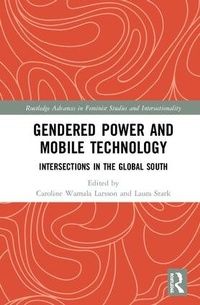
Gendered Power and Mobile Technology
Intersections in the Global South
1st Edition
Published on 18. June 2019
Book
Hardback
202 pages
978-1-138-03939-1 (ISBN)
Description
Mobile phones are widely viewed as the information and communication technology that holds the most promise for bridging global digital divides.
Gendered Power and Mobile Technology uses empirical research to focus on changing intersections between technology, gender and other categories of social and cultural power difference (such as age, race, class, and ethnicity) in the use of mobile communication technologies. Asking how these intersections can inform development discourse, practice, and research, this volume seeks to rectify the lack of attention to the Global South, calling for more sensitivity to the contexts and consequences of mobile phone use. Indeed, drawing on case studies from Ecuador, Ghana, Kenya, Mexico, Peru, Tanzania, and Uganda, this book engages with the intersectionality paradigm to tease out the complexities of using mobile technologies for development purposes.
Gendered Power and Mobile Technology will appeal to students and researchers interested in fields such as media studies, development studies, gender and technology, feminist technoscience, anthropology, and sociology.
Gendered Power and Mobile Technology uses empirical research to focus on changing intersections between technology, gender and other categories of social and cultural power difference (such as age, race, class, and ethnicity) in the use of mobile communication technologies. Asking how these intersections can inform development discourse, practice, and research, this volume seeks to rectify the lack of attention to the Global South, calling for more sensitivity to the contexts and consequences of mobile phone use. Indeed, drawing on case studies from Ecuador, Ghana, Kenya, Mexico, Peru, Tanzania, and Uganda, this book engages with the intersectionality paradigm to tease out the complexities of using mobile technologies for development purposes.
Gendered Power and Mobile Technology will appeal to students and researchers interested in fields such as media studies, development studies, gender and technology, feminist technoscience, anthropology, and sociology.
More details
Series
Language
English
Place of publication
London
United Kingdom
Publishing group
Taylor & Francis Ltd
Target group
College/higher education
Illustrations
2 s/w Photographien bzw. Rasterbilder, 1 s/w Zeichnung, 1 s/w Tabelle
1 Tables, black and white; 1 Line drawings, black and white; 2 Halftones, black and white
Dimensions
Height: 234 mm
Width: 156 mm
Weight
442 gr
ISBN-13
978-1-138-03939-1 (9781138039391)
Copyright in bibliographic data and cover images is held by Nielsen Book Services Limited or by the publishers or by their respective licensors: all rights reserved.
Schweitzer Classification
Other editions
Additional editions
Caroline Wamala Larsson | Laura Stark
Gendered Power and Mobile Technology
Intersections in the Global South
Book
03/2021
1st Edition
Routledge
€68.10
Shipment within 15-20 days
Caroline Wamala Larsson | Laura Stark
Gendered Power and Mobile Technology
Intersections in the Global South
E-Book
05/2019
1st Edition
Routledge
€61.99
Available for download
Caroline Wamala Larsson | Laura Stark
Gendered Power and Mobile Technology
Intersections in the Global South
E-Book
05/2019
1st Edition
Routledge
€61.99
Available for download
Persons
Caroline Wamala Larsson is an Associate Professor in Gender Studies and Head of Research with the Swedish Program for ICT in Developing Regions (SPIDER), an independent resource centre at Stockholm University, Sweden.
Laura Stark is Professor of Ethnology at the University of Jyvaeskylae, Finland.
Laura Stark is Professor of Ethnology at the University of Jyvaeskylae, Finland.
Content
List of contributors
1 Rethinking gender and technology within intersections in the global South
Laura Stark and Caroline Wamala Larsson
PART I Mobile money in transacting femininities and masculinities
2 Gender and mobile phone usage in Kenyan women's everyday lives
Jessica Gustafsson
3 Sex, social reproduction, and mobile telephony as responses to precarity in urban Tanzania
Laura Stark
4 Rethinking financial inclusion: social shaping of mobile money among bodaboda men in Kampala
Caroline Wamala Larsson
PART II Mobile connectivities: negotiating age, gender, and agency
5 One phone, two phones, four phones: older women and mobile telephony in Lima, Peru
Mireia Fernandez-Ardevol
6 Redefining relations: the appropriation of new ICT by young rural women in Peru
Mariana Barreto Avila and Andrea Garcia Abad
7 Reinforcing inequalities? Mobile telephony and HIV/AIDs in Ghana
Perpetual Crentsil
PART III Mobile continuities at the intersection of ethnicity, class, and gender
8 Women's tech initiatives in Uganda: doing intersectionality and feminist technoscience
Linda Paxling
9 Digital snails? Shuar women and mobile communication in Ecuador
Yolanda Martinez Suarez and Saleta de Salvador Agra
10 Communitarian mobile telephony services in rural Mexico: Red Celular Talea de Castro and Telecomunicaciones Indigenas Comunitarias
Lorena Perez
Index
1 Rethinking gender and technology within intersections in the global South
Laura Stark and Caroline Wamala Larsson
PART I Mobile money in transacting femininities and masculinities
2 Gender and mobile phone usage in Kenyan women's everyday lives
Jessica Gustafsson
3 Sex, social reproduction, and mobile telephony as responses to precarity in urban Tanzania
Laura Stark
4 Rethinking financial inclusion: social shaping of mobile money among bodaboda men in Kampala
Caroline Wamala Larsson
PART II Mobile connectivities: negotiating age, gender, and agency
5 One phone, two phones, four phones: older women and mobile telephony in Lima, Peru
Mireia Fernandez-Ardevol
6 Redefining relations: the appropriation of new ICT by young rural women in Peru
Mariana Barreto Avila and Andrea Garcia Abad
7 Reinforcing inequalities? Mobile telephony and HIV/AIDs in Ghana
Perpetual Crentsil
PART III Mobile continuities at the intersection of ethnicity, class, and gender
8 Women's tech initiatives in Uganda: doing intersectionality and feminist technoscience
Linda Paxling
9 Digital snails? Shuar women and mobile communication in Ecuador
Yolanda Martinez Suarez and Saleta de Salvador Agra
10 Communitarian mobile telephony services in rural Mexico: Red Celular Talea de Castro and Telecomunicaciones Indigenas Comunitarias
Lorena Perez
Index