

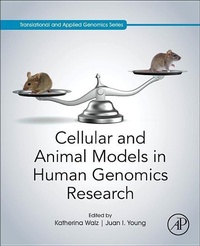
Cellular and Animal Models in Human Genomics Research
Published on 31. July 2019
Book
Paperback/Softback
226 pages
978-0-12-816573-7 (ISBN)
Description
Cellular and Animal Models in Human Genomics Research provides an indispensable resource for applying comparative genomics in the annotation of disease-gene associated variants that are identified by human genomic sequencing. The book presents a thorough overview of effective protocols for the use of cellular and animal modeling methods to turn lists of plausible genes into causative biomarkers. With chapters written by international experts, the book first addresses the fundamental aspects of using cellular and animal models in genetic and genomic studies, including in-depth examples of specific models and their utility, i.e., yeast, worms, flies, fish, mice and large animals.
Protocols for properly conducting model studies, genomic technology, modeling candidate genes vs. genetic variants, integrative modeling, utilizing induced pluripotent stem cells, and employing CRISPR-Cas9 are also discussed in-depth.
Protocols for properly conducting model studies, genomic technology, modeling candidate genes vs. genetic variants, integrative modeling, utilizing induced pluripotent stem cells, and employing CRISPR-Cas9 are also discussed in-depth.
More details
Series
Language
English
Place of publication
San Diego
United States
Publishing group
Elsevier Science Publishing Co Inc
Target group
Professional and scholarly
Active researchers, basic and translational scientists, clinicians, postgraduates, and students in the areas of genetics, human genomics, pathology, cellular biology, organismal biology, molecular biology, biochemistry, and bioinformatics
Product notice
Paperback (trade)
Unsewn / adhesive bound
Dimensions
Height: 231 mm
Width: 191 mm
Thickness: 15 mm
Weight
476 gr
ISBN-13
978-0-12-816573-7 (9780128165737)
Copyright in bibliographic data and cover images is held by Nielsen Book Services Limited or by the publishers or by their respective licensors: all rights reserved.
Schweitzer Classification
Other editions
Additional editions
E-Book
07/2019
Academic Press
€155.00
Available for download
Persons
Katherina Walz, Ph.D., is a Research Associate Professor at the Dr. John T. Macdonald Foundation Department of Human Genetics, and the Director for the Division of Human Disease Modeling at the John P. Hussman Institute for Human Genomics, University of Miami, Florida. Dr. Walz obtained her Ph.D. in Biology (1998) from the University of Buenos Aires, and did a postdoctoral training at Dr. JR Lupski's laboratory in the Molecular and Human Genetics Department at Baylor College of Medicine, Houston, TX (1998-2004). She established her own laboratory at the Centro de Estudios Cientificos (CECS), Valdivia, Chile (2005-2009) and she later moved it to the University of Miami (2009-present). She is interested in the molecular basis of human genetic conditions, from the definition of phenotypic outcomes and the validation of the genetic cause, to the elucidation of the molecular and physiological pathways related to human genetic diseases. Juan I. Young, Ph.D., is a Research Associate Professor in the Dr. John T. Macdonald Foundation Department of Human Genetics and the Co-Director of the Center for Molecular Genetics at the John P. Hussman Institute for Human Genomics, University of Miami, Florida. Dr. Young obtained his Ph.D. in Biology (1998) from the University of Buenos Aires, and did his postdoctoral training at Baylor College of Medicine, Houston, TX (1998-2004). He established his own laboratory at the Centro de Estudios Cientificos (CECS), Valdivia, Chile (2005-2009) and moved it to the University of Miami in 2009. Dr. Young is a neurobiologist interested in identifying epigenetic signatures of human genetic diseases and in establishing animal models of neurological diseases. He has a long-standing interest in neurodevelopmental disorders in general, and in understanding epigenetics-mediated pathogenesis processes.
Volume editor
Research Associate Professor at the Dr. John T. Macdonald Foundation Department of Human Genetics, and the Director for the Division of Human Disease Modeling at the John P. Hussman Institute for Human Genomics, University of Miami, Florida
Research Associate Professor in the Dr. John T. Macdonald Foundation Department of Human Genetics and the Co-Director of the Center for Molecular Genetics at the John P. Hussman Institute for Human Genomics, University of Miami, Florida
Content
1. Introduction to human genetics
2. Disease in a dish: Cellular models to understand human conditions
3. Tiny models to answer big questions: The worm and the yeast as tools in human genetics research
4. Understanding human genetic disease with the fly
5. Studying human genetic variation in zebrafish
6. The mouse, a key model organism for biomedical research
7. Crispr/Cas technology
8. Integrative modeling and novel technologies in human genomics
9. Models to understand human genomics, final considerations
2. Disease in a dish: Cellular models to understand human conditions
3. Tiny models to answer big questions: The worm and the yeast as tools in human genetics research
4. Understanding human genetic disease with the fly
5. Studying human genetic variation in zebrafish
6. The mouse, a key model organism for biomedical research
7. Crispr/Cas technology
8. Integrative modeling and novel technologies in human genomics
9. Models to understand human genomics, final considerations