

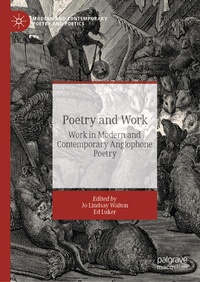
Poetry and Work
Description
Poetry and Work offers a timely and much-needed re-examination of the relationship between work and poetry. The volume questions how lines are drawn between work and non-work, how social, political, and technological upheavals transform the nature of work, how work appears or hides within poetry, and asks if poetry is work, or play, or something else completely. The book interrogates whether poetry and avant-garde and experimental writing can provide models for work that is less alienated and more free. In this major new collection, sixteen scholars and poets draw on a lively array of theory and philosophy, archival research, fresh readings, and personal reflection in order to consider work and poetry: the work in poetry and the work of poetry. Individual chapters address issues such as the many professions, occupations, and tasks of poets beyond and around writing; poetry's special relationship with 'craft'; work's relationship with gender, class, race,disability, and sexuality; how work gets recognised or rendered invisible in aesthetic production and beyond; the work of poetry and the work of political activism and organising; and the notion of poetry itself as a space where work and play can blur, and where postwork imaginaries can be nurtured and explored.
Reviews / Votes
"This volume represents an outstanding contribution to current debates in contemporary poetry. It examines the poetry of work and the work that poetry does in a highly original, theoretically sophisticated and analytically nuanced manner. The essays engage with work and labour across a range of poetries and constituencies and provide a timely address to the place of work in the context of a post-work future and the privatised digital market. It is likely to be seen as a major, paradigm-shifting work in relation to contemporary poetry." (Robert Hampson, Professor of English, Royal Holloway, University of London, UK, and author of Seaport (2008)"To think poetry and work together is to question poetry's standing both against and as work, to hypothesize what poetry itself might be in the world of those who wish to end all we have hitherto known as labor. The essays in this collection engage fearlessly with the permutations, consequences and destructive capacities of this questioning. They represent a new generation - perhaps, we hope, the last generation - of those who will even speak the words poetry and work as if they were commensurate. That the book speaks to such a hope is the highest possible form of recommendation." (Anne Boyer, Associate Professor, Kansas City Art Institute, USA, and author of A Handbook of Disappointed Fate (2018) and Garments Against Women (2015))
"In a time when there is virtually no subjectivity that hasn't found its 'voice,' no 'topic' that hasn't been duly treated, no 'issue' that's not been confronted, the concept and reality of work in poetics remains elusive at best; at worst, a near censorship of it reigns. But upon close examination, it becomes clear that overtly flushing out the phenomenon of work from aesthetic acts, embarrasses aesthetic discourse in general. Idealism collapses unto materialism. And it is from this humbling and renewed state of awareness that we must begin. In this riveting new collection, the three intertwined aspects of work - the symbolic, the productive, and the distributive - are explored thoroughly. The essays themselves stand as authentic poetic acts. Cultural archeologists of the future might well regard this volume as an essential guide to the ever expanding horizon of that strange human productive activity we call poetry." (Rodrigo Toscano, author of Collapsible Poetics Theater (2008) and Explosion Rocks Springfield (2016))
"This collection of essays rigorously explores how capitalism, reproductive labor, the falling rate of profit, and acts of working are represented in post-war poetry. Poets are unacknowledged day job workers of the cultural production world. A significant part of post-war poetry is written during time stolen on the day job or late in the evening, after a long shift. As such, poems are full of theoretical possibilities for understanding how work has shaped the aesthetics, the affinities, and the utopian claims of contemporary literature. This book stands as a committed investigation into an array of affinities between the ordinary grounding of work and its utopian claims." (Juliana Spahr, Professor of English, Mills college, USA, and author of That Winter the Wolf Came (2015))
More details
Other editions
Additional editions
Persons
Jo Lindsay Walton is Research Fellow in Critical and Cultural Theory at the Sussex Humanities Lab, UK. His main research interests are modern and contemporary poetry, speculative fiction, and political economy.
Ed Luker is Associate Lecturer at University of Surrey, UK. He completed his PhD at Northumbria University on the poetry of J.H. Prynne in relation to British and North American poetry. As a poet his work includes Peak Return (2014), Headlost (2014), The Sea Together (2016), Compound Out The Fractured World (2017), and Heavy Waters (2019).
Content
1. Introduction, Ed Luker and Jo Lindsay Walton .- 2. Show Your Workings: Other Forms of Labor in Recent Poetry, Peter Middleton .- 3. Bird-Song by Everyone, for Everyone: Poetry, Work and Play in J.H. Prynne's Prose, Lisa Jeschke .- 4. "The stitching of her wake": The Collaboration of Pamela Campion and Ian Hamilton Finlay, Lila Matsumoto .- 5. Basil Bunting and the Work of Poetry, Annabel Haynes .- 6. Art Takes All My Time: Work in the Poetry and Prison Writing of Anna Mendelssohn, Eleanor Careless .- 7. Queer Labour in Boston: The work of John Wieners, Gay Liberation and Fag Rag, Nat Raha .- 8. Without the Text at Hand: Postcolonial Writing and the Work of Memorisation, Aimée Lê .- 9. Body Burdens: The Materiality of Work in Rita Wong's forage, Samantha Walton. - 10. "Because We Love Wrong": Citizenship and Labour in Alena Hairston's The Logan Topographies, Lytton Smith .- 11. "What Gives Pause or Impetus": The Double Bind of Labor in Rodrigo Toscano's Poetics, Jose-Luis Moctezuma .- 12. Distributed and Entangled Posture in Catherine Wagner's My New Job and Nervous Device, Holly Pester .- 13. The Exploit: Affective Labor and Poetry at the University, Catherine Wagner.- 14. Floating On-if not Up-ward, Tyrone Williams .- 15. Extract from The Poetic Labor Project, Amber DiPietra .