

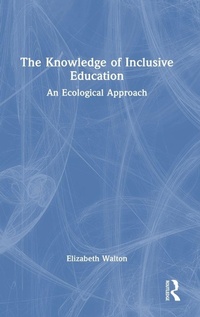
The Knowledge of Inclusive Education
An Ecological Approach
1st Edition
Published on 28. March 2025
Book
Hardback
204 pages
978-1-032-33501-8 (ISBN)
Description
The Knowledge of Inclusive Education is a paradigm-shifting exploration of inclusive education as a dynamic knowledge practice. The knowledge that underpins the practice is understood through the metaphor of an ecology, with valuable contributions from educators, researchers, parents, students, policymakers, and international organisations.
By examining the knowledge of policy, research, teacher education, and activism, Elizabeth Walton constructs a future for inclusive education that affirms different material-discursive places, inquiry, and possibility and replaces traditional research hierarchies with a life-affirming ecology. Readers will gain a novel perspective on the knowledge/s of inclusive education across multiple interacting domains.
With theoretical resources ranging from the work of Lorraine Code and Basil Bernstein to concepts from Legitimation Code Theory, Decolonial theory, and Posthumanism, this book offers a unique and innovative approach to the multiple perspectives and knowledges that inform inclusive education policy and practice. Its conceptual and empirical research draws from several international contexts, ensuring that The Knowledge of Inclusive Education will be of interest to educators, scholars, and advocates of inclusive education worldwide and valued by those willing to embrace collaborative new directions in inclusive teaching, learning, and research.
By examining the knowledge of policy, research, teacher education, and activism, Elizabeth Walton constructs a future for inclusive education that affirms different material-discursive places, inquiry, and possibility and replaces traditional research hierarchies with a life-affirming ecology. Readers will gain a novel perspective on the knowledge/s of inclusive education across multiple interacting domains.
With theoretical resources ranging from the work of Lorraine Code and Basil Bernstein to concepts from Legitimation Code Theory, Decolonial theory, and Posthumanism, this book offers a unique and innovative approach to the multiple perspectives and knowledges that inform inclusive education policy and practice. Its conceptual and empirical research draws from several international contexts, ensuring that The Knowledge of Inclusive Education will be of interest to educators, scholars, and advocates of inclusive education worldwide and valued by those willing to embrace collaborative new directions in inclusive teaching, learning, and research.
Reviews / Votes
This important book shines a light on the real experts on inclusive education - teachers, teacher educators, parents and students - and guides us through what we still need to know and do in order to be inclusive. Walton challenges us to 'undo and redo' inclusive education to rediscover the power and politics that must be at its heart and fills us with hope, courage and determination for an inclusive future.Professor Julie Allan FAcSS, Professor of Equity and Inclusion, University of Birmingham, UK
In this expansive and field-shaping book, Walton takes readers through a sophisticated and thought-provoking journey of understanding the complex practice of inclusive education. It is recommended reading for all who are committed to the development of a more just and equitable inclusive education system in diverse contexts.
Professor Ruksana Osman, Senior Deputy Vice-Chancellor, Wits University, South Africa
An important book that brings together different 'knowledges' of inclusive education which can often exist in opposition or silos. Walton writes with clarity and rigour, challenges us to think differently and provides hope and direction for the future of inclusive education.
Tom Rees - Chief Executive, Ormiston Academies Trust, England, UK
More details
Language
English
Place of publication
London
United Kingdom
Publishing group
Taylor & Francis Ltd
Target group
College/higher education
Undergraduate Advanced
Illustrations
3 s/w Photographien bzw. Rasterbilder, 8 s/w Zeichnungen, 11 s/w Tabellen, 11 s/w Abbildungen
11 Tables, black and white; 8 Line drawings, black and white; 3 Halftones, black and white; 11 Illustrations, black and white
Dimensions
Height: 240 mm
Width: 161 mm
Thickness: 17 mm
Weight
502 gr
ISBN-13
978-1-032-33501-8 (9781032335018)
Copyright in bibliographic data and cover images is held by Nielsen Book Services Limited or by the publishers or by their respective licensors: all rights reserved.
Schweitzer Classification
Other editions
Additional editions
E-Book
03/2025
1st Edition
Routledge
€55.49
Available for download
E-Book
03/2025
1st Edition
Routledge
€55.49
Available for download
Book
03/2025
1st Edition
Routledge
€63.50
Shipment within 10-20 days
Person
Elizabeth Walton is a Professor of Education at the University of Nottingham and a Visiting Professor at the University of the Witwatersrand. She has previously published Teacher Education for Diversity (2018, Routledge) and The Language of Inclusive Education (2016, Routledge).
Content
Chapter 1: Inclusive education: A knowledge practice based on an ecology of knowledges
Chapter 2: Types, typologies and triads: Knowledge for inclusive teaching
Chapter 3: "That's where the action is": Teacher educators in the inclusive education knowledge ecology
Chapter 4: Teachers as collective inclusive education knowledge bricoleurs
Chapter 5: "Think of what you could learn": Parent knowledge in the inclusive education knowledge ecology
Chapter 6: "They don't understand what we are going through": The value of student voice in the inclusive education knowledge ecology
Chapter 7: Topics, trends and trajectories: Academic knowledge in the inclusive education knowledge ecology
Chapter 8: Toolkits and guideline documents: Grey literature in the inclusive education knowledge ecology
Chapter 9: Policy knowledge-making in the inclusive education knowledge ecology
Chapter 10: A decolonial and ecological undoing and redoing of inclusive education knowledge
Chapter 2: Types, typologies and triads: Knowledge for inclusive teaching
Chapter 3: "That's where the action is": Teacher educators in the inclusive education knowledge ecology
Chapter 4: Teachers as collective inclusive education knowledge bricoleurs
Chapter 5: "Think of what you could learn": Parent knowledge in the inclusive education knowledge ecology
Chapter 6: "They don't understand what we are going through": The value of student voice in the inclusive education knowledge ecology
Chapter 7: Topics, trends and trajectories: Academic knowledge in the inclusive education knowledge ecology
Chapter 8: Toolkits and guideline documents: Grey literature in the inclusive education knowledge ecology
Chapter 9: Policy knowledge-making in the inclusive education knowledge ecology
Chapter 10: A decolonial and ecological undoing and redoing of inclusive education knowledge