

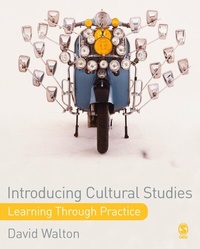
Introducing Cultural Studies
Learning through Practice
1st Edition
Published on 29. November 2007
Book
Hardback
336 pages
978-1-4129-1894-7 (ISBN)
Description
"An outstanding entry level text aimed at those with little or no cultural studies knowledge... Innovative, creative and clever."
- Times Higher Education
"The ideal textbook for FE and first year HE cultural studies students. Its quality and character allow the reader to 'feel' the enthusiasm of its author which in turn becomes infectious, instilling in the reader a genuine sense of ebullient perturbation."
- Art/Design/Media, The Higher Education Authority
An introduction to the practice of cultural studies, this book is ideal for undergraduate courses. Full of practical exercises that will get students thinking and writing about the issues they encounter, this book offers its readers the conceptual tools to practice cultural analysis for themselves. There are heuristics to help students prepare and write projects, and the book provides plenty of examples to help students develop their own ideas.
Written in a creative, playful and witty style, this book:
Links key concepts to the key theorists of cultural studies.
Includes a wide range of references of popular cultural forms.
Emphasizes the multidisciplinary nature of cultural studies.
Includes pedagogical features, such as dialogues, graphs, images and recommended readings.
The book's skills-based approach enables students to develop their creative skills, and shows students how to improve their powers of analysis generally.
- Times Higher Education
"The ideal textbook for FE and first year HE cultural studies students. Its quality and character allow the reader to 'feel' the enthusiasm of its author which in turn becomes infectious, instilling in the reader a genuine sense of ebullient perturbation."
- Art/Design/Media, The Higher Education Authority
An introduction to the practice of cultural studies, this book is ideal for undergraduate courses. Full of practical exercises that will get students thinking and writing about the issues they encounter, this book offers its readers the conceptual tools to practice cultural analysis for themselves. There are heuristics to help students prepare and write projects, and the book provides plenty of examples to help students develop their own ideas.
Written in a creative, playful and witty style, this book:
Links key concepts to the key theorists of cultural studies.
Includes a wide range of references of popular cultural forms.
Emphasizes the multidisciplinary nature of cultural studies.
Includes pedagogical features, such as dialogues, graphs, images and recommended readings.
The book's skills-based approach enables students to develop their creative skills, and shows students how to improve their powers of analysis generally.
Reviews / Votes
An outstanding entry level text aimed at those with little or no cultural studies knowledge... Innovative, creative and cleverTHE
Times Higher Education
What a weird and wonderful book. It is the Ronseal of Cultural Studies Literature; it does what it says on the tin... the ideal textbook for Further Education and first year Higher Education Cultural Studies Students... It is also a brilliant revision and essay writing tool for more advanced learners. It is concise, honest and straightforward in its aims and content and witty in its approach... This does not mean however that its content is 'dumbed down'. It valiantly manages to retain all the highly academic information required for this area of study and does not shy away from using the appropriate terminology and language that Cultural Studies students must familiarise themselves with. The 'Oversimplification Warnings', 'Practice Exercises', illustrations and 'Notes' act as practical or cognitive revision for the body of text rather than as a 'gutter press' substitute... this is a highly successful book, in that it has accomplished its intentions, but it is also a motivational book. Its quality and character allow the reader to 'feel' the enthusiasm of its author which in turn becomes infectious, instilling in the reader a genuine sense of ebullient perturbation
Art/Design/Media
The Higher Education Authority
It does not attempt to be in any way exhaustive, as it shows a constant awareness of "what's been left out", but, working towards "interpretive independence", it aims to provide students with sufficient notional skills to start doing their own cultural criticism... Like the best cultural studies works, Walton's exhilarating book may leave the student wondering what cultural studies actually is, perhaps undecided about a final definition, but nonetheless confident enough to start practising it
ATLANTIS
Journal of the Spanish Association of Anglo-American Studies
Ideal for courses linked to the ECTS (European Credit Transfer System) laid down by the Bologna process that is transforming university education in Europe, epecially as the author shows a constant awareness of teaching in terms of developing students' critical competencies
J. Ruben Valdes Miyares
Universidad de Oviedo
More details
Language
English
Place of publication
Thousand Oaks
United States
Target group
College/higher education
Dimensions
Height: 232 mm
Width: 186 mm
Weight
736 gr
ISBN-13
978-1-4129-1894-7 (9781412918947)
Copyright in bibliographic data and cover images is held by Nielsen Book Services Limited or by the publishers or by their respective licensors: all rights reserved.
Schweitzer Classification
Other editions
Additional editions
Book
11/2007
1st Edition
SAGE Publications Inc
€98.70
Shipment within 10-20 days

E-Book
11/2007
1st Edition
SAGE Publications Ltd
from
€74.99
Available for download
E-Book
11/2007
1st Edition
SAGE Publications Ltd
from
€74.99
Available for download
Person
David Walton has a degree in English Literature (University of Wales 1985) an M.Phil (University of Oxford 1987), a Certificate in Education (University of Greenwich, London 1988), and a TEFL qualification (University of Aston, Birmingham 1987). He was awarded his doctorate in 1992 by the University of Murcia. He began his teaching career in further education in Britain before being contracted as an associate lecturer in the English Department of the University of Murcia in 1989. He became Senior Lecturer in the area of Cultural Studies in 2001 and has promoted the area in Spain for more than ten years. He is one of the founder members of the Culture and Power group which has organized annual conferences in Spain and Portugal every year since 1995 and has contributed to most of the publications to come out of these conferences. He is a founder member and President of the Iberian Association of Cultural Studies (IBACS). He has co-organized conferences on English-speaking cultures and co-organized two International Conferences on cultural studies for IBACS, both held at the Universidad de Murcia. Apart from his undergraduate teaching, he has taught audiovisual translation at M.A. level and has given doctorate courses on the construction of national identity and given many conference papers. He currently teaches cultural studies at undergraduate level and postmodern theory and culture at M.A. level. He has published widely, his publications reflecting his research interests which include literary and cultural theory, cultural studies, popular culture, visual culture and postmodern theories of culture.
His latest books are 'Introducing Cultural Studies: Learning Through Practice' (SAGE, 2008) and 'Doing Cultural Theory' (SAGE, 2012). He has a chapter on Chris Morris' satire which will appear in 'No Known Cure: The Comedy of Chris Morris' (edited by James Leggott & Jamie Sexton (Palgrave Macmilan, 2003), and has a number of other chapters which are in print on the interfaces between philosophy and cultural studies and graffiti and popular culture.
His latest books are 'Introducing Cultural Studies: Learning Through Practice' (SAGE, 2008) and 'Doing Cultural Theory' (SAGE, 2012). He has a chapter on Chris Morris' satire which will appear in 'No Known Cure: The Comedy of Chris Morris' (edited by James Leggott & Jamie Sexton (Palgrave Macmilan, 2003), and has a number of other chapters which are in print on the interfaces between philosophy and cultural studies and graffiti and popular culture.
Content
PART ONE: HIGH CULTURE GLADIATORS: SOME INFLUENTIAL EARLY MODELS OF CULTURAL ANALYSIS
Culture and Anarchy in the UK
A Dialogue with Matthew Arnold
The Leavisites and T.S. Eliot Combat Mass Urban Culture
Adorno, the Frankfurt School and the 'Culture Industry'
PART TWO: THE TRANSFORMATIVE POWER OF WORKING-CLASS CULTURE
From a Day Out at the Seaside to the Milk Bar
Richard Hoggart and Working-Class Culture
E.P. Thompson and Working-Class Culture as a Site for Conflict, Consciousness and Resistance
Towards a Recognizable Theory of Culture
Raymond Williams
PART THREE: CONSOLIDATING CULTURAL STUDIES: SUBCULTURES, THE POPULAR, IDEOLOGY AND HEGEMONY
Introducing Stuart Hall
The Importance and Re-evaluation of Popular Mass Culture
Youth Subcultures and Resistance
A Dialogue with Quadrophenia
Subcultures and Widening Horizons
Further Strategies for Practice
How to Dominate the Masses Without Resorting to the Inquisition
Antonio Gramsci and Hegemony Theory
A Few Ways You Might Adapt Ideas from Louis Althusser to Cultural Studies
a Dialogue with Dr Jeckyll and Mr Hyde
PART FOUR: PROBING THE MARGINS, REMEMBERING THE FORGOTTEN: REPRESENTATION, SUBORDINATION AND IDENTITY
Crying Woolf! Thinking with Feminism
Adapting Theory to Explore Race, Ethnicity and Sexuality
The Case of East is East
PART FIVE: HONING YOUR SKILLS, CONCLUSIONS AND 'BEGIN-ENDINGS'
Consolidating Practice, Heuristic Thinking, Creative Cri-tickle Acts and Further Research
Culture and Anarchy in the UK
A Dialogue with Matthew Arnold
The Leavisites and T.S. Eliot Combat Mass Urban Culture
Adorno, the Frankfurt School and the 'Culture Industry'
PART TWO: THE TRANSFORMATIVE POWER OF WORKING-CLASS CULTURE
From a Day Out at the Seaside to the Milk Bar
Richard Hoggart and Working-Class Culture
E.P. Thompson and Working-Class Culture as a Site for Conflict, Consciousness and Resistance
Towards a Recognizable Theory of Culture
Raymond Williams
PART THREE: CONSOLIDATING CULTURAL STUDIES: SUBCULTURES, THE POPULAR, IDEOLOGY AND HEGEMONY
Introducing Stuart Hall
The Importance and Re-evaluation of Popular Mass Culture
Youth Subcultures and Resistance
A Dialogue with Quadrophenia
Subcultures and Widening Horizons
Further Strategies for Practice
How to Dominate the Masses Without Resorting to the Inquisition
Antonio Gramsci and Hegemony Theory
A Few Ways You Might Adapt Ideas from Louis Althusser to Cultural Studies
a Dialogue with Dr Jeckyll and Mr Hyde
PART FOUR: PROBING THE MARGINS, REMEMBERING THE FORGOTTEN: REPRESENTATION, SUBORDINATION AND IDENTITY
Crying Woolf! Thinking with Feminism
Adapting Theory to Explore Race, Ethnicity and Sexuality
The Case of East is East
PART FIVE: HONING YOUR SKILLS, CONCLUSIONS AND 'BEGIN-ENDINGS'
Consolidating Practice, Heuristic Thinking, Creative Cri-tickle Acts and Further Research