

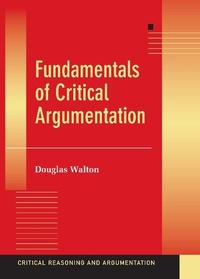
Fundamentals of Critical Argumentation
Published on 31. October 2005
Book
Hardback
360 pages
978-0-521-82319-7 (ISBN)
Description
Fundamentals of Critical Argumentation presents the basic tools for the identification, analysis, and evaluation of common arguments for beginners. The book teaches by using examples of arguments in dialogues, both in the text itself and in the exercises. Examples of controversial legal, political, and ethical arguments are analyzed. Illustrating the most common kinds of arguments, the book also explains how to evaluate each kind by critical questioning. Douglas Walton shows how arguments can be reasonable under the right dialogue conditions by using critical questions to evaluate them. The book teaches by example, both in the text itself and in exercises, but it is based on methods that have been developed through the author's thirty years of research in argumentation studies.
More details
Series
Language
English
Place of publication
Cambridge
United Kingdom
Target group
College/higher education
Professional and scholarly
Illustrations
6 Line drawings, unspecified
Dimensions
Height: 260 mm
Width: 183 mm
Thickness: 24 mm
Weight
872 gr
ISBN-13
978-0-521-82319-7 (9780521823197)
Copyright in bibliographic data and cover images is held by Nielsen Book Services Limited or by the publishers or by their respective licensors: all rights reserved.
Schweitzer Classification
Other editions
Additional editions
Douglas Walton
Fundamentals of Critical Argumentation
E-Book
01/2006
1st Edition
Cambridge University Press
€35.49
Available for download
Douglas Walton
Fundamentals of Critical Argumentation
Book
10/2005
Cambridge University Press
€62.80
Shipment within 15-20 days
Douglas Walton
Fundamentals of Critical Argumentation
E-Book
10/2005
Cambridge University Press
€29.49
Available for download
Person
Content
1. Arguments and dialogues; 2. Concepts useful for understanding arguments; 3. Argumentation schemes; 4. Argument reconstruction; 5. Dialogues; 6. Detecting bias; 7. Relevance; 8. Practical reasoning in a dialogical framework.