

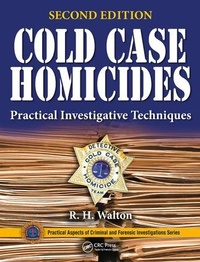
Cold Case Homicides
Practical Investigative Techniques, Second Edition
2nd Edition
Published on 25. July 2017
Book
Hardback
660 pages
978-1-4822-3790-0 (ISBN)
Description
This book, now in its second edition, is the first and most exhaustive text covering the still growing popularity of cold case investigations which locate perpetrators and free the innocent. The new edition adds approximately 80 pages of content, including material on clandestine graves and investigating cold gang cases. The book merges theory with practice through the use of case histories, photographs, illustrations and checklists that convey essential, fundamental concepts while providing a strong, practical basis for the investigative process.
More details
Series
Edition
2nd edition
Language
English
Place of publication
Bosa Roca
United States
Publishing group
Taylor & Francis Inc
Target group
Professional and scholarly
Academic and Professional Practice & Development
Illustrations
1 s/w Tabelle, 92 Farbfotos bzw. farbige Rasterbilder, 9 s/w Zeichnungen, 137 s/w Photographien bzw. Rasterbilder
1 Tables, black and white; 9 Line drawings, black and white; 92 Halftones, color; 137 Halftones, black and white
Dimensions
Height: 254 mm
Width: 203 mm
Weight
1696 gr
ISBN-13
978-1-4822-3790-0 (9781482237900)
Copyright in bibliographic data and cover images is held by Nielsen Book Services Limited or by the publishers or by their respective licensors: all rights reserved.
Schweitzer Classification
Other editions
New editions
Book
approx. 02/2026
3rd Edition
CRC Press
€83.00
Not yet published
Additional editions
Book
03/2021
2nd Edition
CRC Press
€83.50
Shipment within 15-20 days
E-Book
07/2017
2nd Edition
CRC Press
€72.49
Available for download
E-Book
07/2017
2nd Edition
CRC Press
€72.49
Available for download
Previous edition
Book
06/2006
1st Edition
CRC Press
€138.50
Article exhausted; check for reprint
Person
R.H. Walton is Associate Professor in the Criminal Justice Program at Utah State University Eastern.
Content
Dedication
Acknowledgements
Preface
Introduction
Chapter One: The Cold Case Problem
R.H. Walton
Chapter Two: Case File Review
R.H. Walton
Chapter Three: Read the Book: Learn the Case
R.H. Walton
Chapter Four: Investigation
R.H. Walton
Chapter Five: Long Term Missing Persons and No-Body Homicides
R.H. Walton
Chapter Six: Prosecution of Cold Cases
Ann Marie Schubert
Chapter Seven: Vicap, Hits, and TracKRS
R.H. Walton
Chapter Eight: Criminal Justice Information Services and NCIC
R.H. Walton
Chapter Nine: Interviewing Senior Citizens
R.H. Walton
Chapter Ten: Death Certificate, Obituary and Coroner's Inquest
R.H. Walton
Chapter Eleven: Cold Case Investigation Units
R.H. Walton
Chapter Twelve: Media in Cold Case Investigation
R.H. Walton
Chapter Thirteen: Friction Skin Impressions
Edward Palma
Chapter Fourteen: Automated Fingerprint Identification Systems
Peter Komarinski
Chapter Fifteen: From Serology to DNA in Cold Case Investigations
Mike Grubb
Chapter Sixteen: Trace Evidence in Cold Case Investigations
Jay Henry
Chapter Seventeen: National Missing and Unidentified Persons Database
Thomas Dibase and R.H. Walton
Chapter Eighteen: Combined DNA Index System (CODIS)
Connie Milton
Chapter Ninteen: National Integrated Ballistic Information Network
Katharine Dyer
Chapter Twenty: Forensic Anthropology in Cold Cases
Madeline Hinkes
Chapter Twenty-One: Forensic Dentistry in Cold Cases
Norman Sperber and Anthony R. Cardoza
Chapter Twenty-Two: Forensic Exhumation
R. H. Walton
Chapter Twenty-Three: Criminal Investigative Analysis in Cold Case Investigations
Sharon Pagaling Hagan
Chapter Twenty-Four: Warming Up with Wiretaps
Robert P. Hickey
Chapter Twenty-Five: Bloodstain Pattern Analysis in Homicide Cold Case Investigations
Tom Bevel
Chapter Twenty-Six: Blood Enhancement
Rod Englert
Chapter Twenty-Seven: Forensic Document Examination
Marie Durina
Chapter Twenty-Eight: Forensic Art in Cold Cases
Karen Taylor
Chapter Twenty-Nine: Polygraph in Cold Cases
Paul Redden
Chapter Thirty: Geographic Profiling in Cold Cases
Kim Rossmo
Chapter Thirty-One: 'Who You Know': Resources in Cold Case Investigations
R.H. Walton
Concluding Thoughts
Index
Acknowledgements
Preface
Introduction
Chapter One: The Cold Case Problem
R.H. Walton
Chapter Two: Case File Review
R.H. Walton
Chapter Three: Read the Book: Learn the Case
R.H. Walton
Chapter Four: Investigation
R.H. Walton
Chapter Five: Long Term Missing Persons and No-Body Homicides
R.H. Walton
Chapter Six: Prosecution of Cold Cases
Ann Marie Schubert
Chapter Seven: Vicap, Hits, and TracKRS
R.H. Walton
Chapter Eight: Criminal Justice Information Services and NCIC
R.H. Walton
Chapter Nine: Interviewing Senior Citizens
R.H. Walton
Chapter Ten: Death Certificate, Obituary and Coroner's Inquest
R.H. Walton
Chapter Eleven: Cold Case Investigation Units
R.H. Walton
Chapter Twelve: Media in Cold Case Investigation
R.H. Walton
Chapter Thirteen: Friction Skin Impressions
Edward Palma
Chapter Fourteen: Automated Fingerprint Identification Systems
Peter Komarinski
Chapter Fifteen: From Serology to DNA in Cold Case Investigations
Mike Grubb
Chapter Sixteen: Trace Evidence in Cold Case Investigations
Jay Henry
Chapter Seventeen: National Missing and Unidentified Persons Database
Thomas Dibase and R.H. Walton
Chapter Eighteen: Combined DNA Index System (CODIS)
Connie Milton
Chapter Ninteen: National Integrated Ballistic Information Network
Katharine Dyer
Chapter Twenty: Forensic Anthropology in Cold Cases
Madeline Hinkes
Chapter Twenty-One: Forensic Dentistry in Cold Cases
Norman Sperber and Anthony R. Cardoza
Chapter Twenty-Two: Forensic Exhumation
R. H. Walton
Chapter Twenty-Three: Criminal Investigative Analysis in Cold Case Investigations
Sharon Pagaling Hagan
Chapter Twenty-Four: Warming Up with Wiretaps
Robert P. Hickey
Chapter Twenty-Five: Bloodstain Pattern Analysis in Homicide Cold Case Investigations
Tom Bevel
Chapter Twenty-Six: Blood Enhancement
Rod Englert
Chapter Twenty-Seven: Forensic Document Examination
Marie Durina
Chapter Twenty-Eight: Forensic Art in Cold Cases
Karen Taylor
Chapter Twenty-Nine: Polygraph in Cold Cases
Paul Redden
Chapter Thirty: Geographic Profiling in Cold Cases
Kim Rossmo
Chapter Thirty-One: 'Who You Know': Resources in Cold Case Investigations
R.H. Walton
Concluding Thoughts
Index