

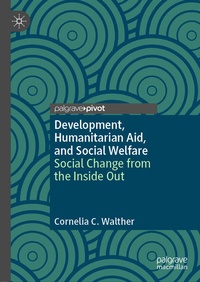
Development, Humanitarian Aid, and Social Welfare
Description
This book examines how human behavior is shaped by our aspirations, emotions, thoughts and sensations, and conversely, how the experiences that result from our behavior impact ourselves, others and the planet. Based on an analysis of the constant interplay between these four layers, it offers practical solutions to systematically induce sustainable social change dynamics. It shows why change, in addition to economic and political transformation at the macro level, begins with mind-shifts at the micro level. Hereby it establishes the missing link between investments in personal empowerment and collective welfare. A novel theoretical paradigm is the foundation of this book, which is anchored in the perspective of an ongoing 'body-mind-heart-soul connection.' Based on the premise that an equitable society is to the benefit of everyone, it is argued that efforts made for others have benefits at three levels - for the individual who acts, the one who has been acted for and for society.
Reviews / Votes
"Little did I realize that medicine is actually a social science, or ought to be. And that much as mind and body are connected, so are individuals and societies. This book helps me connect my fragmented pieces of understanding from various studies, experiences and jobs I have had. As we now set out on the decade of action to reach the SDGs, this book will help many of us not just understand, but also to do a better job." (Stefan Swartling Peterson, Chief of Child Survival, United Nations Children's Emergency Fund (UNICEF), USA)"This book offers a perspective whose time has come. No matter whether we are humanitarians or development workers, academics or philanthropists, we need to acknowledge that the entire expanse of our respective strengths enfolds when we work in complementarity, rather than competition." (Pierre Micheletti, President, Action Against Hunger (ACF), Professor, Grenoble Institute of Political Studies, France)
"Cornelia Walther's book has the merit of repositioning people's beliefs and motivations as an indispensable factor in addressing our humanitarian and social challenges." (Benoit Miribel, Co-founder of Forum Espace Humanitaire (FEH) and Humanitarian Alternatives Review, France)
More details
Other editions
Additional editions
Person
Cornelia C. Walther has been working for the past 18 years with the United Nations Children's Emergency Fund (UNICEF) in West Africa, Afghanistan and Haiti, focusing on the design of innovative communication and advocacy approaches.
Content
Chapter 1. Introduction: A Roadmap.- Chapter 2. Context.- Chapter 3. Universal principles that rule reality.- Chapter 4.The four elements of the framework.- Chapter 5. Justification of the proposed paradigm shift.- Chapter 6. Individuals: A reference point for collective transformation.- Chapter 7. Transformation from the inside out, nurtured from the outside in.- Chapter 8. Applying the POZE paradigm.- Chapter 9. Perspectives: The risks and opportunities of technology.- Chapter 10. Final Thoughts - Overcoming Incommensurability.