

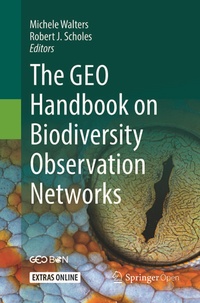
The GEO Handbook on Biodiversity Observation Networks
Description
Biodiversity observation systems are almost everywhere inadequate to meet local, national and international (treaty) obligations. As a result of alarmingly rapid declines in biodiversity in the modern era, there is a strong, worldwide desire to upgrade our monitoring systems, but little clarity on what is actually needed and how it can be assembled from the elements which are already present. This book intends to provide practical guidance to broadly-defined biodiversity observation networks at all scales, but predominantly the national scale and higher. This is a practical how-to book with substantial policy relevance. It will mostly be used by technical specialists with a responsibility for biodiversity monitoring to establish and refine their systems. It is written at a technical level, but one that is not discipline-bound: it should be intelligible to anyone in the broad field with a tertiary education.
More details
Other editions
Additional editions
Persons
Robert (Bob) J. Scholes , is Distinguished Professor of Systems Ecology at the University of the Witwatersrand, South Africa. He is widely published in the areas of global change, biodiversity, ecosystem services and earth observation. He is or has been a member of several steering committees of international Global Change research programmes, including the International Geosphere-Biosphere Programme, Diversitas and the Program on Ecosystem Change and Society. He was a member of the team that devised the first Group on Earth Observation Implementation Plan and served as the first chair of the GEO Biodiversity Observation Network. He is a member of the South African Academy of Science, fellow of the Royal Society of South Africa, and a foreign associate of the US National Academy of Science.
Content
1. The Biodiversity Data Impediment to a Sustainable World (Working in a Networked World).- 2. Essential Biodiversity Variables.- 3. Stratification and Terrestrial Ecosystem Observations.- 4. Ecosystem Services.- 5. Species Observations.- 6. Monitoring Changes in Genetic Diversity.- 7. Marine and Coastal Systems.- 8. Biodiversity Observations for Freshwater Ecosystems.- 9. Remote Sensing for Biodiversity.- 10. Involving Citizen Scientists in Biodiversity Observation.- 11. Biodiversity Modelling.- 12. Cyber-Architecture.- 13. Using Data for Decision-Making: From Observations To Indicators and Other Policy Tools.- 14. Capacity Building in Biodiversity Monitoring - Case Studies.