

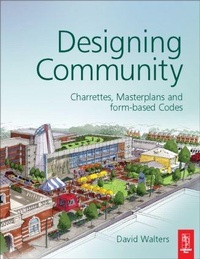
Designing Community
Charrettes, master plans and form-based codes
1st Edition
Published on 4. April 2007
Book
Paperback/Softback
282 pages
978-0-7506-6925-2 (ISBN)
Description
Greenfield sites around towns and cities, and redevelopment infill sites in existing urban areas often become battlegrounds between the conflicting interests of developers and communities.
In America, design charrettes (intensive design and planning workshops) have become widely used as a means of bringing together these divergent groups, using detailed design exercises to establish agreement around a development masterplan. Despite the increasing frequency of their use, charrettes are widely misunderstood and can be misapplied. This book provides a detailed guidance on the proper and most effective ways to use this helpful tool. The book combines charrette masterplanning with the creation of "design-based" codes (also known as "form-based" codes) to control the development's implementation in line with the design and planning principles established during the charrette process.
In America, design charrettes (intensive design and planning workshops) have become widely used as a means of bringing together these divergent groups, using detailed design exercises to establish agreement around a development masterplan. Despite the increasing frequency of their use, charrettes are widely misunderstood and can be misapplied. This book provides a detailed guidance on the proper and most effective ways to use this helpful tool. The book combines charrette masterplanning with the creation of "design-based" codes (also known as "form-based" codes) to control the development's implementation in line with the design and planning principles established during the charrette process.
Reviews / Votes
"As strong in its theoretical grasp as it is in enumerating the practical aspects of design codes and charrettes, Designing Community guides us through the strategies we need to adopt to create better communal spaces...Design professionals should take the core messages of this book to heart and use its to improve our public realm".AJ 30.08.07
"Students will find... a rich source of examples, comparisons and opinions. I would go far as to suggest that a precis of this volume ought to be considered to all in the planning process from the local parish councillors up to the government strategists."
Building Engineer Jan 08
More details
Language
English
Place of publication
Oxford
United Kingdom
Publishing group
Taylor & Francis Ltd
Target group
Professional and scholarly
Professional Practice & Development
Product notice
Paperback (trade)
sewn/stitched
Dimensions
Height: 247 mm
Width: 192 mm
Thickness: 22 mm
Weight
806 gr
ISBN-13
978-0-7506-6925-2 (9780750669252)
Copyright in bibliographic data and cover images is held by Nielsen Book Services Limited or by the publishers or by their respective licensors: all rights reserved.
Schweitzer Classification
Other editions
Additional editions
Book
12/2016
1st Edition
Routledge
€200.56
Shipment within 10-20 days
Person
David Walters
Content
1. Introduction: Urban design vs. planning: the role of design charrettes, master plans and form-based codes to reform the planning process.
2. History i: The history of community involvement in planning from 19th century anarchist roots to today.
3. History ii: The evolution of the planning process: the renaissance of physical planning and the importance of urban design.
4. Theory i: Key urban design principles
5. Theory ii: Codes and Guidelines
6. Theory iii: Representation and Communication
7. Practice i: Charrette Principles and Organization
8. Practice ii: Charrette Processes and Products
9. Case Study i: Downtown redevelopment case study from author's own practice. This community has a form-based zoning ordinance in place.
10. Case Study ii: Greenfield case study from author's own practice. This community has a normative, sprawl-inducing zoning ordinance in place.
11. Afterword: Summary and recap
12. Appendix: Example of Form-based Code
2. History i: The history of community involvement in planning from 19th century anarchist roots to today.
3. History ii: The evolution of the planning process: the renaissance of physical planning and the importance of urban design.
4. Theory i: Key urban design principles
5. Theory ii: Codes and Guidelines
6. Theory iii: Representation and Communication
7. Practice i: Charrette Principles and Organization
8. Practice ii: Charrette Processes and Products
9. Case Study i: Downtown redevelopment case study from author's own practice. This community has a form-based zoning ordinance in place.
10. Case Study ii: Greenfield case study from author's own practice. This community has a normative, sprawl-inducing zoning ordinance in place.
11. Afterword: Summary and recap
12. Appendix: Example of Form-based Code