

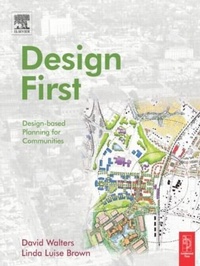
Design First
Design-based planning for communities
1st Edition
Published on 30. April 2004
Book
Paperback/Softback
304 pages
978-0-7506-5934-5 (ISBN)
Description
Well-grounded in the history and theory of Anglo-American urbanism, this illustrated textbook sets out objectives, policies and design principles for planning new communities and redeveloping existing urban neighborhoods. Drawing from their extensive experience, the authors explain how better plans (and consequently better places) can be created by applying the three-dimensional principles of urban design and physical place-making to planning problems.
Design First uses case studies from the authors' own professional projects to demonstrate how theory can be turned into effective practice, using concepts of traditional urban form to resolve contemporary planning and design issues in American communities.
The book is aimed at architects, planners, developers, planning commissioners, elected officials and citizens -- and, importantly, students of architecture and planning -- with the objective of reintegrating three-dimensional design firmly back into planning practice.
Design First uses case studies from the authors' own professional projects to demonstrate how theory can be turned into effective practice, using concepts of traditional urban form to resolve contemporary planning and design issues in American communities.
The book is aimed at architects, planners, developers, planning commissioners, elected officials and citizens -- and, importantly, students of architecture and planning -- with the objective of reintegrating three-dimensional design firmly back into planning practice.
Reviews / Votes
Years on the front lines of urban design, advocacy & teaching have equipped (the authors) with a considerable store of wisdom... - The Charlotte Observer...for all citizens with an interest in what might be taking shape outside their front doors and down their streets. - The Charlotte Observer
....written with well-founded confidence that new planning projects in this region can hold lessons for national -- even international audiences. - The Charlotte Observer
... the book falls into the classic format epitomized by Robert Venturis' Complexity and Contradiction in Architecture. - New Urban News
The scope of the material is exhaustive. - New Urban News
The book is a lucid and welcome addition to the literature for many reasons - Planning Magazine
More details
Language
English
Place of publication
Oxford
United Kingdom
Publishing group
Taylor & Francis Ltd
Target group
Professional and scholarly
Professional Practice & Development
Illustrations
Approx. 100 illustrations (50 in full color)
Dimensions
Height: 246 mm
Width: 189 mm
Weight
710 gr
ISBN-13
978-0-7506-5934-5 (9780750659345)
Copyright in bibliographic data and cover images is held by Nielsen Book Services Limited or by the publishers or by their respective licensors: all rights reserved.
Schweitzer Classification
Other editions
Additional editions
Book
02/2017
1st Edition
Routledge
€229.30
Shipment within 10-20 days
David Walters | Linda Brown
Design First
E-Book
08/2012
1st Edition
Routledge
€78.99
Available for download
David Walters | Linda Brown
Design First
E-Book
08/2012
1st Edition
Routledge
€78.99
Available for download
Persons
Linda Brown is a writer, critic, teacher and professional painter. A fellow of the MacDowell Colony in New Hampshire, her paintings hang in many prestigious public and private collections, including the Federal Reserve and IBM. Her art criticism has been published in regional and national magazines, including Art Papers and Ceramics Monthly. Under a pseudonym, Brown has written three novels, published in the UK. She has taught graduate courses in art criticism with an emphasis on postmodern art and architecture, and has been a public art consultant on several community design workshops.
Content
Introduction; I. HISTORY: Paradigms Lost, Development Control, Traditional Urbanism; II. THEORY: Good Urbanism, Public Space vs. Cyberspace, Urban Design Principles, Land use, Transportation & Building Form, Managed Growth & the Market Economy, Community-based Design; III. PRACTICE: Setting Goals, Anglo-American Variations, Design Workshop, The Master Plan, Implementation Strategies; IV. CASE STUDIES; V. AFTERWORD