

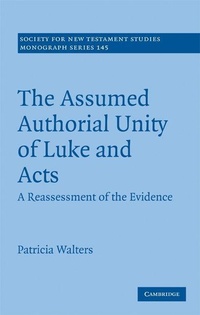
The Assumed Authorial Unity of Luke and Acts
A Reassessment of the Evidence
Published on 12. February 2009
Book
Hardback
256 pages
978-0-521-50974-9 (ISBN)
Description
For nearly nineteen hundred years, few have questioned the single authorship of Luke and Acts. A careful reassessment of the internal and external evidence, however, reveals this assumption to be built on a shakier foundation than was previously thought. Patricia Walters's innovative study offers a statistical analysis of Luke and Acts, pointing to the existence of highly significant differences in their prose style. In particular, a comprehensive survey and re-examination of the two books' least contested authorial stratum - their seams and summaries - brings to light ancient prose compositional patterns that distinguish Luke and Acts beyond a reasonable doubt. Walters's application of statistical analysis is unique in biblical scholarship, and will provide impetus for using similar methods in other areas of the field. This book will therefore be of great interest to academic researchers and students of early Christianity, classical literature and rhetoric, and New Testament studies.
More details
Series
Language
English
Place of publication
Cambridge
United Kingdom
Target group
Professional and scholarly
Dimensions
Height: 222 mm
Width: 145 mm
Thickness: 19 mm
Weight
497 gr
ISBN-13
978-0-521-50974-9 (9780521509749)
Copyright in bibliographic data and cover images is held by Nielsen Book Services Limited or by the publishers or by their respective licensors: all rights reserved.
Schweitzer Classification
Other editions
Additional editions
Book
02/2011
Cambridge University Press
€48.50
Shipment within 15-20 days
E-Book
05/2009
1st Edition
Cambridge University Press
€32.49
Available for download
Person
Patricia Walters is an assistant professor and coordinator of the Religious Studies program at Rockford College, Illinois.
Content
1. Background and methodology; 2. Authorial data: seams and summaries; 3. Authorial criteria: Greek prose compositional conventions; 4. Authorial unity: analysis results and probabilities; 5. Final considerations and future directions.