

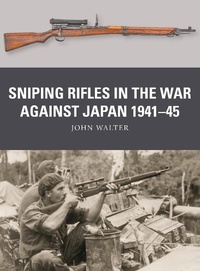
Sniping Rifles in the War Against Japan 1941-45
Published on 15. February 2024
Book
Paperback/Softback
80 pages
978-1-4728-5832-0 (ISBN)
Description
Fully illustrated, this absorbing study explores the evolving sniping technology and tactics employed by both sides in Asia and the Pacific during 1941-45.
During World War II, both the Japanese and their Allied opponents made widespread use of snipers armed with a variety of rifles, scopes and accessories and prepared by widely differing levels of training and tactical doctrine. The challenges of fighting in a variety of harsh environments, from the Pacific islands to the vast expanses of China, prompted improvisation and innovation on both sides in the ongoing war between snipers and their adversaries. Often operating at relatively close ranges in restrictive terrain, snipers made particularly ingenious use of camouflage and deception as the fighting spread across Asia and the Pacific in the wake of the Pearl Harbor attack, while troops tasked with countering enemy marksmen had to learn the hard way how best to defeat a seemingly invisible enemy.
Small arms expert John Walter considers the strengths and limitations of the rifles, scopes and accessories deployed by Japanese snipers and their Allied counterparts, as well as their different approaches to sniping tactics and training. Specially commissioned artwork and carefully chosen photographs illustrate this enthralling study of the sniping war in Asia and the Pacific during World War II.
During World War II, both the Japanese and their Allied opponents made widespread use of snipers armed with a variety of rifles, scopes and accessories and prepared by widely differing levels of training and tactical doctrine. The challenges of fighting in a variety of harsh environments, from the Pacific islands to the vast expanses of China, prompted improvisation and innovation on both sides in the ongoing war between snipers and their adversaries. Often operating at relatively close ranges in restrictive terrain, snipers made particularly ingenious use of camouflage and deception as the fighting spread across Asia and the Pacific in the wake of the Pearl Harbor attack, while troops tasked with countering enemy marksmen had to learn the hard way how best to defeat a seemingly invisible enemy.
Small arms expert John Walter considers the strengths and limitations of the rifles, scopes and accessories deployed by Japanese snipers and their Allied counterparts, as well as their different approaches to sniping tactics and training. Specially commissioned artwork and carefully chosen photographs illustrate this enthralling study of the sniping war in Asia and the Pacific during World War II.
Reviews / Votes
An absorbing study of the evolution of sniping. * Britain At War Magazine (April 2024) *More details
Series
Language
English
Place of publication
United Kingdom
Publishing group
Bloomsbury Publishing PLC
Illustrations
Colour artwork plates; black & white and colour photographs and illustrations.
Dimensions
Height: 243 mm
Width: 179 mm
Thickness: 7 mm
Weight
266 gr
ISBN-13
978-1-4728-5832-0 (9781472858320)
Copyright in bibliographic data and cover images is held by Nielsen Book Services Limited or by the publishers or by their respective licensors: all rights reserved.
Schweitzer Classification
Other editions
Additional editions
John Walter
Sniping Rifles in the War Against Japan 1941-45
E-Book
02/2024
1st Edition
Osprey Publishing
€15.49
Available for download
John Walter
Sniping Rifles in the War Against Japan 1941-45
E-Book
02/2024
1st Edition
Osprey Publishing
€15.49
Available for download
Persons
John Walter is the author of some 70 books, including Hotchkiss Machine Guns and Walther Pistols for Osprey's Weapon series.
Johnny Shumate works as a freelance illustrator in Tennessee. His greatest influences are Angus McBride, Don Troiani and Edouard Detaille.
Alan Gilliland writes, illustrates and publishes fiction (www.ravensquill.com), as well as illustrating for a variety of publishers (alangillilandillustration.blogspot.com).
Johnny Shumate works as a freelance illustrator in Tennessee. His greatest influences are Angus McBride, Don Troiani and Edouard Detaille.
Alan Gilliland writes, illustrates and publishes fiction (www.ravensquill.com), as well as illustrating for a variety of publishers (alangillilandillustration.blogspot.com).
Content
Introduction
Development
Use
Impact
Conclusion
Bibliography
Index
Development
Use
Impact
Conclusion
Bibliography
Index