

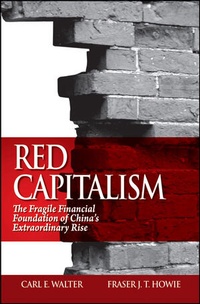
Red Capitalism
The Fragile Financial Foundation of China's Extraordinary Rise
1st Edition
Published on 7. January 2011
Book
Hardback
256 pages
978-0-470-82586-0 (ISBN)
Description
In 1974 China's last Emperor, Deng Xiaoping, traveled to New York to speak at the United Nations. This was the first time such a senior Chinese leader had ever visited the United States. As the delegation prepared its trip the question was asked, "How can we pay?"A mad scramble ensued in the capital as the Emperor's men called all the banks to assemble foreign currency. After searching high and low, they were able to scrape up only $38,000. Now just 30 years later China appears to have won the global Monopoly game with foreign exchange reserves of over $2 trillion and an economy the government says will grow at 8% despite recession of the world's other economies. Everyone is looking to China.
How did China in just 30 years pick itself off the floor and become America's largest creditor, positioning itself if not to surpass the United States, then perhaps acquire major aspects of its crumbling economy? In Red Capitalism authors Carl Walter and Fraser Howie go deep into the Chinese financial machine to illuminate the social and political consequences of China's unique business model and pose the question whether it has, in fact, lived up to all the hype surrounding it and whether, after all, the 21st century really will be China's century.
Red Capitalism is indispensable reading for those who would understand the limits that China's past development decisions have imposed on its brilliant future. No one who is considering China business strategies in today's extremely challenged global economy can afford to miss this book.
Reviews / Votes
'Anyone who is overly impressed with the apparent resilience of China today would do well to read [this] book' (The Economist, December 2010). '...an impressive wealth of analytical detail and political nous'. (FT, January 2011).More details
Edition
1., Auflage
Language
English
Place of publication
Chichester
United Kingdom
Publishing group
John Wiley and Sons Ltd
Target group
Professional and scholarly
Illustrations
Illustrations
Dimensions
Height: 21 cm
Width: 14 cm
Thickness: 27 mm
Weight
550 gr
ISBN-13
978-0-470-82586-0 (9780470825860)
Schweitzer Classification
Other editions
New editions
Carl Walter | Fraser Howie
Red Capitalism
The Fragile Financial Foundation of China's Extraordinary Rise
Book
03/2012
Wiley
€28.50
Shipment within 15-20 days
Persons
Carl E. Walter has worked in China's financial sector for the past twenty years and has actively participated in many of its financial reforms. He played a major role in China's groundbreaking first overseas IPO in 1992 as well as the first listing of a state-owned enterprise on the New York Stock Exchange in 1994. He held a senior position in China's first and most successful joint venture investment bank where he supported a number of significant domestic stock and debt underwritings for major Chinese corporations and financial institutions. More recently, he helped build one of the most successful and profitable domestic security, risk, and currency trading operations for a major international investment bank. Fluent in Mandarin, he holds a PhD from Stanford University and a graduate certificate from Beijing University. Carl is a longtime resident of Beijing. Fraser J. T. Howie has been trading, analyzing, and writing about Asian stock markets for nearly twenty years. During that time, he has worked in Hong Kong, trading equity derivatives at Bankers Trust and Morgan Stanley. After moving to China in 1998, he worked in the sales and trading department of China International Capital Corporation followed by a stint with China M&A Management Company. He is a regular commentator on China and its financial system, having spoken in Hong Kong, Tokyo, Beijing, Shanghai, Singapore, and Cambridge. He is currently a managing director at a leading Asia-Pacific brokerage firm in Singapore helping international investors invest in both the Indian and Chinese markets.
Content
Chapter 1: "One short nap took me all the way back to before 1949".
1978-2008: 30 years of Opening.
1992-2005: 13 years of Reform.
2005: the end of Reform.
China is a family business.
Chapter 2: China's fortress banking system.
Banks are China's financial system.
Crisis and bank reform, 1994 and 1998.
China's fortress banking system in 2009.
The sudden thirst for capital and cash dividends, 2010.
Chapter 3: The fragile fortress.
The foundation of China's banking machine.
Bad bank performance and its implications, 2009.
The "perpetual put" option to PBOC.
China's new post-Lehman Brothers banking model.
Implications.
Chapter 4: China's captive bond market.
Why does China have a bond market?
Yield curves in China.
The base of the Pyramid: "protecting" household depositors.
Chapter 5: The struggle over China's bond markets.
China Development Bank, the Ministry of Finance and the Big 4 Banks.
People's Bank of China, NDRC and CSRC: corporate bonds.
Local governments unleashed.
China Investment Corporation: the lynchpin of China's financial system.
Cycles in China's financial markets.
Chapter 6: Western finance, SOE reform and China's stock markets.
Why does China have stock markets?
What the stock markets gave China.
Chapter 7: The National Team is China's government.
The National Team, the Organization Department, Huijin and SASAC.
Chinese stock markets: Who benefits?
A casino or a success or both?
Implications.
Chapter 8: The Forbidden City.
The Emperor of Finance.
Behind the vermillion walls.
Red capitalism means leverage.
The Emperor's new financial playthings.
Appendices.