

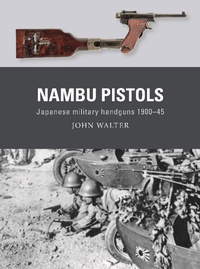
Nambu Pistols
Japanese military handguns 1900-45
Published on 27. April 2023
Book
Paperback/Softback
80 pages
978-1-4728-5542-8 (ISBN)
Description
This is the absorbing story of the handguns credited to Nambu Kijiro, the principal personal-defence weapons of the Imperial forces.
Featuring full-color artwork and carefully chosen photographs, this book charts the origins, development, combat use, and legacy of the Nambu pistols. Cutaway artwork reveals the inner workings of these important handguns, while specially commissioned battlescenes depict them in use in action.
Influenced by the German C 96 and other semi-automatic pistols, the first Nambu model was never accepted for universal issue, being confined largely to purchase by Japanese officers. Adopted in 1925, the 14th Year Type was to become the best-known of these handguns, serving in every campaign undertaken by the Japanese in the 1930s and then throughout World War II. It served alongside the bizarrely conceived Type 94, intended as the weapon of airmen, tank crew, and anyone to whom its compact dimensions were useful.
When World War II ended, thousands of Nambu pistols arrived in America with US veterans of World War II, while others were carried by insurgents and other armed groups across South East Asia for decades after 1945. Fully illustrated, this is the engrossing story of these distinctive pistols, from their origins to their legacy.
Featuring full-color artwork and carefully chosen photographs, this book charts the origins, development, combat use, and legacy of the Nambu pistols. Cutaway artwork reveals the inner workings of these important handguns, while specially commissioned battlescenes depict them in use in action.
Influenced by the German C 96 and other semi-automatic pistols, the first Nambu model was never accepted for universal issue, being confined largely to purchase by Japanese officers. Adopted in 1925, the 14th Year Type was to become the best-known of these handguns, serving in every campaign undertaken by the Japanese in the 1930s and then throughout World War II. It served alongside the bizarrely conceived Type 94, intended as the weapon of airmen, tank crew, and anyone to whom its compact dimensions were useful.
When World War II ended, thousands of Nambu pistols arrived in America with US veterans of World War II, while others were carried by insurgents and other armed groups across South East Asia for decades after 1945. Fully illustrated, this is the engrossing story of these distinctive pistols, from their origins to their legacy.
Reviews / Votes
Without a doubt the author has done a great service to those interested in Japanesepersonal weapons. -- Stuart Blank * Military Archive Research * With a mix of archive and modern photos, along with artwork that does include fine cutaway diagrams, the story of the design is well illustrated. * Military Model Scene *
More details
Series
Language
English
Place of publication
United Kingdom
Publishing group
Bloomsbury Publishing PLC
Illustrations
Colour artwork plates; black & white and colour photographs and illustrations.
Dimensions
Height: 246 mm
Width: 186 mm
Thickness: 7 mm
Weight
259 gr
ISBN-13
978-1-4728-5542-8 (9781472855428)
Copyright in bibliographic data and cover images is held by Nielsen Book Services Limited or by the publishers or by their respective licensors: all rights reserved.
Schweitzer Classification
Other editions
Additional editions
E-Book
04/2023
1st Edition
Osprey Publishing
€15.49
Available for download
E-Book
04/2023
1st Edition
Osprey Publishing
€15.49
Available for download
Persons
John Walter is among the world's most prolific writers on small arms, and the author of 70 books. His Osprey titles include Hotchkiss Machine Guns, Weapons of the Civil War Cavalryman, and Walther Pistols, all in the Weapon series.
Adam Hook specializes in detailed historical reconstructions, and has illustrated Osprey titles on subjects as diverse as the Aztecs, the Ancient Greeks and the modern Chinese Army.
Alan Gilliland writes, illustrates and publishes fiction (www.ravensquill.com), as well as illustrating for a variety of publishers (alangillilandillustration.blogspot.com).
Adam Hook specializes in detailed historical reconstructions, and has illustrated Osprey titles on subjects as diverse as the Aztecs, the Ancient Greeks and the modern Chinese Army.
Alan Gilliland writes, illustrates and publishes fiction (www.ravensquill.com), as well as illustrating for a variety of publishers (alangillilandillustration.blogspot.com).
Content
Introduction
Development
Use
Impact
Conclusion
Bibliography
Index
Development
Use
Impact
Conclusion
Bibliography
Index