

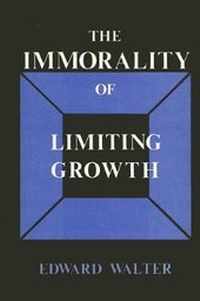
Immorality of Limiting Growth, The
Published on 30. June 1981
Book
Paperback/Softback
186 pages
978-0-87395-479-2 (ISBN)
Description
The Industrial Age has ended, according to "no-growth futurism," because the finitude of the earth has been reached. Its proponents maintain that technological innovation cannot save industrial society because of pollution, over population, and inflation. They call for a transformed society in which productivity, pollution, and population growth are strictly controlled.
This volume emphatically challenges the no-growth viewpoint on both philosophical and empirical grounds. In it, Edward Walter demonstrates that the interests of those who are socially deprived cannot be fulfilled in a "steady-state" because the privileged classes are able to use their power to prevent redistribution of wealth and to retain their advantages.
Far from equating technology with pollution and the depletion of natural resources, Walter sees it as the means by which resource shortages can be overcome and pollution control can be achieved. He describes and recommends an "essential liberalism," that could provide economic development to all classes in a spirit of international cooperation-without necessitating the transformation of human nature and political institutions.
This volume emphatically challenges the no-growth viewpoint on both philosophical and empirical grounds. In it, Edward Walter demonstrates that the interests of those who are socially deprived cannot be fulfilled in a "steady-state" because the privileged classes are able to use their power to prevent redistribution of wealth and to retain their advantages.
Far from equating technology with pollution and the depletion of natural resources, Walter sees it as the means by which resource shortages can be overcome and pollution control can be achieved. He describes and recommends an "essential liberalism," that could provide economic development to all classes in a spirit of international cooperation-without necessitating the transformation of human nature and political institutions.
Reviews / Votes
"This book is clear; it is well written; it is consistent. Above all, it is timely. Walter discusses a problem which cannot be ignored." - Professor Wilfrid Desan, Georgetown UniversityMore details
Language
English
Place of publication
Albany, NY
United States
Product notice
Paperback (trade)
Illustrations
Total Illustrations: 0
Dimensions
Height: 229 mm
Width: 152 mm
Thickness: 25 mm
Weight
227 gr
ISBN-13
978-0-87395-479-2 (9780873954792)
Copyright in bibliographic data and cover images is held by Nielsen Book Services Limited or by the publishers or by their respective licensors: all rights reserved.
Schweitzer Classification
Person
Edward Walter is Professor of Philosophy and department chair at the University of Missouri, Kansas City. He is the author of numerous scholarly articles on philosophical and social questions.
Content
Introduction PART I: THE TECHNICAL AND PHILOSOPHICAL PROBLEMS CREATED BY NO-GROWTH FUTURISM
1. The Challenge to Industrial Society: No-Growth Futurism
2. The Likely Consequences of Attempting to Institute a Steady State
3. Counterpoint: The Moral Implications of No-Growth Futurisms and Doubts about the Empirical Claims of No-Growth Futurists
4. Essential Liberalism
5. Liberalism, Material Development, and Industrial Growth
6. Practical Liberal Policy
7. The Promise of Social Science Forecasting
PART II: THE EMPIRICAL EVIDENCE RELEVANT TO THE PROBLEM OF GROWTH
8. The Availability of Energy Resources
9. The Availability of Mineral Resources
10. Population Problems
11. Pollution Problems
12. Conclusion: A Rational Future
Notes
Index
1. The Challenge to Industrial Society: No-Growth Futurism
2. The Likely Consequences of Attempting to Institute a Steady State
3. Counterpoint: The Moral Implications of No-Growth Futurisms and Doubts about the Empirical Claims of No-Growth Futurists
4. Essential Liberalism
5. Liberalism, Material Development, and Industrial Growth
6. Practical Liberal Policy
7. The Promise of Social Science Forecasting
PART II: THE EMPIRICAL EVIDENCE RELEVANT TO THE PROBLEM OF GROWTH
8. The Availability of Energy Resources
9. The Availability of Mineral Resources
10. Population Problems
11. Pollution Problems
12. Conclusion: A Rational Future
Notes
Index