

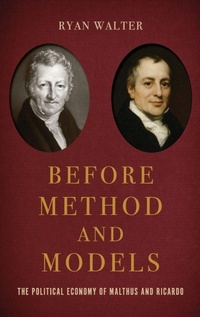
Before Method and Models
The Political Economy of Malthus and Ricardo
Published on 25. October 2021
Book
Hardback
266 pages
978-0-19-760305-5 (ISBN)
Description
A boldly revisionist history of the first disputes in nineteenth-century Britain over the role of economists in society
Economics now so dominates our understanding of how the world works that some of the field's most influential concepts seem akin to natural laws. Yet economists themselves are a relatively recent species of intellectual, first emerging in the late eighteenth and early nineteenth centuries. And like the economists of our own era, the pioneering work of the early economists was decidedly a product of its time.
Before Method and Models looks back to the first disputes in nineteenth-century Britain over the role of economists in society to explain how the broader historical and intellectual context has always shaped the field. Ryan Walter's boldly revisionist history focuses on Thomas Robert Malthus and David Ricardo, both of whom were attacked for producing a type of knowledge that was perceived to be dangerous to society. Rather than simply assuming that "classical political economy" always existed, Walter recovers the historical circumstances that actually shaped the development of their methods and concepts. The book delves into the major political controversies of the time - the Bullion Controversy and the Corn Laws debate - and the arguments that Malthus and Ricardo advanced in order to shape the outcome. By examining the hostile responses of Malthus and Ricardo's contemporaries, the book shows how the major challenge facing the first economists was to legitimize the activity of theorizing and then reforming economic life.
In a time when debate about commerce and politics was conducted without our modern methods and models, Malthus and Ricardo fought for the creation of the new field of political economy and a role for their work at the center of politics. Walter's reconstruction of the era reveals an exceedingly sophisticated debate regarding the costs and benefits of reforming both institutions and laws through the new science of political economy.
Economics now so dominates our understanding of how the world works that some of the field's most influential concepts seem akin to natural laws. Yet economists themselves are a relatively recent species of intellectual, first emerging in the late eighteenth and early nineteenth centuries. And like the economists of our own era, the pioneering work of the early economists was decidedly a product of its time.
Before Method and Models looks back to the first disputes in nineteenth-century Britain over the role of economists in society to explain how the broader historical and intellectual context has always shaped the field. Ryan Walter's boldly revisionist history focuses on Thomas Robert Malthus and David Ricardo, both of whom were attacked for producing a type of knowledge that was perceived to be dangerous to society. Rather than simply assuming that "classical political economy" always existed, Walter recovers the historical circumstances that actually shaped the development of their methods and concepts. The book delves into the major political controversies of the time - the Bullion Controversy and the Corn Laws debate - and the arguments that Malthus and Ricardo advanced in order to shape the outcome. By examining the hostile responses of Malthus and Ricardo's contemporaries, the book shows how the major challenge facing the first economists was to legitimize the activity of theorizing and then reforming economic life.
In a time when debate about commerce and politics was conducted without our modern methods and models, Malthus and Ricardo fought for the creation of the new field of political economy and a role for their work at the center of politics. Walter's reconstruction of the era reveals an exceedingly sophisticated debate regarding the costs and benefits of reforming both institutions and laws through the new science of political economy.
Reviews / Votes
Walter's book valuably draws attention to the deep ethical concern surrounding the production of theoretical knowledge * Jon Cooper, Oeconomia * The book illustrates the displacement of the subfield of the history of economics from economics proper to intellectual history-a development already noted in 1969 by Alexander Gerschenkron, who wrote: "The Department of Physics at Harvard has completely eliminated history of physics from its curriculum; such history has been shifted to an independent History of Science Department. By contrast, in the Department of Political Science, history of political thought is still the daily bread of the discipline. Today's economics finds itself between those extremes, but certainly not in the middle. We are getting closer and closer to physics" * Alain Alcouffe, Journal of Modern History * In sum, while I have some reservations, they should not detract from what is undoubtedlya major scholarly contribution that fully deserves the serious attention of historians ofeconomics. Ryan Walter's book is both a valuable resource and a salutary antidote topseudo-"histories" that have appeared in recent decades. * Terry Peach, The European Journal of the History of EconomicThought *More details
Series
Language
English
Place of publication
New York
United States
Target group
College/higher education
Dimensions
Height: 240 mm
Width: 161 mm
Thickness: 19 mm
Weight
567 gr
ISBN-13
978-0-19-760305-5 (9780197603055)
Copyright in bibliographic data and cover images is held by Nielsen Book Services Limited or by the publishers or by their respective licensors: all rights reserved.
Schweitzer Classification
Other editions
Additional editions
E-Book
08/2021
OUP eBook
€84.49
Available for download
E-Book
08/2021
OUP eBook
€84.49
Available for download
Person
Ryan Walter is Associate Professor in the School of Politics and International Studies at University of Queensland.
Content
Conventions Introduction Chapter 1: The Debate over Theory Before Malthus and Ricardo: Burke, Mackintosh, and Stewart PART II: Political Economy and Parliamentary Reasoning Chapter 2: The Vocabulary of Theory and Practice in the Bullion Controversy, 1797-1811 Chapter 3: The Corn Laws and Free Trade Casuistry, 1813-15 PART III: The Greater Stakes of Doctrinal Contest Chapter 4: Doctrinal Contest I: Value Chapter 5: Doctrinal Contest II: Rent Chapter 6: Doctrinal Contest III: Profits Conclusion: A New Past Bibliography