

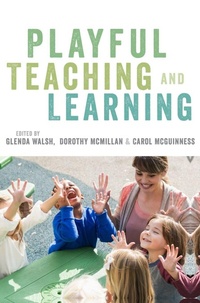
Playful Teaching and Learning
1st Edition
Published on 6. April 2017
Book
Hardback
240 pages
978-1-4739-4880-8 (ISBN)
Description
Every early years practitioner should be able to captivate and maintain the interest of young children in their setting, through the provision of a playful learning experience.
Covering age ranges 3-8 years, this textbook explores the importance of infusing playfulness throughout the entire early years day, and includes chapters that:
establish the core principles underpinning playful teaching and learning
help students and practitioners understand how playfulness can be applied to all aspects of the early years curriculum including mathematics, literacy, outdoor environments, science & technology, and ICT
explore core issues in early years provision including observing, planning & assessment, and how they relate to playful learning
emphasise the role and qualities of the playful professional.
This is a fantastic resource for any student or practitioner looking to enrich the lives of young children through meaningful playful learning experiences.
Covering age ranges 3-8 years, this textbook explores the importance of infusing playfulness throughout the entire early years day, and includes chapters that:
establish the core principles underpinning playful teaching and learning
help students and practitioners understand how playfulness can be applied to all aspects of the early years curriculum including mathematics, literacy, outdoor environments, science & technology, and ICT
explore core issues in early years provision including observing, planning & assessment, and how they relate to playful learning
emphasise the role and qualities of the playful professional.
This is a fantastic resource for any student or practitioner looking to enrich the lives of young children through meaningful playful learning experiences.
Reviews / Votes
This book draws on a wealth of research on play, learning, pedagogy and curriculum in early childhood education. The contributors rightly emphasise the importance of play to children, and the opportunities that play provides for learning and development. Each of the chapters is informed by international research, and offers contrasting perspectives about different forms of play, and the challenges that practitioners face in their practice.-- Professor Elizabeth Wood How do you capture and maintain the interests of young children through the provision of playful learning, while ensuring that effective learning is taking place? This is the driving principal of this thought provoking, but also very practical book that will enrich the knowledge of practitioners of all levels, and add to the reflective nature of their pedagogy. -- Neil Henty This is a fantastic resource for any student or practitioner looking to enrich the lives of young children through meaningful playful learning experiences. Extensively researched with an excellent number of case studies to show how the principles work in practice, plus references for further reading, this is authoritative yet highly readable. It really highlights the benefits to children of a playful approach to learning, giving teachers confidence to incorporate the principles into everyday teaching. -- Sarah Brew
More details
Edition
First Edition
Language
English
Place of publication
London
United Kingdom
Target group
College/higher education
Dimensions
Height: 250 mm
Width: 175 mm
Thickness: 18 mm
Weight
600 gr
ISBN-13
978-1-4739-4880-8 (9781473948808)
Copyright in bibliographic data and cover images is held by Nielsen Book Services Limited or by the publishers or by their respective licensors: all rights reserved.
Schweitzer Classification
Other editions
Additional editions
Glenda Walsh | Dorothy McMillan | Carol McGuinness
Playful Teaching and Learning
Book
04/2017
1st Edition
SAGE Publications Ltd
€71.20
Shipment within 15-20 days
Persons
Glenda Walsh is Head of Early Years Education and principal lecturer at Stranmillis University College, a College of Queen's University Belfast. Her research interests centre on quality issues in Early Childhood Education, particularly in the field of pedagogy and curriculum. Her PhD thesis focused on an evaluation of play versus formal experiences for 4-5 year old children in Denmark and Northern Ireland and for the purposes of her doctoral study, she designed an observation tool, known as the Quality Learning Instrument. Subsequently she has been involved in many major research projects such as the longitudinal evaluation of the Early Years Enriched Curriculum Project in Northern Ireland and she also headed a major project on examining pedagogy in Early Childhood Education for the Department of Education in the Republic of Ireland. Her publications reflect her interest in curriculum and pedagogy, focusing in particular on resolving the dilemmas associated with play as learning and teaching in practice.
Dorothy McMillan was, until recently, a senior lecturer in Early Childhood Education at Stranmillis University College, Belfast, teaching on the PGCE (Early Years), BA and MA in Early Childhood Studies degree programmes. She has wide experience of working with children, as a former primary school teacher, nursery school principal and playgroup leader, and has also been involved in setting up and running parent and toddler groups. Her doctoral thesis centred on the conceptual notion of 'educare' in preschool settings and its implications for early years training. Her research interests are focused on training and early years professionalism issues, including management and leadership. Dorothy recently moved to live in The Netherlands where she has joined the staff team at the International Baptist Theological Study Centre in Amsterdam.
Carol McGuinness is Professor Emerita at Queen's University Belfast, Northern Ireland. Her research interests are in the application of cognitive and developmental psychology to classroom learning, specifically, how teachers can promote the development of children's thinking skills. She authored the influential Department of Education (then DfEE) report From Thinking Skills to Thinking Classrooms (1999), and directed the Activating Children's Thinking Skills (ACTS) project, funded by the ESRC's Teaching and Learning Research Programme (2002-2005). Working with Glenda Walsh and colleagues, she led the longitudinal evaluation of the play-based curriculum in the early years of primary school in Northern Ireland, the Enriched Curriculum (2000-2009). Both these strands of research have had significant influence on education policy in Northern Ireland and elsewhere. More recently, with Robert Swartz (Center for Teaching Thinking, Boston), she is advising the International Baccalaureate on the development of thinking in their curriculum (2014-2016).
Dorothy McMillan was, until recently, a senior lecturer in Early Childhood Education at Stranmillis University College, Belfast, teaching on the PGCE (Early Years), BA and MA in Early Childhood Studies degree programmes. She has wide experience of working with children, as a former primary school teacher, nursery school principal and playgroup leader, and has also been involved in setting up and running parent and toddler groups. Her doctoral thesis centred on the conceptual notion of 'educare' in preschool settings and its implications for early years training. Her research interests are focused on training and early years professionalism issues, including management and leadership. Dorothy recently moved to live in The Netherlands where she has joined the staff team at the International Baptist Theological Study Centre in Amsterdam.
Carol McGuinness is Professor Emerita at Queen's University Belfast, Northern Ireland. Her research interests are in the application of cognitive and developmental psychology to classroom learning, specifically, how teachers can promote the development of children's thinking skills. She authored the influential Department of Education (then DfEE) report From Thinking Skills to Thinking Classrooms (1999), and directed the Activating Children's Thinking Skills (ACTS) project, funded by the ESRC's Teaching and Learning Research Programme (2002-2005). Working with Glenda Walsh and colleagues, she led the longitudinal evaluation of the play-based curriculum in the early years of primary school in Northern Ireland, the Enriched Curriculum (2000-2009). Both these strands of research have had significant influence on education policy in Northern Ireland and elsewhere. More recently, with Robert Swartz (Center for Teaching Thinking, Boston), she is advising the International Baccalaureate on the development of thinking in their curriculum (2014-2016).
Content
Section 1: Principles of Playful Teaching and Learning
Chapter 1 Why Playful Teaching and Learning? - Glenda Walsh
Chapter 2 Mental Models of Early Years Practice: Digging Deeper - Liz Sproule
Chapter 3 Pillars of Practice for Playful Teaching and Learning - Glenda Walsh
Section 2: Playful Teaching and Learning across the Curriculum
Chapter 4 Playful Thinking in Action: Tools for Cultivating Children's Thinking - Carol McGuinness
Chapter 5 Playful Pedagogies in Early Childhood Mathematics - Ross O Corrain and Elizabeth Dunphy
Chapter 6 Playful Approaches to Literacy - Catherine Gilliland
Chapter 7 Growing the Child in the Playful Setting - Marion Dowling and Glenda Walsh
Chapter 8 Playful Learning in Natural Outdoor Environments - Richard Greenwood
Chapter 9 ICT Made Playful - Christine Stephen
Chapter 10 Playful Approaches to Science and Technology - Andrea Doherty and John McCullagh
Section 3: The Role of the Playful Professional
Chapter 11 Hopeful Intentions: Planning for Playful Teaching and Learning - Jacqueline Fallon
Chapter 12 Assessment in the Playful Teaching and Learning Experience - Glenda Walsh and Elizabeth Sproule
Chapter 13 Towards the Playful Professional - Dorothy McMillan
Chapter 1 Why Playful Teaching and Learning? - Glenda Walsh
Chapter 2 Mental Models of Early Years Practice: Digging Deeper - Liz Sproule
Chapter 3 Pillars of Practice for Playful Teaching and Learning - Glenda Walsh
Section 2: Playful Teaching and Learning across the Curriculum
Chapter 4 Playful Thinking in Action: Tools for Cultivating Children's Thinking - Carol McGuinness
Chapter 5 Playful Pedagogies in Early Childhood Mathematics - Ross O Corrain and Elizabeth Dunphy
Chapter 6 Playful Approaches to Literacy - Catherine Gilliland
Chapter 7 Growing the Child in the Playful Setting - Marion Dowling and Glenda Walsh
Chapter 8 Playful Learning in Natural Outdoor Environments - Richard Greenwood
Chapter 9 ICT Made Playful - Christine Stephen
Chapter 10 Playful Approaches to Science and Technology - Andrea Doherty and John McCullagh
Section 3: The Role of the Playful Professional
Chapter 11 Hopeful Intentions: Planning for Playful Teaching and Learning - Jacqueline Fallon
Chapter 12 Assessment in the Playful Teaching and Learning Experience - Glenda Walsh and Elizabeth Sproule
Chapter 13 Towards the Playful Professional - Dorothy McMillan