

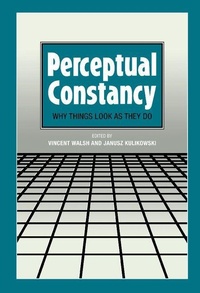
Perceptual Constancy
Why Things Look as They Do
Published on 13. August 1998
Book
Hardback
560 pages
978-0-521-46061-3 (ISBN)
Description
Perceptual Constancy examines a group of long-standing problems in the field of perception and provides a review of the fundamentals of the problems and their solutions. Experts in several different fields - including computational vision, physiology, neuropsychology, psychophysics and comparative psychology - present their approaches to one of the fundamental problems of perception: how does the brain extract a stable world from an ever-changing retinal input? How do we achieve color constancy despite changes in the wavelength content of daylight? How do we recognize objects from different viewpoints? And how do we know the sizes of those objects? The volume is divided into three sections, each of which addresses developmental, clinical and comparative issues, psychophysics, and physiology.
Reviews / Votes
"This interesting...volume updates research on the nature of perceptual constancies and how they arise. ...this important work should become a core reference in this area. ...the primary audience for the book will be graduate students and researchers in experimental psychology. Recommended to libraries serving these readers." Choice "...this volume should be a valuable resource for both graduate students and researchers in visual perception. The book consists of 18 chapters that examine perceptual constancy from a variety of viewpoints. Developmental, comparative, psychophysical, psychological, and computational perspectives are represented in this collection." Journal of Mathematical PsychologyMore details
Language
English
Place of publication
Cambridge
United Kingdom
Target group
Professional and scholarly
Illustrations
28 line figures
Dimensions
Height: 235 mm
Width: 157 mm
Thickness: 37 mm
Weight
1050 gr
ISBN-13
978-0-521-46061-3 (9780521460613)
Copyright in bibliographic data and cover images is held by Nielsen Book Services Limited or by the publishers or by their respective licensors: all rights reserved.
Schweitzer Classification
Other editions
Additional editions
Book
08/2010
Cambridge University Press
€72.70
Shipment within 15-20 days
Persons
Content
Contributors; Introduction: what you see is not what you get Vincent Walsh and Janusz Kulikowski; 1. Visual organization and perceptual constancies in early infancy Alan Slater; 2. The McCollough effect: misperception and reality G. Keith Humphrey; 3. Perception of rotated two-dimensional and three-dimensional objects and visual shapes Pierre Jolicoeur and G. Keith Humphrey; 4. Computational approaches to shape constancy Shimon Edelman and Daphna Weinshall; 5. Learning constancies for object perception Peter Foeldiak; 6. Perceptual constancies in lower vertebrates David Ingle; 7. Generalizing across object orientation and size Elizabeth Ashbridge and David I. Perret; 8. The neuropsychology of visual object constancy Rebecca Lawson and Glyn W. Humphreys; 9. Color constancy and color vision during infancy: methodological and empirical issues James L. Dannemiller; 10. Empirical studies in color constancy Jimmy M. Troost; 11. Computational models of color constancy A. C. Hurlbert; 12. Comparative aspects of color constancy Christa Neumeyer; 13. The physiological substrates of color constancy Hidehiko Komatsu; 14. Size and speed constancy Suzanne P. McKee and Harvey S. Smallman; 15. Depth constancies Thomas S. Collett and Andrew J. Parker; 16. The perception of dynamical constancies Mary K. Kaiser; 17. Perceptual learning Merav Ahissar and Shaul Hochstein; 18. The history of size constancy and size illusions Helen E. Ross and Cornelius Plug; Author index; Subject index.