

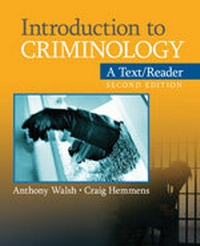
Introduction to Criminology
A Text/Reader
2nd Edition
Published on 1. February 2011
Book
Paperback/Softback
648 pages
978-1-4129-9236-7 (ISBN)
Description
A unique text/reader that takes a comprehensive, interdisciplinary approach to the study of criminology.
Providing an affordable alternative to the standard textbook, this new edition of the authors' popular text/reader provides instructors and students the best of both worlds - authored text with carefully selected accompanying readings. Now thoroughly updated with new articles, new content, and new statistics, tables, and figures, this Second Edition provides an interdisciplinary perspective on crime and criminality that incorporates the latest theories, concepts, and research from sociology, psychology, genetics, evolutionary biology, and the neurosciences.
Providing an affordable alternative to the standard textbook, this new edition of the authors' popular text/reader provides instructors and students the best of both worlds - authored text with carefully selected accompanying readings. Now thoroughly updated with new articles, new content, and new statistics, tables, and figures, this Second Edition provides an interdisciplinary perspective on crime and criminality that incorporates the latest theories, concepts, and research from sociology, psychology, genetics, evolutionary biology, and the neurosciences.
More details
Series
Edition
2nd Revised edition
Language
English
Place of publication
Thousand Oaks
United States
Target group
College/higher education
Edition type
Revised edition
Dimensions
Height: 232 mm
Width: 187 mm
Weight
1021 gr
ISBN-13
978-1-4129-9236-7 (9781412992367)
Copyright in bibliographic data and cover images is held by Nielsen Book Services Limited or by the publishers or by their respective licensors: all rights reserved.
Schweitzer Classification
Other editions
New editions
Book
11/2013
3rd Edition
SAGE Publications Inc
€110.52
Article is exhausted; no reprint
Persons
Anthony Walsh, is a professor of criminology at Boise State University. He received his PhD from Bowling Green State University at the ripe old age of 43. He has field experience in law enforcement and corrections and is the author of more than 150 journal articles and book chapters and 41 books, including Biology and Criminology; Feminist Criminology Through a Biosocial Lens; Law, Justice, and Society (with Hemmens); Correctional Assessment, Casework, and Counseling (with Stohr); The Neurobiology of Criminal Behavior: Gene-Brain-Culture Interaction (with Bolen, Ashgate); Corrections: The Essentials (with Stohr); The Science Wars: The Politics of Gender and Race; Criminological Theory: Assessing Philosophical Assumptions; Biosociology: Bridging the Biology-Sociology Divide; Criminology: The Essentials (with Jorgensen); and Answering Atheists: How Science Points to God and the Benefits of Christianity. His interests include biosocial criminology, statistics, and criminal justice assessment and counseling.
Craig Hemmens is a professor in the Department of Criminal Justice and Criminology at Washington State University. He holds a JD from North Carolina Central University School of Law and a PhD in criminal justice from Sam Houston State University. Professor Hemmens has published 20 books and more than 200 articles, many dealing with legal issues in criminal justice. He currently serves as editor of the Criminal Law Bulletin and previously served as the editor of the Journal of Criminal Justice Education and as president of the Academy of Criminal Justice Sciences. His current research interests include criminal law and procedure.
Craig Hemmens is a professor in the Department of Criminal Justice and Criminology at Washington State University. He holds a JD from North Carolina Central University School of Law and a PhD in criminal justice from Sam Houston State University. Professor Hemmens has published 20 books and more than 200 articles, many dealing with legal issues in criminal justice. He currently serves as editor of the Criminal Law Bulletin and previously served as the editor of the Journal of Criminal Justice Education and as president of the Academy of Criminal Justice Sciences. His current research interests include criminal law and procedure.
Content
Foreword
Preface
Acknowledgments
Dedication
SECTION I. Introduction and Overview of Crime and Criminology
How to Read a Research Article
Reading:
1. The Use and Usefulness of Criminology, 1751-2005: Enlightened Justice and Its Failures, by Lawrence W. Sherman
SECTION II. Measuring Crime and Criminal Behavior
Readings:
2. Gender Gap Trends for Violent Crimes, 1980 to 2003: A UCR-NCVS Comparison, by Darrell Steffensmeier, Hua Zhong, Jeff Ackerman, Jennifer Schwartz, and Suzanne Agha
3. Race and the Probability of Arrest, by Stewart J. D'Alessio and Lisa Stolzenberg
4. Methamphetamine Use, Self-Reported Violent Crime, and Recidivism Among Offenders in California Who Abuse Substances, by Jerome Cartier, David Farabee, and Michael L. Prendergast
SECTION III. The Early Schools of Criminology and Modern Counterparts
Readings:
5. An Introduction to the Principles of Morals and Legislation, by Jeremy Bentham
6. A Crying Shame: The Over-Rationalized Conception of Man in the Rational Choice Perspective, by Willem de Haan and Jaco Vos
7. The Economics of Crime, by Gary S. Becker
SECTION IV. Social Structural Theories
Readings
8. Community Correlates of Rural Youth Violence, by D. Wayne Osgood and Jeff M. Chambers
9. Social Structure and Anomie, by Robert K. Merton
10. Gangs and Social Change, by Martin Sanchez-Jankowski
SECTION V. Social Process Theories
Readings:
11. A Social Learning Theory of Crime, by Ronald L. Akers
12. The Nature of Criminality: Low Self-Control, by Michael R. Gottfredson and Travis Hrischi
13. Social Control in China: Applications of the Labeling Theory and the Reintegrative Shaming Theory, by Xiaoming Chen
14. Gender and Crime Among Felony Offenders: Assessing the Generality of Social Control and Differential Association Theories, by Leanne Fiftal Alarid, Velmer S. Burton, Jr., and Francis T. Cullen
SECTION VI. Critical Theories: Marxist, Conflict, and Feminist
Readings:
15. Marx, Engels, and Bonger on Crime and Social Control, by Ian Taylor, Paul Walton, and Jock Young
16. Crime, Punishment, and the American Dream: Toward a Marxist Integration, by Barbara A. Sims
17. Patriarchy, Crime, and Justice: Feminist Criminology in an Era of Backlash, by Meda Chesney-Lind
SECTION VII. Psychosocial Theories: Individual Traits and Criminal Behavior
Readings:
18. Feeble-Mindedness, by H. H. Goddard
19. Temperament, Environment, and Antisocial Behavior in a Population Sample of Preadolescent Boys and Girls, by Rene Veenstra, Siegwart Lindenberg, Albertine J. Oldehinkel, Andrea F. De Winter, and Johan Ormel
20. Psychopathy: Theory, Measurement, and Treatment, by Anh Vien and Anthony R. Beech
SECTION VIII. Biosocial Approaches
Readings:
21. Behavior Genetics and Anomie/Strain Theory, by Anthony Walsh
22. Neuroimaging Studies of Aggessive and Violent Behavior: Current Findings and Implications for Criminology and Criminal Justice, by Jana L. Bufkin and Vickie R. Luttrell
23. A Theory Explaining Biological Correlates of Criminality, by Lee Ellis
24. A Gene-Based Evolutionary Explanation for the Association Between Criminal Involvement and Number of Sex Partners, by Kevin M. Beaver, John P. Wright, and Anthony Walsh
SECTION IX. Developmental Theories: From Delinquency to Crime to Desistance
Readings:
25. Reactive vs. Proactive Antisocial Behavior: Differential Correlates of Child ADHD Symptoms? by David S. Bennett, Maria Pitale, Vaishali Vora, and Alyssa A. Rheingold
26. The Adolescence-Limited/Life-Course Persistent Theory of Antisocial Behavior: What Have We Learned? by Terrie E. Moffitt and Anthony Walsh
27. Unraveling Juvenile Delinquency, by Sheldon Glueck and Eleanor Glueck
28. A Life-Course View of the Development of Crime, by Robert J. Sampson and John H. Laub
SECTION X. Violent Crimes
Readings:
29. Explaining Gang Homicides in Newark, New Jersey: Collective Behavior or Social Disorganization? by Jesenia M. Pizarro and Jean Marie McGloin
30. Stick-Up, Street Culture, and Offender Motivation, by Bruce A. Jacobs and Richard Wright
31. Rapists Continuing to Have Sex With Victims Following the Initial Assault: Evidence for Evolved Strategies, by Lee Ellis, Alan Widmayer, and Craig T. Palmer
SECTION XI. Multiple Murder and Terrorism
Readings:
32. African Americans and Serial Killing in the Media: The Myth and the Reality, by Anthony Walsh
33. Mass Murderers: Implications for Mental Health Professionals, by Lisa Aitken, Piet Oosthuizen, Robin Emsley, and Soraya Seedat
34. The Terrorist Mind I: A Psychological and Political Analysis, by Laurence Miller
SECTION XII. Property Crime
Readings
35. Sneaky Thrills, by Jack Katz
36. Searching a Dwelling: Deterrence and the Undeterred Residential Burglar, by Richard Wright
37. The Novelty of "Cybercrime": An Assessment in Light of Routine Activity Theory, by Majid Yar
SECTION XIII. Public Order Crime
Readings:
38. Alcohol Problems and the Differentiation of Partner, Stranger, and General Violence, by Rosemary Cogan and Bud C. Ballinger III
39. The Association Between Multiple Drug Misuse and Crime, by Trevor Bennett and Katy Holloway
40. Prostitution as a Form of Work, by Ronald Weitzer
SECTION XIV. White-Collar and Organized Crime
Readings:
41. Criminal Thinking and Identity in Male White-Collar Offenders, by Glen D. Walters and Matthew D. Geyer
42. Examining the Role of Differential Association and Techniques of Neutralization in Explaining Corporate Crime, by Nicole Leeper Piquero, Stephen G. Tibbetts, and Michael B. Blankenship
43. The Causes of Organized Crime: Do Criminals Organize Around Opportunities for Crime or Do Criminal Opportunities Create New Offenders? by Jay S. Albanese
44. State Failure, Economic Failure, and Predatory Organized Crime: A Comparative Analysis, by Hung-En Sung
SECTION XV. Victimology: Exploring the Experience of Victimization
Readings:
45. The Criminal and His Victim, by Hans von Hentig
46. Violent Victimization as a Risk Factor for Violent Offending Among Juveniles, by Jennifer N. Shaffer and R. Barry Ruback
47. Victimological Developments in the World During the Past Three Decades (I): A Study of Comparative Victimology, by Hans Joachim Schneider
48. Victimological Developments in the World During the Past Three Decades (II): A Study of Comparative Victimology, by Hans Joachim Schneider
Glossary
Credits and Sources
References
Index
About the Editors
Preface
Acknowledgments
Dedication
SECTION I. Introduction and Overview of Crime and Criminology
How to Read a Research Article
Reading:
1. The Use and Usefulness of Criminology, 1751-2005: Enlightened Justice and Its Failures, by Lawrence W. Sherman
SECTION II. Measuring Crime and Criminal Behavior
Readings:
2. Gender Gap Trends for Violent Crimes, 1980 to 2003: A UCR-NCVS Comparison, by Darrell Steffensmeier, Hua Zhong, Jeff Ackerman, Jennifer Schwartz, and Suzanne Agha
3. Race and the Probability of Arrest, by Stewart J. D'Alessio and Lisa Stolzenberg
4. Methamphetamine Use, Self-Reported Violent Crime, and Recidivism Among Offenders in California Who Abuse Substances, by Jerome Cartier, David Farabee, and Michael L. Prendergast
SECTION III. The Early Schools of Criminology and Modern Counterparts
Readings:
5. An Introduction to the Principles of Morals and Legislation, by Jeremy Bentham
6. A Crying Shame: The Over-Rationalized Conception of Man in the Rational Choice Perspective, by Willem de Haan and Jaco Vos
7. The Economics of Crime, by Gary S. Becker
SECTION IV. Social Structural Theories
Readings
8. Community Correlates of Rural Youth Violence, by D. Wayne Osgood and Jeff M. Chambers
9. Social Structure and Anomie, by Robert K. Merton
10. Gangs and Social Change, by Martin Sanchez-Jankowski
SECTION V. Social Process Theories
Readings:
11. A Social Learning Theory of Crime, by Ronald L. Akers
12. The Nature of Criminality: Low Self-Control, by Michael R. Gottfredson and Travis Hrischi
13. Social Control in China: Applications of the Labeling Theory and the Reintegrative Shaming Theory, by Xiaoming Chen
14. Gender and Crime Among Felony Offenders: Assessing the Generality of Social Control and Differential Association Theories, by Leanne Fiftal Alarid, Velmer S. Burton, Jr., and Francis T. Cullen
SECTION VI. Critical Theories: Marxist, Conflict, and Feminist
Readings:
15. Marx, Engels, and Bonger on Crime and Social Control, by Ian Taylor, Paul Walton, and Jock Young
16. Crime, Punishment, and the American Dream: Toward a Marxist Integration, by Barbara A. Sims
17. Patriarchy, Crime, and Justice: Feminist Criminology in an Era of Backlash, by Meda Chesney-Lind
SECTION VII. Psychosocial Theories: Individual Traits and Criminal Behavior
Readings:
18. Feeble-Mindedness, by H. H. Goddard
19. Temperament, Environment, and Antisocial Behavior in a Population Sample of Preadolescent Boys and Girls, by Rene Veenstra, Siegwart Lindenberg, Albertine J. Oldehinkel, Andrea F. De Winter, and Johan Ormel
20. Psychopathy: Theory, Measurement, and Treatment, by Anh Vien and Anthony R. Beech
SECTION VIII. Biosocial Approaches
Readings:
21. Behavior Genetics and Anomie/Strain Theory, by Anthony Walsh
22. Neuroimaging Studies of Aggessive and Violent Behavior: Current Findings and Implications for Criminology and Criminal Justice, by Jana L. Bufkin and Vickie R. Luttrell
23. A Theory Explaining Biological Correlates of Criminality, by Lee Ellis
24. A Gene-Based Evolutionary Explanation for the Association Between Criminal Involvement and Number of Sex Partners, by Kevin M. Beaver, John P. Wright, and Anthony Walsh
SECTION IX. Developmental Theories: From Delinquency to Crime to Desistance
Readings:
25. Reactive vs. Proactive Antisocial Behavior: Differential Correlates of Child ADHD Symptoms? by David S. Bennett, Maria Pitale, Vaishali Vora, and Alyssa A. Rheingold
26. The Adolescence-Limited/Life-Course Persistent Theory of Antisocial Behavior: What Have We Learned? by Terrie E. Moffitt and Anthony Walsh
27. Unraveling Juvenile Delinquency, by Sheldon Glueck and Eleanor Glueck
28. A Life-Course View of the Development of Crime, by Robert J. Sampson and John H. Laub
SECTION X. Violent Crimes
Readings:
29. Explaining Gang Homicides in Newark, New Jersey: Collective Behavior or Social Disorganization? by Jesenia M. Pizarro and Jean Marie McGloin
30. Stick-Up, Street Culture, and Offender Motivation, by Bruce A. Jacobs and Richard Wright
31. Rapists Continuing to Have Sex With Victims Following the Initial Assault: Evidence for Evolved Strategies, by Lee Ellis, Alan Widmayer, and Craig T. Palmer
SECTION XI. Multiple Murder and Terrorism
Readings:
32. African Americans and Serial Killing in the Media: The Myth and the Reality, by Anthony Walsh
33. Mass Murderers: Implications for Mental Health Professionals, by Lisa Aitken, Piet Oosthuizen, Robin Emsley, and Soraya Seedat
34. The Terrorist Mind I: A Psychological and Political Analysis, by Laurence Miller
SECTION XII. Property Crime
Readings
35. Sneaky Thrills, by Jack Katz
36. Searching a Dwelling: Deterrence and the Undeterred Residential Burglar, by Richard Wright
37. The Novelty of "Cybercrime": An Assessment in Light of Routine Activity Theory, by Majid Yar
SECTION XIII. Public Order Crime
Readings:
38. Alcohol Problems and the Differentiation of Partner, Stranger, and General Violence, by Rosemary Cogan and Bud C. Ballinger III
39. The Association Between Multiple Drug Misuse and Crime, by Trevor Bennett and Katy Holloway
40. Prostitution as a Form of Work, by Ronald Weitzer
SECTION XIV. White-Collar and Organized Crime
Readings:
41. Criminal Thinking and Identity in Male White-Collar Offenders, by Glen D. Walters and Matthew D. Geyer
42. Examining the Role of Differential Association and Techniques of Neutralization in Explaining Corporate Crime, by Nicole Leeper Piquero, Stephen G. Tibbetts, and Michael B. Blankenship
43. The Causes of Organized Crime: Do Criminals Organize Around Opportunities for Crime or Do Criminal Opportunities Create New Offenders? by Jay S. Albanese
44. State Failure, Economic Failure, and Predatory Organized Crime: A Comparative Analysis, by Hung-En Sung
SECTION XV. Victimology: Exploring the Experience of Victimization
Readings:
45. The Criminal and His Victim, by Hans von Hentig
46. Violent Victimization as a Risk Factor for Violent Offending Among Juveniles, by Jennifer N. Shaffer and R. Barry Ruback
47. Victimological Developments in the World During the Past Three Decades (I): A Study of Comparative Victimology, by Hans Joachim Schneider
48. Victimological Developments in the World During the Past Three Decades (II): A Study of Comparative Victimology, by Hans Joachim Schneider
Glossary
Credits and Sources
References
Index
About the Editors