

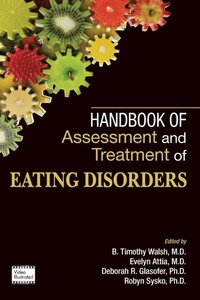
Handbook of Assessment and Treatment of Eating Disorders
Published on 8. December 2015
Book
Paperback/Softback
358 pages
978-1-58562-509-3 (ISBN)
Description
The recent publication of the revised Diagnostic and
Statistical Manual of Mental Disorders (DSM-5) has had a profound
impact on the classification of eating disorders, introducing changes that
were formalized after years of study by the Eating Disorders Work Group. The
Handbook of Assessment and Treatment of Eating Disorders is the
only book that provides clinicians with everything they need to know to
implement these changes in assessment, diagnosis, and treatment. After an
overview of feeding and eating disorders that systematically reviews the
changes from DSM-IV to DSM-5, some of the foremost scholars in each area
address eating disorders in adults, children and adolescents, and special
populations. Chapters on assessment and treatment, along with accompanying
videos, offer comprehensive, state-of-the-art coverage that will benefit
clinicians in practice, such as psychiatrists and psychotherapists, as well
as mental health trainees.
Clinicians will find the following features
and content especially useful:
* Five full chapters on assessment tools cover the evolution of
measures and instruments, from the primitive beginnings to the cutting edge
of new technological applications. The challenges of diagnosing feeding and
eating disorders in children and adolescents are also addressed.
*
Treatment chapters cover restrictive eating, including anorexia nervosa and
avoidant/restrictive food intake disorder, binge eating, including bulimia
nervosa and binge-eating disorder, and other eating problems, including
pica, rumination disorder, and night eating syndrome.
* One chapter
focuses on eating problems among men and boys, who have diverse
presentations, and the motivations and body image disturbances that may
differ from those typically found among females.
* Because attunement to
culturally and socially patterned characteristics of clinical presentation
is essential to an informed and accurate mental health assessment, an entire
chapter is devoted to clinical effectiveness in multicultural and
cross-cultural settings.
* Each chapter ends with key clinical points to
help readers focus on the most salient content, test comprehension, and
review for examinations.
Clinicians in both training and practice
will find the book's up-to-date, DSM-5-compatible content to be utterly
essential. The Handbook of Assessment and Treatment of Eating
Disorders belongs in the library of every mental health professional
practicing today.
Statistical Manual of Mental Disorders (DSM-5) has had a profound
impact on the classification of eating disorders, introducing changes that
were formalized after years of study by the Eating Disorders Work Group. The
Handbook of Assessment and Treatment of Eating Disorders is the
only book that provides clinicians with everything they need to know to
implement these changes in assessment, diagnosis, and treatment. After an
overview of feeding and eating disorders that systematically reviews the
changes from DSM-IV to DSM-5, some of the foremost scholars in each area
address eating disorders in adults, children and adolescents, and special
populations. Chapters on assessment and treatment, along with accompanying
videos, offer comprehensive, state-of-the-art coverage that will benefit
clinicians in practice, such as psychiatrists and psychotherapists, as well
as mental health trainees.
Clinicians will find the following features
and content especially useful:
* Five full chapters on assessment tools cover the evolution of
measures and instruments, from the primitive beginnings to the cutting edge
of new technological applications. The challenges of diagnosing feeding and
eating disorders in children and adolescents are also addressed.
*
Treatment chapters cover restrictive eating, including anorexia nervosa and
avoidant/restrictive food intake disorder, binge eating, including bulimia
nervosa and binge-eating disorder, and other eating problems, including
pica, rumination disorder, and night eating syndrome.
* One chapter
focuses on eating problems among men and boys, who have diverse
presentations, and the motivations and body image disturbances that may
differ from those typically found among females.
* Because attunement to
culturally and socially patterned characteristics of clinical presentation
is essential to an informed and accurate mental health assessment, an entire
chapter is devoted to clinical effectiveness in multicultural and
cross-cultural settings.
* Each chapter ends with key clinical points to
help readers focus on the most salient content, test comprehension, and
review for examinations.
Clinicians in both training and practice
will find the book's up-to-date, DSM-5-compatible content to be utterly
essential. The Handbook of Assessment and Treatment of Eating
Disorders belongs in the library of every mental health professional
practicing today.
Reviews / Votes
This book attempts to be useful to a diverse array ofpractitioners, both psychologists and psychiatrists. It's particularly
in-depth discussion about various psychotherapies and assessment measures
may make it more appropriate for psychologists, but it may be just as useful
for psychiatry residents wanting to explore the area of eating disorders
more. Sections on psychopharmacology, while possibly superficial, are also
helpful in an introductory sense. The discussion of the updated DSM
classification, including the reasons for such changes, was particularly
useful. Readers will likely find this book gives them a greater appreciation
for screening for and treating eating disorders, as well as making them feel
more comfortable treating such disorders. -- Michael Byrne, MD(Rush University Medical Center) * Doody *
More details
Language
English
Place of publication
VA
United States
Target group
Professional and scholarly
US School Grade: College Graduate Student and over
Product notice
Paperback (trade)
Illustrations
20 Figures; 27 Tables, unspecified
Dimensions
Height: 229 mm
Width: 152 mm
Thickness: 15 mm
Weight
585 gr
ISBN-13
978-1-58562-509-3 (9781585625093)
Copyright in bibliographic data and cover images is held by Nielsen Book Services Limited or by the publishers or by their respective licensors: all rights reserved.
Schweitzer Classification
Other editions
Additional editions
B. Timothy Walsh | Evelyn Attia | Deborah R. Glasofer
Handbook of Assessment and Treatment of Eating Disorders
E-Book
10/2015
1st Edition
American Psychiatric Association Publishing
€47.99
Available for download
Persons
B. Timothy Walsh, M.D., is Ruane Professor of
Pediatric Psychopharmacology in Psychiatry at Columbia University College of
Physicians and Surgeons, and Director of the Division of Clinical
Therapeutics at New York State Psychiatric Institute, New York, New
York.
Evelyn Attia, M.D., is Professor of Psychiatry at
Columbia University Medical Center, and Director of the Eating Disorders
Research Unit at New York State Psychiatric Institute, New York, New
York.
Deborah R. Glasofer, Ph.D., is Assistant Professor of
Clinical Psychology in Psychiatry at Columbia University College of
Physicians and Surgeons. Psychologist at the Eating Disorders Research Unit
at New York State Psychiatric Institute, New York, New York.
Robyn
Sysko, Ph.D., is Assistant Professor of Psychiatry at the Eating and
Weight Disorders Program in the Department of Psychiatry at the Icahn School
of Medicine at Mount Sinai, New York, New York.
Pediatric Psychopharmacology in Psychiatry at Columbia University College of
Physicians and Surgeons, and Director of the Division of Clinical
Therapeutics at New York State Psychiatric Institute, New York, New
York.
Evelyn Attia, M.D., is Professor of Psychiatry at
Columbia University Medical Center, and Director of the Eating Disorders
Research Unit at New York State Psychiatric Institute, New York, New
York.
Deborah R. Glasofer, Ph.D., is Assistant Professor of
Clinical Psychology in Psychiatry at Columbia University College of
Physicians and Surgeons. Psychologist at the Eating Disorders Research Unit
at New York State Psychiatric Institute, New York, New York.
Robyn
Sysko, Ph.D., is Assistant Professor of Psychiatry at the Eating and
Weight Disorders Program in the Department of Psychiatry at the Icahn School
of Medicine at Mount Sinai, New York, New York.
Content
Contributors
Foreword
Preface
Video Guide
PART I: Introduction
Chapter 1. Classification of Eating
Disorders
PART II: Evaluation and Diagnosis of Eating
Problems
Chapter 2. Eating Problems in Adults
Chapter 3. Eating
Problems in Children and Adolescents
Chapter 4. Eating Problems in
Individuals With Overweight and Obesity
Chapter 5. Assessment of Eating
Disorders and Problematic Eating Behavior in Bariatric Surgery
Patients
Chapter 6. Eating-Related Pathology in Men and Boys
Chapter
7. Eating Problems in Special Populations: CULTURAL CONSIDERATIONS
PART
III: Assessment Tools
Chapter 8. Assessment Measures, Then and Now: A
LOOK BACK AT SEMINAL MEASURES AND A LOOK FORWARD TO THE BRAVE NEW
WORLD
Chapter 9. Self-Report Assessments of Eating Pathology
Chapter
10. Use of the Eating Disorder Assessment for DSM-5
Chapter 11.
Diagnosis of Feeding and Eating Disorders in Children and Adolescents
Chapter 12. Application of Modern Technology in Eating Disorder
Assessment and Intervention
PART IV: Treatment
Chapter 13. Treatment
of Restrictive Eating and Low-Weight Conditions, Including Anorexia Nervosa
and Avoidant/ Restrictive Food Intake Disorder
Chapter 14. Treatment of
Binge Eating, Including Bulimia Nervosa and Binge-Eating
Disorder
Chapter 15. Treatment of Other Eating Problems, Including Pica
and Rumination
Index
Foreword
Preface
Video Guide
PART I: Introduction
Chapter 1. Classification of Eating
Disorders
PART II: Evaluation and Diagnosis of Eating
Problems
Chapter 2. Eating Problems in Adults
Chapter 3. Eating
Problems in Children and Adolescents
Chapter 4. Eating Problems in
Individuals With Overweight and Obesity
Chapter 5. Assessment of Eating
Disorders and Problematic Eating Behavior in Bariatric Surgery
Patients
Chapter 6. Eating-Related Pathology in Men and Boys
Chapter
7. Eating Problems in Special Populations: CULTURAL CONSIDERATIONS
PART
III: Assessment Tools
Chapter 8. Assessment Measures, Then and Now: A
LOOK BACK AT SEMINAL MEASURES AND A LOOK FORWARD TO THE BRAVE NEW
WORLD
Chapter 9. Self-Report Assessments of Eating Pathology
Chapter
10. Use of the Eating Disorder Assessment for DSM-5
Chapter 11.
Diagnosis of Feeding and Eating Disorders in Children and Adolescents
Chapter 12. Application of Modern Technology in Eating Disorder
Assessment and Intervention
PART IV: Treatment
Chapter 13. Treatment
of Restrictive Eating and Low-Weight Conditions, Including Anorexia Nervosa
and Avoidant/ Restrictive Food Intake Disorder
Chapter 14. Treatment of
Binge Eating, Including Bulimia Nervosa and Binge-Eating
Disorder
Chapter 15. Treatment of Other Eating Problems, Including Pica
and Rumination
Index