

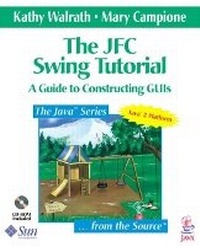
The JFC Swing Tutorial
A Guide to Constructing GUIs
Published on 23. July 1999
Book
Mixed media product
976 pages
978-0-201-43321-0 (ISBN)
Description
Developed and co-written by the lead writer on the Swing team, this book covers everything you need to know to write GUIs that use Swing components. The JFC Swing Tutorial uses a task-oriented, example-driven approach to introduce you to fundamental concepts and applications. Designed to be read either cover-to-cover or as a quick reference, this book explains how to use each Swing component, perform layout, do basic drawing, and convert 1.1 AWT programs to Swing. This book covers Swing 1.1.1.
An appendix lists the complete source code for dozens of example applications and applets. The CD-ROM includes Swing 1.1.1, JDK 1.1, the Java 2 Platform, and the hypertext version of all three Java Tutorial books.
An appendix lists the complete source code for dozens of example applications and applets. The CD-ROM includes Swing 1.1.1, JDK 1.1, the Java 2 Platform, and the hypertext version of all three Java Tutorial books.
More details
Language
English
Place of publication
Boston
United States
Publishing group
Pearson Education (US)
Target group
College/higher education
Dimensions
Width: 233 mm
Thickness: 44 mm
Weight
1488 gr
ISBN-13
978-0-201-43321-0 (9780201433210)
Copyright in bibliographic data and cover images is held by Nielsen Book Services Limited or by the publishers or by their respective licensors: all rights reserved.
Schweitzer Classification
Other editions
New editions
Book
03/2004
2nd Edition
Addison Wesley
€65.65
Article is exhausted; no reprint
Persons
Kathy Walrath is a senior technical writer on the Swing team at Sun Microsystems. After graduating from the University of California, Berkeley, with a B.S. in Electrical Engineering and Computer Science, Kathy wrote extensively about Unix, Mach, and NextStep. Since 1993, Kathy has been writing specifications and how-to guides for the Java platform. Mary Campione was formerly a senior technical writer at Sun Microsystems, where she started writing about the Java platform in 1995. Mary graduated from California Polytechnic, San Luis Obispo, with a B.S. in Computer Science and has worked as both a technical writer and programmer.
0201433214AB11062003
0201433214AB11062003
Content
GETTING STARTED WITH SWING.
1. About the JFC and Swing.
2. Compiling and Running Swing Programs.
3. Running Swing Applets.
4. A Quick Tour of a Swing Application's Code.
FEATURES AND CONCEPTS.
5. Components and the Containment Hierarchies.
6. Layout Management.
7. Event Handling.
8. Painting.
9. Threads and Swing.
10. More Swing Features and Concepts.
11. The Anatomy of a Swing-Based Program.
USING SWING COMPONENTS.
12. A Visual Index to Swing Components.
13. The JComponent Class.
14. Using Top-Level Containers.
15. Using Intermediate Swing Containers.
16. Using Atomic Components.
17. Solving Common Component Problems.
LAYING OUT COMPONENTS.
18. Using Layout Managers.
19. Creating a Custom Layout Manager.
20. Doing Without a Layout Manager (Absolute Positioning).
21. Solving Common Layout Problems.
USING OTHER SWING FEATURES.
WRITING EVENT LISTENERS.
22. Some Simple Event-Handling Examples.
23. General Rules for Writing Event Listeners.
24. Listeners Supported by Swing Components.
25. Implementing Listeners for Commonly Handled Events.
26. Summary of Listener API.
27. Solving Common Event-Handling Problems.
WORKING WITH GRAPHICS.
28. Overview of Custom Painting.
29. Using Graphics Primitives.
30. Using Images.
31. Performing Animation.
32. Solving Common Graphics Problems.
CONVERTING TO SWING.
33. Why to Convert.
34. How to Convert.
35. Conversion Resources.
36. Solving Common Conversion Problems.
Appendix A: Code Examples.
Appendix B: Reference.
Index. 0201433214T04062001
1. About the JFC and Swing.
2. Compiling and Running Swing Programs.
3. Running Swing Applets.
4. A Quick Tour of a Swing Application's Code.
FEATURES AND CONCEPTS.
5. Components and the Containment Hierarchies.
6. Layout Management.
7. Event Handling.
8. Painting.
9. Threads and Swing.
10. More Swing Features and Concepts.
11. The Anatomy of a Swing-Based Program.
USING SWING COMPONENTS.
12. A Visual Index to Swing Components.
13. The JComponent Class.
14. Using Top-Level Containers.
15. Using Intermediate Swing Containers.
16. Using Atomic Components.
17. Solving Common Component Problems.
LAYING OUT COMPONENTS.
18. Using Layout Managers.
19. Creating a Custom Layout Manager.
20. Doing Without a Layout Manager (Absolute Positioning).
21. Solving Common Layout Problems.
USING OTHER SWING FEATURES.
WRITING EVENT LISTENERS.
22. Some Simple Event-Handling Examples.
23. General Rules for Writing Event Listeners.
24. Listeners Supported by Swing Components.
25. Implementing Listeners for Commonly Handled Events.
26. Summary of Listener API.
27. Solving Common Event-Handling Problems.
WORKING WITH GRAPHICS.
28. Overview of Custom Painting.
29. Using Graphics Primitives.
30. Using Images.
31. Performing Animation.
32. Solving Common Graphics Problems.
CONVERTING TO SWING.
33. Why to Convert.
34. How to Convert.
35. Conversion Resources.
36. Solving Common Conversion Problems.
Appendix A: Code Examples.
Appendix B: Reference.
Index. 0201433214T04062001