

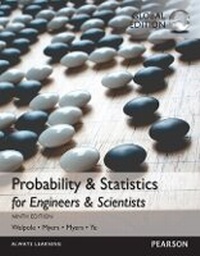
Probability & Statistics for Engineers & Scientists, Global Edition
9th Edition
Published on 26. August 2016
Book
Paperback/Softback
816 pages
978-1-292-16136-5 (ISBN)
Description
For junior/senior undergraduates taking probability and statistics as applied to engineering, science, or computer science.
This classic text provides a rigorous introduction to basic probability theory and statistical inference, with a unique balance between theory and methodology. Interesting, relevant applications use real data from actual studies, showing how the concepts and methods can be used to solve problems in the field. This revision focuses on improved clarity and deeper understanding.
This classic text provides a rigorous introduction to basic probability theory and statistical inference, with a unique balance between theory and methodology. Interesting, relevant applications use real data from actual studies, showing how the concepts and methods can be used to solve problems in the field. This revision focuses on improved clarity and deeper understanding.
More details
Edition
9th edition
Language
English
Place of publication
Harlow
United Kingdom
Target group
Professional and scholarly
Dimensions
Height: 234 mm
Width: 188 mm
Thickness: 30 mm
Weight
1216 gr
ISBN-13
978-1-292-16136-5 (9781292161365)
Copyright in bibliographic data and cover images is held by Nielsen Book Services Limited or by the publishers or by their respective licensors: all rights reserved.
Schweitzer Classification
Other editions
Additional editions
Ronald Walpole | Raymond Myers | Sharon Myers
Probability & Statistics for Engineers & Scientists, Global Edition
E-Book
10/2016
9th Edition
Pearson Education Limited
from
€59.39
Available for download
Previous edition
Ronald E. Walpole | Raymond H. Myers | Sharon L. Myers
Probability and Statistics for Engineers and Scientists: Pearson New International Edition
Book
07/2013
9th Edition
Pearson Education Limited
€66.84
Article exhausted; check for reprint
Content
1. Introduction to Statistics and Data Analysis
1.1 Overview: Statistical Inference, Samples, Populations, and the Role of Probability
1.2 Sampling Procedures; Collection of Data
1.3 Measures of Location: The Sample Mean and Median
Exercises
1.4 Measures of Variability
Exercises
1.5 Discrete and Continuous Data
1.6 Statistical Modeling, Scientific Inspection, and Graphical Methods
1.7 General Types of Statistical Studies: Designed Experiment, Observational Study, and Retrospective Study
Exercises
2. Probability
2.1 Sample Space
2.2 Events
Exercises
2.3 Counting Sample Points
Exercises
2.4 Probability of an Event
2.5 Additive Rules
Exercises
2.6 Conditional Probability, Independence and Product Rules
Exercises
2.7 Bayes' Rule
Exercises
Review Exercises
2.8 Potential Misconceptions and Hazards; Relationship to Material in Other Chapters
3. Random Variables and Probability Distributions
3.1 Concept of a Random Variable
3.2 Discrete Probability Distributions
3.3 Continuous Probability Distributions
Exercises
3.4 Joint Probability Distributions
Exercises
Review Exercises
3.5 Potential Misconceptions and Hazards; Relationship to Material in Other Chapters
4. Mathematical Expectation
4.1 Mean of a Random Variable
Exercises
4.2 Variance and Covariance of Random Variables
Exercises
4.3 Means and Variances of Linear Combinations of Random Variables
4.4 Chebyshev's Theorem
Exercises
Review Exercises
4.5 Potential Misconceptions and Hazards; Relationship to Material in Other Chapters
5. Some Discrete Probability Distributions
5.1 Introduction and Motivation
5.2 Binomial and Multinomial Distributions
Exercises
5.3 Hypergeometric Distribution
Exercises
5.4 Negative Binomial and Geometric Distributions
5.5 Poisson Distribution and the Poisson Process
Exercises
Review Exercises
5.6 Potential Misconceptions and Hazards; Relationship to Material in Other Chapters
6. Some Continuous Probability Distributions
6.1 Continuous Uniform Distribution
6.2 Normal Distribution
6.3 Areas under the Normal Curve
6.4 Applications of the Normal Distribution
Exercises
6.5 Normal Approximation to the Binomial
Exercises
6.6 Gamma and Exponential Distributions
6.7 Chi-Squared Distribution
6.8 Beta Distribution
6.9 Lognormal Distribution (Optional)
6.10 Weibull Distribution (Optional)
Exercises
Review Exercises
6.11 Potential Misconceptions and Hazards; Relationship to Material in Other Chapters
7. Functions of Random Variables (Optional)
7.1 Introduction
7.2 Transformations of Variables
7.3 Moments and Moment-Generating Functions
Exercises
8. Sampling Distributions and More Graphical Tools
8.1 Random Sampling and Sampling Distributions
8.2 Some Important Statistics
Exercises
8.3 Sampling Distributions
8.4 Sampling Distribution of Means and the Central Limit Theorem
Exercises
8.5 Sampling Distribution of S2
8.6 t-Distribution
8.8 Quantile and Probability Plots
Exercises
Review Exercises
8.9 Potential Misconceptions and Hazards; Relationship to Mate
1.1 Overview: Statistical Inference, Samples, Populations, and the Role of Probability
1.2 Sampling Procedures; Collection of Data
1.3 Measures of Location: The Sample Mean and Median
Exercises
1.4 Measures of Variability
Exercises
1.5 Discrete and Continuous Data
1.6 Statistical Modeling, Scientific Inspection, and Graphical Methods
1.7 General Types of Statistical Studies: Designed Experiment, Observational Study, and Retrospective Study
Exercises
2. Probability
2.1 Sample Space
2.2 Events
Exercises
2.3 Counting Sample Points
Exercises
2.4 Probability of an Event
2.5 Additive Rules
Exercises
2.6 Conditional Probability, Independence and Product Rules
Exercises
2.7 Bayes' Rule
Exercises
Review Exercises
2.8 Potential Misconceptions and Hazards; Relationship to Material in Other Chapters
3. Random Variables and Probability Distributions
3.1 Concept of a Random Variable
3.2 Discrete Probability Distributions
3.3 Continuous Probability Distributions
Exercises
3.4 Joint Probability Distributions
Exercises
Review Exercises
3.5 Potential Misconceptions and Hazards; Relationship to Material in Other Chapters
4. Mathematical Expectation
4.1 Mean of a Random Variable
Exercises
4.2 Variance and Covariance of Random Variables
Exercises
4.3 Means and Variances of Linear Combinations of Random Variables
4.4 Chebyshev's Theorem
Exercises
Review Exercises
4.5 Potential Misconceptions and Hazards; Relationship to Material in Other Chapters
5. Some Discrete Probability Distributions
5.1 Introduction and Motivation
5.2 Binomial and Multinomial Distributions
Exercises
5.3 Hypergeometric Distribution
Exercises
5.4 Negative Binomial and Geometric Distributions
5.5 Poisson Distribution and the Poisson Process
Exercises
Review Exercises
5.6 Potential Misconceptions and Hazards; Relationship to Material in Other Chapters
6. Some Continuous Probability Distributions
6.1 Continuous Uniform Distribution
6.2 Normal Distribution
6.3 Areas under the Normal Curve
6.4 Applications of the Normal Distribution
Exercises
6.5 Normal Approximation to the Binomial
Exercises
6.6 Gamma and Exponential Distributions
6.7 Chi-Squared Distribution
6.8 Beta Distribution
6.9 Lognormal Distribution (Optional)
6.10 Weibull Distribution (Optional)
Exercises
Review Exercises
6.11 Potential Misconceptions and Hazards; Relationship to Material in Other Chapters
7. Functions of Random Variables (Optional)
7.1 Introduction
7.2 Transformations of Variables
7.3 Moments and Moment-Generating Functions
Exercises
8. Sampling Distributions and More Graphical Tools
8.1 Random Sampling and Sampling Distributions
8.2 Some Important Statistics
Exercises
8.3 Sampling Distributions
8.4 Sampling Distribution of Means and the Central Limit Theorem
Exercises
8.5 Sampling Distribution of S2
8.6 t-Distribution
8.8 Quantile and Probability Plots
Exercises
Review Exercises
8.9 Potential Misconceptions and Hazards; Relationship to Mate