

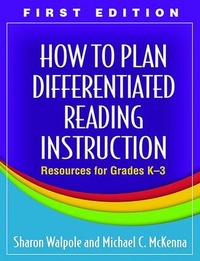
How to Plan Differentiated Reading Instruction, First Edition
Resources for Grades K-3
1st Edition
Published on 30. June 2009
Book
Paperback/Softback
177 pages
978-1-60623-264-4 (ISBN)
Description
Offering step-by-step guidance to simplify planning and decision making, this book reviews the basics of differentiated reading instruction and provides detailed, ready-to-use lesson plans and materials to help teachers hit the ground running. Teachers get everything they need to implement four types of instructional groups over multiple three-week cycles. For fluency, vocabulary, and comprehension, lessons are based on popular, inexpensive trade books. For phonemic awareness and word recognition, dozens of reproducibles are provided, all in a convenient large-size format. The book can be used on its own or as a complement to Differentiated Reading Instruction: Strategies for the Primary Grades, which offers a complete introduction to the authors' approach.
Reviews / Votes
"This is an ideal resource for primary-grade educators who know the importance of differentiated instruction but are still resorting to the one-size-fits-all approach to teaching, due to time constraints and other demands. How to Plan Differentiated Instruction provides a plethora of lesson plans, reproducibles, and assessments so that teachers can begin meeting their students' needs immediately. Readers will feel confident creating their own differentiated lessons after using these teacher-friendly model plans as guided practice."--Jodi Nichols, MEd, Instructional Leader and Reading Specialist, Garrett County (Maryland) Public Schools"Many of us struggle to put the literacy puzzle together. Even with a knowledge of best practices, it's a challenge to plan instruction that meets the needs of all our students. How to Plan Differentiated Reading Instruction is a comprehensive resource that clarifies the planning process and shows teachers how to use assessments to plan for differentiated instruction."--Jennifer Allen, MEd, literacy specialist, Waterville (Maine) Public Schools
"Walpole and McKenna have expertly responded to concerns of educators from the field to create this indispensable guide. Teachers will be refreshed by its user-friendly, common-sense approach. The strength of the book lies in its power to 'unpack' the authors' thinking about lesson planning, thus serving as a practical springboard for teachers as they provide for the literacy needs of every student."--Sonia Q. Cabell, MEd, research staff, Preschool Language and Literacy Lab, University of Virginia; former second-grade teacher and reading coach
"Based on their extensive experience in the design of early reading instruction and in professional development, Walpole and McKenna explain how to organize reading instruction in the primary grades to provide grade-level instruction in vocabulary and comprehension together with differentiated instruction in word recognition and fluency. To make this system work, teachers need systematic routines for word recognition instruction, and the book provides those routines with clear explanations. The book is a terrific resource in my literacy course focused on children with special needs; my students implement the lessons in the field as tier 2 instruction."--Charles A. MacArthur, PhD, School of Education, University of Delaware
More details
Series
Language
English
Place of publication
New York
United States
Target group
Professional and scholarly
Product notice
Paperback (UK-B)
Dimensions
Height: 267 mm
Width: 203 mm
Weight
409 gr
ISBN-13
978-1-60623-264-4 (9781606232644)
Copyright in bibliographic data and cover images is held by Nielsen Book Services Limited or by the publishers or by their respective licensors: all rights reserved.
Schweitzer Classification
Other editions
New editions
Sharon Walpole | Michael C. McKenna
How to Plan Differentiated Reading Instruction, Second Edition
Resources for Grades K-3
Book
08/2017
2nd Edition
Guilford Press
€41.00
Shipment within 15-20 days
Persons
Sharon Walpole, PhD, is Professor in the School of Education at the University of Delaware. She has extensive school-based experience designing and implementing tiered instructional programs. Dr. Walpole has also been involved in federally funded and other schoolwide reform projects. Her current work involves the design and effects of schoolwide reforms, particularly those involving literacy coaches. She has coauthored or coedited several other books with Michael C. McKenna, including How to Plan Differentiated Reading Instruction: Resources for Grades K-3 and The Literacy Coach's Handbook, Second Edition, and she is coauthor of The Building Blocks of Preschool Success with Katherine A. Beauchat and Katrin L. Blamey. Dr. Walpole is a recipient of the Early Career Award for Significant Contributions to Literacy Research and Education from the Literacy Research Association.
Michael C. McKenna, PhD, was Thomas G. Jewell Professor of Reading in the Curry School of Education at the University of Virginia until his death in 2016. He authored, coauthored, or edited more than 20 books, including Assessment for Reading Instruction, Third Edition; How to Plan Differentiated Reading Instruction, Second Edition: Resources for Grades K-3; and Organizing the Early Literacy Classroom; as well as over 100 articles, chapters, and technical reports on a range of literacy topics. Dr. McKenna also served as Series Editor, with Sharon Walpole, of The Essential Library of PreK-2 Literacy. His research was sponsored by the National Reading Research Center and the Center for the Improvement of Early Reading Achievement. He was a corecipient of the Edward B. Fry Book Award from the Literacy Research Association and the Award for Outstanding Academic Books from the American Library Association, and a member of the Reading Hall of Fame.
Michael C. McKenna, PhD, was Thomas G. Jewell Professor of Reading in the Curry School of Education at the University of Virginia until his death in 2016. He authored, coauthored, or edited more than 20 books, including Assessment for Reading Instruction, Third Edition; How to Plan Differentiated Reading Instruction, Second Edition: Resources for Grades K-3; and Organizing the Early Literacy Classroom; as well as over 100 articles, chapters, and technical reports on a range of literacy topics. Dr. McKenna also served as Series Editor, with Sharon Walpole, of The Essential Library of PreK-2 Literacy. His research was sponsored by the National Reading Research Center and the Center for the Improvement of Early Reading Achievement. He was a corecipient of the Edward B. Fry Book Award from the Literacy Research Association and the Award for Outstanding Academic Books from the American Library Association, and a member of the Reading Hall of Fame.
Content
1. What Do We Mean by Differentiated Reading Instruction?
2. Using Assessments to Plan Differentiated Reading Instruction
3. Targeting Phonological Awareness and Word Recognition
4. Targeting Word Recognition and Fluency
5. Targeting Fluency and Comprehension
6. Targeting Vocabulary and Comprehension
7. Making Differentiation Schoolwide
2. Using Assessments to Plan Differentiated Reading Instruction
3. Targeting Phonological Awareness and Word Recognition
4. Targeting Word Recognition and Fluency
5. Targeting Fluency and Comprehension
6. Targeting Vocabulary and Comprehension
7. Making Differentiation Schoolwide