

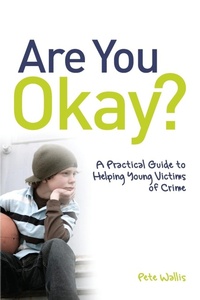
Are You Okay?
A Practical Guide to Helping Young Victims of Crime
Published on 15. May 2010
Book
Paperback/Softback
224 pages
978-1-84905-098-2 (ISBN)
Description
How do you spot the signs that a young person has been victimised? What do you do if you are approached by a young person who has been affected by crime or bullying? What is the impact of crime and how can you best aid the young person's recovery?
Are You Okay deals with these issues that many adults may face when trying to help a young person in their care in the aftermath of a crime. It provides detailed information on the different types of crime from assault and hate crime to cyberbullying and sexual abuse, and explores how they may affect the young person in different ways. The author also addresses difficult issues such as dealing with fears of retaliation, confidentiality and whether a crime should be reported, the grey area between crime and bullying and how best to assess the young person's needs.
This accessible guide will be essential reading for anyone working with children and young people aged 8+, including social workers, youth workers, teachers, police, education welfare officers and victim support and witness service workers.
a
Are You Okay deals with these issues that many adults may face when trying to help a young person in their care in the aftermath of a crime. It provides detailed information on the different types of crime from assault and hate crime to cyberbullying and sexual abuse, and explores how they may affect the young person in different ways. The author also addresses difficult issues such as dealing with fears of retaliation, confidentiality and whether a crime should be reported, the grey area between crime and bullying and how best to assess the young person's needs.
This accessible guide will be essential reading for anyone working with children and young people aged 8+, including social workers, youth workers, teachers, police, education welfare officers and victim support and witness service workers.
a
Reviews / Votes
I found this an accessible, easily readable and practical book. -- BASPCAN News The use of case studies and subheading makes this book easy to use. It is simple to find what you need and it covers a wide range of areas from identifying children at risk, the range of crimes, the legal points and how to help. There is also a range of references and resources to allow the reader to gain further insight into each area. For anyone working with children, this book will be well thumbed and well read. -- The SL Journal It is clear that we need to do more to help children who have been victims of crime. This book will enable people to do exactly that - help people get started with some tried and tested advice and techniques to help young victims. -- Sara Payne, Victims' Champion This book provides a practical guide to supporting young people who have been victims of crime; from assault, bullying and robbery to sexual and physical abuse. The statistics used helpfully contextualise the young people's experiences, but most useful are the case studies showing how crimes against children can be dealt with effectively... The information is presented clearly without oversimplifying what are often complex issues, and without dichotomising "victims" and "offenders". Although aimed at practitioners, policy makers would do well to learn from this book as they look to reform the youth justice system, taking note of the need for early intervention and the use of restorative justice. -- Children & Young People NowMore details
Language
English
Place of publication
London
United Kingdom
Target group
Professional and scholarly
Product notice
Paperback (UK-trade)
Illustrations
6
Dimensions
Height: 229 mm
Width: 152 mm
Thickness: 12 mm
Weight
335 gr
ISBN-13
978-1-84905-098-2 (9781849050982)
Copyright in bibliographic data and cover images is held by Nielsen Book Services Limited or by the publishers or by their respective licensors: all rights reserved.
Schweitzer Classification
Persons
Pete Wallis is Senior Practitioner (Restorative Justice) for Oxfordshire Youth Offending Service UK and a founding member of the charity SAFE! Support for young people affected by crime. He has written and co-written several books on restorative justice and related topics for JKP. Pete Wallis is Senior Practitioner (Restorative Justice) for Oxfordshire Youth Offending Service UK and a founding member of the charity SAFE! Support for young people affected by crime. He has written and co-written several books on restorative justice and related topics for JKP.
Content
Acknowledgements. Introduction. Key Concepts: Protective Behaviours and Restorative Approaches. Part 1. 'What happened?' The crimes and their consequences. 1. The crimes. 2. Indirect victimization or 'hidden harm'. 3. Understanding the effects of crime and recognizing the signs. Part 2. 'You are not alone' stepping in to help. 4. Raising the issue and responding well. 5. Assessment, confidentiality and reporting. Part 3. 'What will happen now?' The criminal justice system. 6. A swift navigation through the criminal justice system. 7. Restorative approaches. 8. The overlap between offending and victimization. 9. Next steps. Conclusion. Resources. Index.