

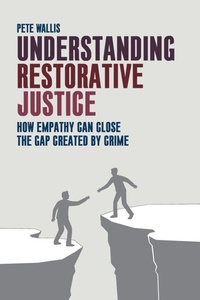
Understanding Restorative Justice
How Empathy Can Close the Gap Created by Crime
1st Edition
Published on 11. July 2014
Book
Paperback/Softback
224 pages
978-1-4473-1742-5 (ISBN)
Description
This unique book is a clear and detailed introduction that analyses how restorative justice nurtures empathy, exploring key themes such as responsibility, shame, forgiveness and closure.
The core notion of the book is that when a crime is committed, it separates people, creating a 'gap'. This can only be reduced or closed through information and insight about the other person, which have the potential to elicit empathy and compassion from both sides. The book explores this extraordinary journey from harm to healing using the structure of a timeline: from an offence, through the criminal justice process and into the heart of the restorative meeting.
Using case studies, the book offers a fresh angle on a topic that is of growing interest both in the UK and internationally. It is ideal as a comprehensive introduction for those new to restorative justice and as a best practice guide for existing practitioners.
The core notion of the book is that when a crime is committed, it separates people, creating a 'gap'. This can only be reduced or closed through information and insight about the other person, which have the potential to elicit empathy and compassion from both sides. The book explores this extraordinary journey from harm to healing using the structure of a timeline: from an offence, through the criminal justice process and into the heart of the restorative meeting.
Using case studies, the book offers a fresh angle on a topic that is of growing interest both in the UK and internationally. It is ideal as a comprehensive introduction for those new to restorative justice and as a best practice guide for existing practitioners.
Reviews / Votes
"A compelling, honest and moving book which will make a huge contribution to the field." Belinda Hopkins, Transforming Conflict "A well-researched, original and welcome contribution to the growing literature on restorative justice, focusing on the development of empathy to gradually reveal the layers of the restorative process." Marian Liebmann, OBE, Independent Restorative Justice Trainer and ConsultantMore details
Edition
First Edition
Language
English
Place of publication
Bristol
United Kingdom
Publishing group
Bristol University Press
Target group
College/higher education
Illustrations
22 s/w Abbildungen, 1 s/w Tabelle, 21 s/w Zeichnungen
21 Line drawings, black and white; 1 Tables, black and white; 22 Illustrations, black and white
Dimensions
Height: 234 mm
Width: 156 mm
Thickness: 13 mm
Weight
348 gr
ISBN-13
978-1-4473-1742-5 (9781447317425)
Copyright in bibliographic data and cover images is held by Nielsen Book Services Limited or by the publishers or by their respective licensors: all rights reserved.
Schweitzer Classification
Other editions
Additional editions
E-Book
07/2014
1st Edition
Policy Press
€25.49
Available for download
E-Book
07/2014
1st Edition
Policy Press
€104.19
Available for download
Person
Pete Wallis is the senior practitioner in restorative justice for Oxfordshire Youth Offending Service. He has facilitated hundreds of restorative meetings and written or co-authored several books and articles on the subject. In 2011 he set up a charity to support young crime victims, and he is a consultant for the new Restorative Services Quality Mark.
Content
Introduction
Part One: Empathy Level Zero: Hurting;
Crime and unhappiness;
The gap caused by crime;
Part Two: Empathy Level One: Seeing;
Entering the criminal justice system;
Into the criminal courts;
Part Three: Empathy Level Two: Voicing;
Unripe restorative justice;
Restorative enquiry;
The keys and blocks to restorative justice;
Choice, encouragement or coercion?;
Part Four: Empathy Level Three: Hearing;
Indirect restorative justice;
The restorative meeting;
Part Five: Empathy Level Four: Helping;
'Doing sorry';
Does it always go so well?;
Part Six: Empathy Level Five: Healing;
Into the heart of restorative justice;
Conclusion.
Part One: Empathy Level Zero: Hurting;
Crime and unhappiness;
The gap caused by crime;
Part Two: Empathy Level One: Seeing;
Entering the criminal justice system;
Into the criminal courts;
Part Three: Empathy Level Two: Voicing;
Unripe restorative justice;
Restorative enquiry;
The keys and blocks to restorative justice;
Choice, encouragement or coercion?;
Part Four: Empathy Level Three: Hearing;
Indirect restorative justice;
The restorative meeting;
Part Five: Empathy Level Four: Helping;
'Doing sorry';
Does it always go so well?;
Part Six: Empathy Level Five: Healing;
Into the heart of restorative justice;
Conclusion.