

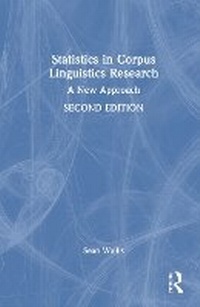
Statistics in Corpus Linguistics Research
A New Approach
2nd Edition
Will be published approx. on 20. March 2026
Book
Hardback
454 pages
978-1-041-03187-1 (ISBN)
Description
Traditional approaches focused on significance tests have often been difficult for linguistics researchers to visualise. Statistics in Corpus Linguistics Research: A New Approach breaks significance tests down for researchers in corpus linguistics and linguistic analysis, promoting a visual approach to understanding the performance of tests with real data, and demonstrating how to derive new confidence intervals and tests.
This fully-revised second edition includes a brand-new chapter describing a novel extended 'MOVER' method to derive accurate confidence intervals for numerous properties. With sample datasets and easy-to-read visuals, this book focuses on practical issues, such as how to:
* pose meaningful research questions in terms of choice and constraint;
* employ confidence intervals correctly (including in graph plots);
* select a significance test (and interpret its results);
* construct confidence intervals for functions of independent proportions;
* measure the size of the effect of one variable on another or the similarity between two distributions; and
* evaluate whether the results of two experiments significantly differ.
Appropriate for anyone from the student just beginning their career to the seasoned researcher, this book is both a practical overview and valuable resource.
A website with downloadable resources for the calculations in this book is published at https://corplingstats.wordpress.com/siclr.
This fully-revised second edition includes a brand-new chapter describing a novel extended 'MOVER' method to derive accurate confidence intervals for numerous properties. With sample datasets and easy-to-read visuals, this book focuses on practical issues, such as how to:
* pose meaningful research questions in terms of choice and constraint;
* employ confidence intervals correctly (including in graph plots);
* select a significance test (and interpret its results);
* construct confidence intervals for functions of independent proportions;
* measure the size of the effect of one variable on another or the similarity between two distributions; and
* evaluate whether the results of two experiments significantly differ.
Appropriate for anyone from the student just beginning their career to the seasoned researcher, this book is both a practical overview and valuable resource.
A website with downloadable resources for the calculations in this book is published at https://corplingstats.wordpress.com/siclr.
More details
Edition
2nd edition
Language
English
Place of publication
London
United Kingdom
Publishing group
Taylor & Francis Ltd
Target group
College/higher education
Postgraduate
Product notice
Laminated cover
Illustrations
132 s/w Zeichnungen, 142 s/w Abbildungen, 10 s/w Photographien bzw. Rasterbilder
132 Line drawings, black and white; 10 Halftones, black and white; 142 Illustrations, black and white
Dimensions
Height: 235 mm
Width: 157 mm
Thickness: 32 mm
Weight
890 gr
ISBN-13
978-1-041-03187-1 (9781041031871)
Copyright in bibliographic data and cover images is held by Nielsen Book Services Limited or by the publishers or by their respective licensors: all rights reserved.
Schweitzer Classification
Other editions
Additional editions
E-Book
03/2026
2nd Edition
Routledge
€55.49
Not yet available
Book
approx. 03/2026
2nd Edition
Routledge
€52.50
Not yet published
E-Book
03/2026
2nd Edition
Routledge
€55.49
Available for download
Previous edition

Book
11/2020
1st Edition
Routledge
€193.50
Shipment within 10-20 days
Person
Sean Wallis is Principal Research Fellow and Deputy Director of the Survey of English Usage at UCL.
Content
Preface Acknowledgments A Note on Terminology and Notation PART 1: Motivations 1 What Might Corpora Tell Us About Language? PART 2: Designing Experiments With Corpora 2 The Idea of Corpus Experiments 3 That Vexed Problem of Choice 4 Choice Versus Meaning 5 Balanced Samples and Imagined Populations PART 3: Confidence Intervals and Significance Tests 6 Introducing Inferential Statistics 7 Plotting With Confidence 8 From Intervals to Tests 9 An Algebra of Intervals 10 Competition Between Choices Over Time 11 The Replication Crisis and the New Statistics 12 Choosing the Right Test PART 4: Effect Sizes and Meta-Tests 13 The Size of an Effect 14 Meta- Tests for Comparing Tables of Results PART 5: Statistical Solutions for Corpus Samples 15 Conducting Research With Imperfect Data 16 Adjusting Intervals for Random-Text Samples PART 6: Concluding Remarks 17 Plotting the Wilson Distribution 18 In Conclusion Appendix A The Interval Equality Principle Appendix B Pseudo-Code for Computational Procedures Glossary References Index