

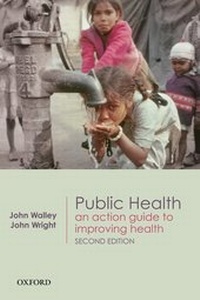
Public Health
An action guide to improving health
2nd Edition
Published on 14. January 2010
Book
Paperback/Softback
376 pages
978-0-19-923893-4 (ISBN)
Description
Many of the health problems in the developing world can be tackled or prevented through public health measures such as essential health care, improved living conditions, water, sanitation, nutrition, immunization, and the adoption of healthy lifestyles. Public Health is an action guide to improving public/community health, with a particular focus on low-middle income countries. It explains public health approaches to developing effective health services and preventive programmes.
This Second Edition contains real examples, illustrations and case histories to bring an important subject to life for the reader. The book covers the essential clinical services and preventive programmes including those for TB, HIV/AIDS, malaria, diarrhoeal diseases and the integrated management of childhood and adult illnesses. Practical methods are given for assessing health needs and working with communities to develop health services, and the development of hospital, health centre, and community health services, particularly mother, neonatal and child health services are explained. Additionally gender, social and economic influences on communities' health are explored.
The clear language that is used throughout the book to describe the key public health skills (such as epidemiology, managing medicines, communicable and non communicable disease control, health financing, and implementing health services and programmes), will be accessible and highly valuable to doctors, community nurses, and other health professionals, whether in training or in practice as health officers and mangers of health services and programmes.
This Second Edition contains real examples, illustrations and case histories to bring an important subject to life for the reader. The book covers the essential clinical services and preventive programmes including those for TB, HIV/AIDS, malaria, diarrhoeal diseases and the integrated management of childhood and adult illnesses. Practical methods are given for assessing health needs and working with communities to develop health services, and the development of hospital, health centre, and community health services, particularly mother, neonatal and child health services are explained. Additionally gender, social and economic influences on communities' health are explored.
The clear language that is used throughout the book to describe the key public health skills (such as epidemiology, managing medicines, communicable and non communicable disease control, health financing, and implementing health services and programmes), will be accessible and highly valuable to doctors, community nurses, and other health professionals, whether in training or in practice as health officers and mangers of health services and programmes.
Reviews / Votes
Review from previous edition The authors tackle the daunting field of public health with verve and intelligence... a very practical and readable work... a reliable and realistic introduction to the subject of helping to improve the health of all our communities. * Tropical Doctor *More details
Edition
2nd Revised edition
Language
English
Place of publication
Oxford
United Kingdom
Target group
Professional and scholarly
College/higher education
Health workers in developing countries, including undergraduate medical students, district medical officers, health programme officers; community and public health nurses and environmental health officers.
Edition type
Revised edition
Illustrations
Various black and white line drawings and halftones
Various black and white line drawings and halftones
Dimensions
Height: 246 mm
Width: 172 mm
Thickness: 19 mm
Weight
643 gr
ISBN-13
978-0-19-923893-4 (9780199238934)
Copyright in bibliographic data and cover images is held by Nielsen Book Services Limited or by the publishers or by their respective licensors: all rights reserved.
Schweitzer Classification
Other editions
Previous edition
John Walley | John Wright | John Hubley
Public Health
An Action Guide to Improving Health in Developing Countries
Book
10/2001
Oxford University Press
€54.47
Article exhausted; check for reprint
Persons
John Walley practiced medicine in the UK until 1984 when he became a provincial Medical Officer of Health in Zimbabwe, where he implemented Mother and child health and PHC-community health worker projects in several districts. Following his MPH and Membership of the Faculty of Public Health Medicine, he became a health programme manager in a region of Ethiopia, developing integrated MCH/ family planning, TB and HIV services. From 1990-93 he was a Consultant for the Global AIDS Control Programme in Geneva and Malawi, and then a Health Training Adviser at the Ministry of Health, Vietnam. He is a co-director of a 7 country communicable disease research programme called COMDIS. His research and development work in recent years has been on TB, HIV and malaria.
John Wright is a clinical epidemiologist and deputy medical director of Bradford Teaching Hospitals Trust. He has a background in hospital medicine and public health in the UK and in Africa. He has been working in Bradford since 1996 and is Visiting Professor in Clinical Epidemiology at the Universities of York, Leeds and Bradford. He worked in a rural hospital in Swaziland with his wife Helen in the 1990's and subsequently continued to maintain close professional and personal links, establishing a strong programme of international health development particularly in the fields of HIV/AIDS and TB. He is the Director of the Bradford Institute for Health and has established and leads the Born in Bradford cohort study which is following the lives of 10,000 children born in the city between 2007-10 to determine the genetic, lifestyle and environmental influence on health and well-being.
John Wright is a clinical epidemiologist and deputy medical director of Bradford Teaching Hospitals Trust. He has a background in hospital medicine and public health in the UK and in Africa. He has been working in Bradford since 1996 and is Visiting Professor in Clinical Epidemiology at the Universities of York, Leeds and Bradford. He worked in a rural hospital in Swaziland with his wife Helen in the 1990's and subsequently continued to maintain close professional and personal links, establishing a strong programme of international health development particularly in the fields of HIV/AIDS and TB. He is the Director of the Bradford Institute for Health and has established and leads the Born in Bradford cohort study which is following the lives of 10,000 children born in the city between 2007-10 to determine the genetic, lifestyle and environmental influence on health and well-being.
Editor
Professor of International Public Health, Nuffield Centre for International Health and Development, Institute of Health Sciences, University of Leeds, Leeds, UK
Professor of Clinical Epidemiology, Bradford Teaching Hospitals NHS Trust, Bradford and Professor of Clinical Epidemiology, University of Bradford, UK
Content
1. Public Health and the burden of disease ; 2. Public Health interventions ; 3. Epidemiology in practice ; 4. Assessing health needs ; 5. Choosing the best Public Health interventions ; 6. Planning, implementing and managing interventions ; 7. Understanding and using health economics and financing ; 8. Health promotion ; 9. Health policy and systems ; 10. Developing a district health care service ; 11. Maternal neonatal and child health ; 12. Essential drugs ; 13. Communicable disease control principles and toolkit ; 14. Controlling major communicable diseases ; 15. Non-communicable diseases ; 16. Quality control, safety and better practice ; 17. Future trends in global public health