

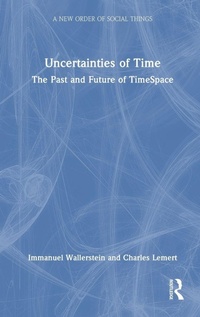
Uncertainties of Time
The Past and Future of TimeSpace
1st Edition
Will be published approx. on 20. March 2026
Book
Hardback
328 pages
978-1-041-08499-0 (ISBN)
Description
Examining the concept of TimeSpace in the work of Immanuel Wallerstein and its crucial role within world-systems analysis, Uncertainties of Time brings together important but previously hard-to-access material from Wallerstein's writings.
TimeSpace is a concept developed from Wallerstein's earliest days in the 1970s until well-into the twenty-first century, drawing from the historian Fernand Braudel and the chemist Ilya Prigogine, to rethink historical time's two overlooked modes-long enduring or eternal time, on the one hand, and, on the other, uncertainty in world-systems. He, thereby, invented a fresh innovation of historical social sciences that brought together economics, politics, and sociology.
This book is an essential volume for understanding Wallerstein's unique contributions to the understanding of the Modern World-System, which he argued came to an end after the world revolution of 1968-leaving us now in an indeterminate world of chaos. This book is thereby invaluable as a resource for researchers and students who care about the history and decline of our chaotic world.
TimeSpace is a concept developed from Wallerstein's earliest days in the 1970s until well-into the twenty-first century, drawing from the historian Fernand Braudel and the chemist Ilya Prigogine, to rethink historical time's two overlooked modes-long enduring or eternal time, on the one hand, and, on the other, uncertainty in world-systems. He, thereby, invented a fresh innovation of historical social sciences that brought together economics, politics, and sociology.
This book is an essential volume for understanding Wallerstein's unique contributions to the understanding of the Modern World-System, which he argued came to an end after the world revolution of 1968-leaving us now in an indeterminate world of chaos. This book is thereby invaluable as a resource for researchers and students who care about the history and decline of our chaotic world.
Reviews / Votes
"This book gets to the core of not only social theory, but the foundations of any historical social science. How we theorize and conceptualize time is foundational for any understanding of the social world, and this is a seminal text that wrestles with the final statement of such an important and eminent scholar."Kristin Plys, Associate Professor of Sociology and History, University of Toronto
"Wallerstein's work continues to generate significant interest, yet his conception of TimeSpace remains an overlooked dimension of his thought. This book offers a valuable guide not only to Wallerstein's broader intellectual contributions but also to the pivotal role this concept played in the evolution of World-Systems Analysis and his vision for the social sciences."
Sam Han, Lecturer in Sociology, University of Bristol
More details
Series
Language
English
Place of publication
London
United Kingdom
Publishing group
Taylor & Francis Ltd
Target group
College/higher education
Professional and scholarly
Academic and Undergraduate Advanced
Dimensions
Height: 240 mm
Width: 161 mm
Thickness: 20 mm
Weight
605 gr
ISBN-13
978-1-041-08499-0 (9781041084990)
Copyright in bibliographic data and cover images is held by Nielsen Book Services Limited or by the publishers or by their respective licensors: all rights reserved.
Schweitzer Classification
Other editions
Additional editions
Book
approx. 03/2026
1st Edition
Routledge
€65.30
Not yet published
E-Book
03/2026
Routledge
€55.49
Available for download
E-Book
03/2026
Routledge
€55.49
Available for download
Persons
Immanuel Wallerstein was Senior Research Fellow in Sociology at Yale from 2000 until his death in 2019. From 1976 to 1999, he was Distinguished Professor of Sociology at Binghamton University (SUNY), where he founded and directed the Fernand Braudel Center for the Study of Economies, Historical Systems, and Civilizations. Wallerstein was recognized for his brilliance the world-over. His many books and countless articles have been translated into dozens of languages. Of them his world-renowned four-volume history of The Modern World-System is a masterful examination of the Western world from 1500 to the modern era. He is now and will be for time to come considered by many the most influential social scientist of his era.
Charles Lemert is University Professor Emeritus at Wesleyan University, USA. He has written extensively on social theory, globalization, and culture. Among more than fifty books, he is author of Muhammad Ali: Trickster in the Culture of Irony (2003), Postmodernism is Not What You Think (2005), Globalization: An Introduction to the End of the Known World (2015), and editor of Social Theory: The Multicultural, Global, and Classic Readings (2021). His recent books include Americans Thinking America and Silence and Society (both 2025).
Charles Lemert is University Professor Emeritus at Wesleyan University, USA. He has written extensively on social theory, globalization, and culture. Among more than fifty books, he is author of Muhammad Ali: Trickster in the Culture of Irony (2003), Postmodernism is Not What You Think (2005), Globalization: An Introduction to the End of the Known World (2015), and editor of Social Theory: The Multicultural, Global, and Classic Readings (2021). His recent books include Americans Thinking America and Silence and Society (both 2025).
Content
1. TimeSpace and the Withering of World Structures (2025), Charles Lemert; Part I: Time and Global Spaces; 2. SpaceTime as the Basis of Knowledge (1997); 3. The Inventions of TimeSpace Realities (1988); 4. The Time of Space and the Space of Time: The Future of Social Science (1998); Part II: New Geopolitical Realities: 1946-1968; 5. On Progress and Transition (1983); 6. Social Change: Change is Eternal, Nothing Ever Changes (1999); 7. Time and Duration: The Unexcluded Middle or Reflections on Braudel & Prigogine (1998); Part III: The Unraveling of the Modern World-System: 1968-1989; 8. 1968, Revolution in the World-System (1989); 9. America and the World: Today, Yesterday, and Tomorrow (1989); 10. 1989, The Continuation of 1968 (1992), with Giovanni Arrighi & Terrance Hopkins; Part IV: TimeSpace and Future Social Sciences: After 1998; 11. The Rise and Future Demise of the Capitalist System (1974); 12. The Imminent End of Capitalism and Unifying Social Sciences (2008); 13. Historical Origins of World-Systems Analysis (2004); Part V: Conclusion: What Future?; 14. The Dilemmas of Open Space (2004); 15. Precipitate Decline and the Advent of Multipolarity (2007); 16. Global Possibilities, 1990-2025 (1996); 17. Wither the TimeSpace of Politics (2025), Charles Lemert