

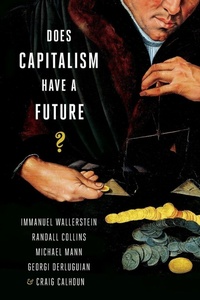
Does Capitalism Have a Future?
Published on 19. December 2013
Book
Paperback/Softback
208 pages
978-0-19-933085-0 (ISBN)
Description
The Great Recession has prompted a reassessment of the specific mode of capitalist accumulation that achieved dominance in the era of globalization. Yet just about all of this literature has focused on one of two issues: why things went wrong, and what we need to do in order to return the system to stability. Outside of a contingent of radical socialists on the fringes of the debate, virtually no one questioned whether capitalism could continue. In Does Capitalism Have a Future?, the prominent theorist Georgi Derleugian has gathered together a quintet of eminent macrosociologists to assess whether the capitalist system can survive.
The prevalent common wisdom, for all its current gloom, nevertheless safely assumes that capitalism cannot break down permanently because there is no alternative. The authors shatter this assumption, arguing that this generalization is not supported by theory but is rather an outgrowth of the optimistic nineteenth-century claim that human history ascends through stages to an enlightened equilibrium of liberal capitalism. Yet as they point out, just about all major historical systems have broken down in the end (e.g., the Roman empire). In the modern epoch there have been several cataclysmic events-notably the French revolution, World War I, and the collapse of the Soviet bloc--that came to pass mainly because contemporary political elites had spectacularly failed to calculate the consequences of the processes they presumed to govern. At present, none of our governing elites and very few of our intellectuals can fathom an ending to our current reigning system. Considering whether a collapse is possible is the task that the quintet--Derleugian, Michael Mann, Randall Collins, Craig Calhoun, and Immanuel Wallerstein--sets out to explore. While all of the contributors arrive at different conclusions, they are in constant dialogue with each other and therefore able to construct relatively seamless--if open-ended--whole. For instance, Wallerstein (who accurately predicted the collapse of the Soviet system in 1979) and Collins, identify fatal structural faults in twenty-first century capitalism. Mann, on the other hand, does not think that there is any serious alternative to the market dynamic, but he does identify other serious threats to the system, including environmental degradation. Calhoun and Derluguian are more circumspect and focus on the role of politics in steering the system toward either revival or collapse.
This most ambitious of books, written by the highest caliber of sociologists, asks the biggest of questions: are we on the cusp of a radical world historical shift or not?
The prevalent common wisdom, for all its current gloom, nevertheless safely assumes that capitalism cannot break down permanently because there is no alternative. The authors shatter this assumption, arguing that this generalization is not supported by theory but is rather an outgrowth of the optimistic nineteenth-century claim that human history ascends through stages to an enlightened equilibrium of liberal capitalism. Yet as they point out, just about all major historical systems have broken down in the end (e.g., the Roman empire). In the modern epoch there have been several cataclysmic events-notably the French revolution, World War I, and the collapse of the Soviet bloc--that came to pass mainly because contemporary political elites had spectacularly failed to calculate the consequences of the processes they presumed to govern. At present, none of our governing elites and very few of our intellectuals can fathom an ending to our current reigning system. Considering whether a collapse is possible is the task that the quintet--Derleugian, Michael Mann, Randall Collins, Craig Calhoun, and Immanuel Wallerstein--sets out to explore. While all of the contributors arrive at different conclusions, they are in constant dialogue with each other and therefore able to construct relatively seamless--if open-ended--whole. For instance, Wallerstein (who accurately predicted the collapse of the Soviet system in 1979) and Collins, identify fatal structural faults in twenty-first century capitalism. Mann, on the other hand, does not think that there is any serious alternative to the market dynamic, but he does identify other serious threats to the system, including environmental degradation. Calhoun and Derluguian are more circumspect and focus on the role of politics in steering the system toward either revival or collapse.
This most ambitious of books, written by the highest caliber of sociologists, asks the biggest of questions: are we on the cusp of a radical world historical shift or not?
Reviews / Votes
Finally, a book that will make a difference! Five eminent scholars put together their collective wisdom and their many disagreements to open up a free-wheeling conversation on one of the most important questions of our time: the future of this economic system we call capitalism. This should be mandatory reading for every college student in the world, not because it furnishes the answers but because it opens up all the most important questions. * David Harvey * Does Capitalism Have a Future is the work of five eminent big-picture thinkers. Their rich analysis of capitalism's contradictions and vision of possibilities for its future evolution are well worth pondering. * Francis Fukuyama *More details
Language
English
Place of publication
New York
United States
Target group
College/higher education
Professional and scholarly
Dimensions
Height: 234 mm
Width: 156 mm
Thickness: 12 mm
Weight
313 gr
ISBN-13
978-0-19-933085-0 (9780199330850)
Copyright in bibliographic data and cover images is held by Nielsen Book Services Limited or by the publishers or by their respective licensors: all rights reserved.
Schweitzer Classification
Other editions
Additional editions
Immanuel Wallerstein | Randall Collins | Michael Mann
Does Capitalism Have a Future?
Book
01/2014
Oxford University Press Inc
€225.20
Shipment within 15-20 days
Immanuel Wallerstein | Randall Collins | Michael Mann
Does Capitalism Have a Future?
E-Book
10/2013
1st Edition
OUP USA
€22.99
Available for download
Immanuel Wallerstein | Randall Collins | Michael Mann
Does Capitalism Have a Future?
E-Book
10/2013
1st Edition
OUP eBook
€22.99
Available for download
Persons
Immanuel Wallerstein is Senior Research Scholar at Yale and founder of the Fernand Braudel Center at Binghamton University.
Randall Collins is Dorothy Swaine Thomas Professor of Sociology University of Pennsylvania and former President of American Sociological Association.
Michael Mann teaches sociology at UCLA.
Georgi Derluguian teaches Social Research and Public Policy at New York University Abu Dhabi.
Craig Calhoun is Director of the London School of Economics.
Randall Collins is Dorothy Swaine Thomas Professor of Sociology University of Pennsylvania and former President of American Sociological Association.
Michael Mann teaches sociology at UCLA.
Georgi Derluguian teaches Social Research and Public Policy at New York University Abu Dhabi.
Craig Calhoun is Director of the London School of Economics.
Editor
Senior Research ScholarSenior Research Scholar, Yale University
Dorothy Swaine Thomas Professor of SociologyDorothy Swaine Thomas Professor of Sociology, Univeristy of Pennsylvania
Sociology LecturerSociology Lecturer, UCLA
Associate Professor of Social ResearchAssociate Professor of Social Research, NYU - Abu Dhabi
DirectorDirector, London School of Economics
Content
COLLECTIVE INTRODUCTION: "THE NEXT BIG TURN" ; 1. IMMANUEL WALLERSTEIN, "STRUCTURAL CRISIS, OR WHY CAPITALISTS MAY NO LONGER FIND CAPITALISM REWARDING" ; 2. RANDALL COLLINS, "THE END OF MIDDLE-CLASS WORK: NO MORE ESCAPES" ; 3. MICHAEL MANN, "THE END MAY BE NIGH, BUT FOR WHOM?" ; 4. GEORGI DERLUGUIAN, "WHAT COMMUNISM WAS" ; 5. CRAIG CALHOUN, "WHAT THREATENS CAPITALISM NOW?" ; COLLECTIVE CONCLUSION: "GETTING REAL"