

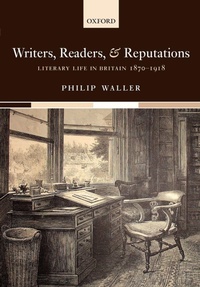
Writers, Readers, and Reputations
Literary Life in Britain 1870-1918
Published on 15. May 2008
Book
Paperback/Softback
1194 pages
978-0-19-954120-1 (ISBN)
Description
Charles Dickens died in 1870, the same year in which universal elementary education was introduced. During the following generation a mass reading public emerged, and the term 'best-seller' was coined. In new and cheap editions Dickens's stories sold hugely, but these were progressively outstripped in quantity by the likes of Hall Caine and Marie Corelli, Charles Garvice and Nat Gould. Who has now heard of these writers? Yet Hall Caine, for one, boasted of having made more money from his pen than any previous author.
This book presents a panoramic view of literary life in Britain over half a century from 1870 to 1918, teasing out authors' relations with the reading public and tracing how reputations were made and unmade. It surveys readers' habits, the book trade, popular literary magazines and the role of reviewers, and examines the construction of a classical canon by critics concerned about the supposed corruption of popular taste. Certain writers were elevated as national heroes, yet Britain drew its writers from abroad as well as from home.
Authors became stars and celebrities, and a literary tourism grew around their haunts. They advertised products from cigarettes to toothpaste; they were fashion-conscious and promoted themsevles via profiles, interviews, and carefully posed photographs; they went on lecture tours to America; and their names were pushed by a new professional breed: the literary agent. Some angled for knighthoods, even peerages, and cut a figure in high society and London clubland. They debated public issues of the day and campaigned on all manner of things from questions of faith and women's rights to censorship and conscription. During the Great War they penned propaganda. Meanwhile the cinema was developing to challenge the supremacy of the written word over the imagination. Authors took to that too, as an opportunity for new adventure. Writers, Readers, and Reputations is richly entertaining and informative, amounting to a collective biography of a generation of writers and their world.
This book presents a panoramic view of literary life in Britain over half a century from 1870 to 1918, teasing out authors' relations with the reading public and tracing how reputations were made and unmade. It surveys readers' habits, the book trade, popular literary magazines and the role of reviewers, and examines the construction of a classical canon by critics concerned about the supposed corruption of popular taste. Certain writers were elevated as national heroes, yet Britain drew its writers from abroad as well as from home.
Authors became stars and celebrities, and a literary tourism grew around their haunts. They advertised products from cigarettes to toothpaste; they were fashion-conscious and promoted themsevles via profiles, interviews, and carefully posed photographs; they went on lecture tours to America; and their names were pushed by a new professional breed: the literary agent. Some angled for knighthoods, even peerages, and cut a figure in high society and London clubland. They debated public issues of the day and campaigned on all manner of things from questions of faith and women's rights to censorship and conscription. During the Great War they penned propaganda. Meanwhile the cinema was developing to challenge the supremacy of the written word over the imagination. Authors took to that too, as an opportunity for new adventure. Writers, Readers, and Reputations is richly entertaining and informative, amounting to a collective biography of a generation of writers and their world.
Reviews / Votes
A book I read slowly and with continuing pleasure and fascination ... * Philip Pullman, Guardian Books of the Year 2008 * ...a book of many pleasures and insights, and the product of remarkably extensive research. * Christopher Hilliard, Twentieth Century British History * ...the remarkable thing about this extraordinary book is that throughout its thousand pages it remains consistently readable, enjoyable, and informative...Waller's style is addictive and discursive...and the reader will gain greatly the more that she or he reads * William Whyte, English Historical Review * The richness of Waller's study is beyond question. This is an extraordinary mine of fact, detail, quotation, anecdote and reminiscence. Every reader, no matter how familiar with the literature of the period, will learn from the range of its excavations. * Dinah Birch, TLS * [A] serious achievement...It will prove an invaluable resource to scholars seeking a reference tool on a huge range of topics, not only because of its coverage, but because Waller produces the kind of scholarship on which one can rely. * Cambridge Quarterly * [His] level of detail enables Waller to convery the extent, variety and texture of the literary professions and the 'reading world' of late nineteenth- and early twentieth-century Britain * Twentieth Century British History * ...a magnificent study, one that will be recognised as a defining literary history of the period. * The Review of English Studies * Wit and a sharp eye for such anecdotes, as well as serious and wide-ranging scholarship, characterises Waller's book. * Caroline Sumpter, Literature and History *More details
Language
English
Place of publication
Oxford
United Kingdom
Target group
College/higher education
Illustrations
8 in text halftones
Dimensions
Height: 244 mm
Width: 170 mm
Thickness: 63 mm
Weight
2008 gr
ISBN-13
978-0-19-954120-1 (9780199541201)
Copyright in bibliographic data and cover images is held by Nielsen Book Services Limited or by the publishers or by their respective licensors: all rights reserved.
Schweitzer Classification
Person
Content
PART I: THE READING WORLD ; PART II: WRITERS AND THE PUBLIC: THE PRICE OF FAME ; PART III: BEST-SELLERS ; PART IV: WRITERS AND THE PUBLIC: PENMEN AS PUNDITS