

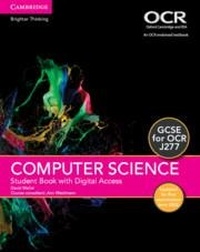
GCSE Computer Science for OCR Student Book with Digital Access (2 Years) Updated Edition
Published on 30. July 2020
Book
Paperback/Softback
248 pages
978-1-108-87393-2 (ISBN)
Description
Written for the OCR GCSE Computer Science updated specification (J277) for first teaching from 2020. This print and digital student book has been updated and reordered and uses an exciting and engaging approach to help students build their knowledge and master underlying computing principles and concepts. Designed to develop computational thinking, programming and problem-solving skills, this resource includes challenges and real-life examples that demonstrate how computer science relates to everyday life with practice questions. Our new reflection feature helps students to reflect on their progress and see where they could improve. Answers can be found in the teacher's resource.
More details
Series
Language
English
Place of publication
Cambridge
United Kingdom
Target group
Primary & secondary/elementary & high school
Illustrations
Worked examples or Exercises
Dimensions
Height: 274 mm
Width: 216 mm
Thickness: 10 mm
Weight
635 gr
ISBN-13
978-1-108-87393-2 (9781108873932)
Copyright in bibliographic data and cover images is held by Nielsen Book Services Limited or by the publishers or by their respective licensors: all rights reserved.
Schweitzer Classification
Other editions
Previous edition
David Waller
GCSE Computer Science for OCR Student Book with Cambridge Elevate Enhanced Edition (2 Years)
Book
05/2016
Cambridge University Press
€53.74
Article exhausted; check for reprint
Persons
Content
Introduction; 1. The Central Processing Unit; 2. Primary and secondary storage; 3. Data representation; 4. Networks; 5. Protocols and layers; 6. Threats to computer systems and networks; 7. Operating systems and utility software; 8. Ethical, legal, cultural and environmental impacts of digital technology; 9. Algorithms; 10. Programming fundamentals; 11. Data types and additional programming techniques; 12. Searching and sorting algorithms; 13. Creating robust programs; 14. Boolean logic; 15. Programming languages and Integrated Development Environments; Programming project skills