

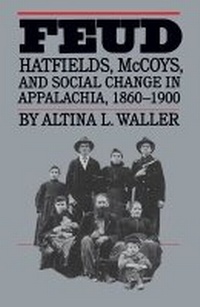
Feud
Hatfields, McCoys, and Social Change in Appalachia, 1860-1900
Published on 30. May 1988
Book
Hardback
332 pages
978-0-8078-1770-4 (ISBN)
Description
The Hatfield-McCoy feud, the entertaining subject of comic strips, popular songs, movies, and television, has long been a part of American folklore and legend. Ironically, the extraordinary endurance of the myth that has grown up around the Hatfields and McCoys has obscured the consideration of the feud as a serious historical event. In this study, Altina Waller tells the real story of the Hatfields and McCoys and the Tug Valley of West Virginia and Kentucky, placing the feud in the context of community and regional change in the era of industrialization.
Waller argues that the legendary feud was not an outgrowth of an inherently violent mountain culture but rather one manifestation of a contest for social and economic control between local people and outside industrial capitalists -- the Hatfields were defending community autonomy while the McCoys were allied with the forces of industrial capitalism. Profiling the colorful feudists ""Devil Anse"" Hatfield, ""Old Ranel"" McCoy, ""Bad"" Frank Phillips, and the ill-fated lovers Roseanna McCoy and Johnse Hatfield, Waller illustrates how Appalachians both shaped and responded to the new economic and social order.
|Wetherington examines the local effects of the Civil War on a section of southern Georgia, in part of the region known as Wiregrass Country. The author looks closely at the experiences of white ""plain folk""--mostly yeoman farmers and craftspeople--who feared that emancipation would encourage freed slaves to move from cotton plantations into the piney woods communities they had claimed for themselves.
Waller argues that the legendary feud was not an outgrowth of an inherently violent mountain culture but rather one manifestation of a contest for social and economic control between local people and outside industrial capitalists -- the Hatfields were defending community autonomy while the McCoys were allied with the forces of industrial capitalism. Profiling the colorful feudists ""Devil Anse"" Hatfield, ""Old Ranel"" McCoy, ""Bad"" Frank Phillips, and the ill-fated lovers Roseanna McCoy and Johnse Hatfield, Waller illustrates how Appalachians both shaped and responded to the new economic and social order.
|Wetherington examines the local effects of the Civil War on a section of southern Georgia, in part of the region known as Wiregrass Country. The author looks closely at the experiences of white ""plain folk""--mostly yeoman farmers and craftspeople--who feared that emancipation would encourage freed slaves to move from cotton plantations into the piney woods communities they had claimed for themselves.
More details
Language
English
Place of publication
Chapel Hill
United States
Target group
College/higher education
Dimensions
Height: 229 mm
Width: 149 mm
ISBN-13
978-0-8078-1770-4 (9780807817704)
Copyright in bibliographic data and cover images is held by Nielsen Book Services Limited or by the publishers or by their respective licensors: all rights reserved.
Schweitzer Classification
Person
Altina L. Waller, professor emerita of history at the University of Connecticut, is author of Reverend Beecher and Mrs. Tilton: Sex and Class in Victorian America.