

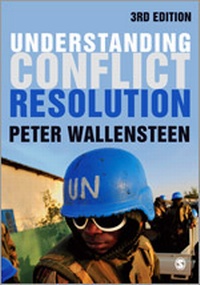
Understanding Conflict Resolution
War, Peace and the Global System
3rd Edition
Published on 10. November 2011
Book
Paperback/Softback
360 pages
978-0-85702-050-5 (ISBN)
Description
The eagerly awaited new edition of this highly-popular text continues to be the most lucid and engaging book available on conflict resolution and peace agreements.
Peter Wallensteen, a renowned academic in the field, draws on recent research and examples from around the world, linking the theory of conflict resolution to real-world cases throughout the book.
NEW to the third edition:
* Expanded coverage of the making of peace agreements, including peace and justice, disarmament, and gender-peace connections
* Coverage of the actions of the Obama administration
* Explores the ongoing situations in Afghanistan, Iraq, Somalia, Sudan, the Cote D'Ivoire, Iran, Pakistan and the Arab democratic wave from a conflict resolution perspective
* Updated coverage of the continuing 'war on terror'.
* Attention is given to the comparison of different outcomes, whether negotiated between parties or victory of one over the other with references to Sri Lanka, the Middle East, and Liberia.
Understanding Conflict Resolution remains an essential text for all students, lecturers and researchers of peace and conflict resolution in international relations, global politics and political science.
Peter Wallensteen, a renowned academic in the field, draws on recent research and examples from around the world, linking the theory of conflict resolution to real-world cases throughout the book.
NEW to the third edition:
* Expanded coverage of the making of peace agreements, including peace and justice, disarmament, and gender-peace connections
* Coverage of the actions of the Obama administration
* Explores the ongoing situations in Afghanistan, Iraq, Somalia, Sudan, the Cote D'Ivoire, Iran, Pakistan and the Arab democratic wave from a conflict resolution perspective
* Updated coverage of the continuing 'war on terror'.
* Attention is given to the comparison of different outcomes, whether negotiated between parties or victory of one over the other with references to Sri Lanka, the Middle East, and Liberia.
Understanding Conflict Resolution remains an essential text for all students, lecturers and researchers of peace and conflict resolution in international relations, global politics and political science.
Reviews / Votes
Those of us guiding students through this field owe Peter Wallensteen great thanks for a masterful and erudite guide to modern-day political violence and conflict resolution. This is one of the best single-authored books on the subject, and one that can be employed as the main text on modules and degree courses, but which is much more than a mere textbook. It draws on the extensive dataset amassed by researchers at Uppsala University to reach some important and robust conclusions about the evolving nature of armed conflict and peace processes...It is a thoroughly recommended purchase for peace and conflict studies studentsTimes Higher Education
There are three major problems confronting the world at the present time: climate change, inequality and organised violence. Wallensteen's path breaking Understanding Conflict Resolution is absolutely essential reading for anyone seeking insight into the origins, management and transformation of the latter. He surveys the major theoretical perspectives on conflict and violence and provides excellent examples of ways in which violence is being handled at intra-state , inter state and regional levels. He raises important and challenging questions about the role of the United Nations and the United States in the building of a more stable and peaceful world order. This book is essential reading for scholars, practitioners and anyone interested in creative, progressive solutions to 21st century problems
Professor Kevin P. Clements
Foundation Chair of Peace and Conflict Studies and Director of the New Zealand National Centre for Peace and Conflict Studies at the University of Otago, New Zealand
Peter Wallensteen's recent addition to the study of managing conflict, Understanding Conflict Resolution (3rd Edition), will provide the most analytically complete and conceptually useful text out there. I have taught a seminar in conflict management for eight years in a row using eight different textbooks, none of them sufficiently analytically developed to provide students with a coherent way to think about managing global conflict. When I discovered Peter's second edition my search for a useable textbook ended. The second edition was great to use in a classroom because the analytical lens and conceptual clarity with which that book was organized resonated with the students. All the other ideas that needed to be presented would be evaluated in light of the core ideas set up by Wallensteen. The newest edition builds on this already successful model by expanding coverage to conflicts that are most salient to today's students and by building on new scholarship about the role of peace agreements in securing long term peace. By framing the methods for managing today's seemingly intractable conflicts in terms of the knowledge built on a generation of scholarship, Wallensteen makes teaching these core ideas rather easy
Patrick M. Regan
Professor of Political Science at the University of Binghamton
More details
Edition
3rd Revised edition
Language
English
Place of publication
London
United Kingdom
Target group
College/higher education
Edition type
Revised edition
Dimensions
Height: 242 mm
Width: 170 mm
Weight
606 gr
ISBN-13
978-0-85702-050-5 (9780857020505)
Copyright in bibliographic data and cover images is held by Nielsen Book Services Limited or by the publishers or by their respective licensors: all rights reserved.
Schweitzer Classification
Other editions
New editions
Peter Wallensteen
Understanding Conflict Resolution
Book
04/2015
4th Edition
SAGE Publications Ltd
€58.37
Article exhausted; check for reprint
Person
Peter Wallensteen is Senior Professor of Peace and Conflict Research at Uppsala University, Uppsala, Sweden, since 2012. He held the Dag Hammarskjoeld Chair of Peace and Conflict Research, Uppsala University (1985-2012). He is also the Richard G. Starmann, Senior Research Professor of Peace Studies at the Kroc Institute for International Peace Studies, University of Notre Dame, Indiana, USA (since 2006). He directs the Uppsala Conflict Data Program (UCDP) and the Special Program on International Targeted Sanctions (SPITS). His Understanding Conflict Resolution: War, Peace and the Global System (Sage, earlier edition, available also in an Arabic translation) is used in teaching around the world. His book Peace Research: Theory and Practice (Routledge 2011) demonstrates his range of research interests and has recently been translated into Chinese. Recently he also edited together with Ambassador Anders Bjurner Regional Organizations and Peacemaking: Challengers to the UN? (Routledge 2015). In 2010, he and Isak Svensson published The Go-Between (United States Institute of Peace Press), a study of mediation efforts by the renowned Swedish diplomat Jan Eliasson. Wallensteen has published widely on conflict trends, conflict resolution, mediation, prevention, sanctions and the United Nations.
Content
PART ONE: THE PROBLEM AND HOW TO APPROACH IT
Understanding Conflict Resolution
Peacemaking as a New Experience
Peace Research and Conflict Resolution
Defining Conflict Resolution
Limits of Conflict Resolution
Outlining This Book
Armed Conflicts and Peace Agreements
The Concept of Conflict
Identifying Armed Conflict
Trends in Armed Conflicts
Outcomes of Armed Conflict
Approaching Conflict Resolution
The Evolution of Conflict Analysis
Focusing on Conflict Dynamics
Focusing on Basic Needs
Focusing on Rational Calculations
Synthesizing Conflict Resolution
Identifying Key Elements in Conflict Analysis
Analysing Conflict Resolution
Basic and Complex Levels of Analysis
The Role of the State
Introducing the Trichotomy of Conflict
Applying the Trichotomy of Conflict and Peace
PART TWO: BASICS OF CONFLICT RESOLUTION
The Resolution of Conflicts between States
Armed Conflicts and Peace Accords between States
Conflict Resolution: Geopolitik and Realpolitik
Conflict Resolution: Idealpolitik and Kapitalpolitik
Conclusions for Interstate Conflict Resolution
Conflict Resolution in Civil Wars
Armed Conflicts and Peace Accords within States
Dealing with Incompatibilities over State Power
Democracy and the Settlement of Civil Wars
Dealing with the Internal Security Dilemma
State Failure, State Reconstruction and Non-state Terrorism
Civil Society in Internal Conflict Resolution
Conflict Resolution in State Formation Conflicts
State Formation Conflicts
Identity Discrimination and Conflict Resolution
Autonomy and Federalism: Territorial Solutions within a State
Independence with or without Integration
State Formation Conflicts and Democracy
PART THREE: COMPLEXITIES IN CONFLICT RESOLUTION
Conflict Complexes and Conflict Resolution
Identifying Regional Conflict Complexes
Regional Conflict and the Organizing of Regions
Major Powers and Conflict Complexes
Global Dimensions of Conflict Resolution
The United Nations in Conflict Resolution
The UN in Peace Agreements
Collective Security
The Security Council in Conflict Resolution
UN Action and Peace Agreements
International Communities in Conflict Resolution
The New Communities
Early Action and Conflict Prevention
Third Parties and Mediation
Structural Changes and Peaceful Conflict
Between the International Community and Pax Americana
Understanding Conflict Resolution
Peacemaking as a New Experience
Peace Research and Conflict Resolution
Defining Conflict Resolution
Limits of Conflict Resolution
Outlining This Book
Armed Conflicts and Peace Agreements
The Concept of Conflict
Identifying Armed Conflict
Trends in Armed Conflicts
Outcomes of Armed Conflict
Approaching Conflict Resolution
The Evolution of Conflict Analysis
Focusing on Conflict Dynamics
Focusing on Basic Needs
Focusing on Rational Calculations
Synthesizing Conflict Resolution
Identifying Key Elements in Conflict Analysis
Analysing Conflict Resolution
Basic and Complex Levels of Analysis
The Role of the State
Introducing the Trichotomy of Conflict
Applying the Trichotomy of Conflict and Peace
PART TWO: BASICS OF CONFLICT RESOLUTION
The Resolution of Conflicts between States
Armed Conflicts and Peace Accords between States
Conflict Resolution: Geopolitik and Realpolitik
Conflict Resolution: Idealpolitik and Kapitalpolitik
Conclusions for Interstate Conflict Resolution
Conflict Resolution in Civil Wars
Armed Conflicts and Peace Accords within States
Dealing with Incompatibilities over State Power
Democracy and the Settlement of Civil Wars
Dealing with the Internal Security Dilemma
State Failure, State Reconstruction and Non-state Terrorism
Civil Society in Internal Conflict Resolution
Conflict Resolution in State Formation Conflicts
State Formation Conflicts
Identity Discrimination and Conflict Resolution
Autonomy and Federalism: Territorial Solutions within a State
Independence with or without Integration
State Formation Conflicts and Democracy
PART THREE: COMPLEXITIES IN CONFLICT RESOLUTION
Conflict Complexes and Conflict Resolution
Identifying Regional Conflict Complexes
Regional Conflict and the Organizing of Regions
Major Powers and Conflict Complexes
Global Dimensions of Conflict Resolution
The United Nations in Conflict Resolution
The UN in Peace Agreements
Collective Security
The Security Council in Conflict Resolution
UN Action and Peace Agreements
International Communities in Conflict Resolution
The New Communities
Early Action and Conflict Prevention
Third Parties and Mediation
Structural Changes and Peaceful Conflict
Between the International Community and Pax Americana