

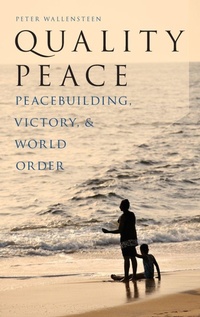
Quality Peace
Strategic Peacebuilding and World Order
Published on 29. October 2015
Book
Hardback
272 pages
978-0-19-021554-5 (ISBN)
Description
In Quality Peace, leading peace researcher Peter Wallensteen offers a broad analysis of peacebuilding, isolating what does and not work when settling conflicts. The book uses statistical analysis to compare two war outcomes-negotiated settlement and victory- in the post-Cold War era. Wallensteen finds that if peace is to last, three conditions must be met: a losing party must retain its dignity; security and the rule of law must be ensured for all; and the time horizon for the settlement must be long enough to ensure a sense of normalcy.
Wallensteen breaks down the components of all of these conditions and applies them to interstate conflicts, civil wars in which rebels are aiming to take over the entire state, and separatist rebellions. He also delves into the issue of world order and the significance of major power relations for local peace efforts. Thus, the work provides a remarkable understanding of how different types of war outcomes deal with post-war conditions.
Sharply argued and comprehensive, Quality Peace will invigorate peace research and stimulate peace practice, becoming an authoritative work in the field.
Wallensteen breaks down the components of all of these conditions and applies them to interstate conflicts, civil wars in which rebels are aiming to take over the entire state, and separatist rebellions. He also delves into the issue of world order and the significance of major power relations for local peace efforts. Thus, the work provides a remarkable understanding of how different types of war outcomes deal with post-war conditions.
Sharply argued and comprehensive, Quality Peace will invigorate peace research and stimulate peace practice, becoming an authoritative work in the field.
Reviews / Votes
"Carefully distinguishing among post war conditions that result in subsequent violence and war from those that do not, Wallensteen has produced a significant, timely and rich analysis of the possibilities for Quality Peace (which he defines in terms of security, dignity and predictability) in the aftermath of conflict between states, internal conflicts over government and internal conflicts over state formation and territory. The detailed analyses of cases and data and the detailed principles presented as testable hypotheses in the conclusion make this the foundational analysis for all subsequent analyses of peaceful (and failed) outcomes. " -Michael Stohl, Director, Orfalea Center for Global and International Studies, University of California, Santa Barbara This book contains impressive statistical data, sometimes used to revise the findings of previous scholarly work; deep exploration of diverse case studies; and impressive lists of notes and references. It is an excellent reference work for all scholars or students of international relations, peace, and conflict. * Mabel Gonzalez Bustelo, Global Policy Journal *More details
Other editions
Additional editions
Book
10/2015
Oxford University Press Inc
€66.10
Shipment within 15-20 days
E-Book
10/2015
1st Edition
OUP eBook
€31.49
Available for download
E-Book
09/2015
1st Edition
OUP eBook
€31.49
Available for download
Person
Peter Wallensteen is a pioneer in peace research, having worked in the field since the 1960s. He was a founder of the Department of Peace and Conflict Research at Uppsala University and the first holder of the Dag Hammarskjoeld chair in peace research in Sweden in 1985. He directed the Uppsala Conflict Data Program, which has become a leading provider of data on armed conflict and other forms of organized violence around the world. Since 2006, Wallensteen has served as the Richard G. Starmann Sr. Research Professor of Peace Studies at the Kroc Institute, University of Notre Dame.
Content
Table of Contents ; Dedication ; Acknowledgements ; Preface ; 1. Peacebuilding, Victory and Quality Peace ; 1.1 The Challenge of Peace after War ; 1.2 Peacebuilding: A Conceptual History ; 1.3 Victory, World Order and Quality Peace ; 1.4 Perspectives on Peace after War ; 1.5 This Book ; Box 1.1. ; Table 1.1 ; 2. Quality Peace and Contemporary Scholarship ; 2.1 Peace in Post-Cold War Conditions ; 2.2. Post-War Conditions in Contemporary Writing ; 2.3 The Strategic Approach: At War's End ; 2.4 The Systemic Approach: Works by Doyle and Sambanis ; 2.5 Structural Approaches: Civil War as Instability ; 2.6 Lessons from Inter-State Wars ; 2.7 The Post-Cold War Period as World Order ; 2.8 Measurements and Indicators ; Table 2.1 ; Table 2.2 ; Table 2.3 ; 3. Quality Peace after Civil Wars ; 3.1. Civil War Outcomes ; 3.2 After Civil War: Peacebuilding Strategies ; 3.3 Civil War and International Attention ; 3.4 Drawing General Conclusions ; 3.5 Quality Peace after Civil War ; Table 3.1 ; 4. Quality Peace and State Formation ; 4.1 Outcomes in State Formation Conflicts ; 4.2 Challenges to Peace in State Formation Conflicts ; 4.3 Termination of State Formation Conflicts: An Overview ; 4.4. State Separation and Quality Peace ; 4.5 Autonomy and Quality Peace ; 4.6 Autonomy: Solution v. Step to Separation ; 4.7 Quality Peace in State Formation Solutions ; Table 4.1 ; 5. Quality Peace between States: A Challenge ; 5.1 Inter-State Peacebuilding: A Neglected Field ; 5.2 Quality Peace and the Settlement of Issues ; 5.3 Quality Peace and Security Building ; 5.4 Quality Peace and Dignity ; 5.5 Challenges of Inter-state Quality Peace ; Table 5.1 ; 6. Quality Peace and World Order: Uncharted Terrain ; 6.1 Bringing in World Order ; 6.2 After World War II: The Consolidation of Victory ; 6.3 After the Cold War: A 'New World Order' ; 6.4. World Order and Quality Peace ; 7. International Organizations and Quality Peace ; 7.1 World Order and Global Institutions ; 7.2 Regional Orders and Their Limits ; 7.3 The United Nations in the Post-Cold War Period ; 7.4 International Organizations and the Future of Quality Peace ; Graph 7.1 ; 8. Paths to Quality Peace ; 8.1 Twenty-Five Conclusions ; 8.2 The Value of Quality Peace ; References ; Index ; Box 1.1UN Secretary-General Boutros Boutros-Ghali and Peacebuilding ; Table 1.1 Peacebuilding in Contemporary Scholarship ; Table 2.1 Peace Agreements and Types of Conflict 1975-2010 ; Table 2.2 Victory in Armed Conflicts since 1975 ; Table 2.3 Peacebuilding and Incompatibility in Internal Conflicts since 1944 ; Table 3.1 Peacebuilding Missions, War Outcomes and Democracy ; Table 4.1 Post-War Situations in State Formation Conflicts, since 1989 ; Table 5.1 Inter-state Armed Conflicts: Outcomes, 1975-2010 ; Graph 7.1 UN Security Council Resolutions, 1946-2013 ; Appendix 3.1 Success in Peacebuilding, Revisiting Doyle and Sambanis ; Appendix 3.2 Case Information for Table 3.1 ; Appendix 3.3 Statistical Information for Table 3.1