

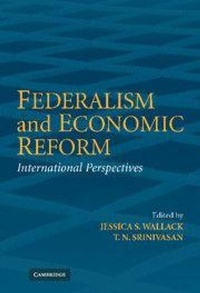
Federalism and Economic Reform
International Perspectives
Published on 21. July 2011
Book
Paperback/Softback
528 pages
978-1-107-40254-6 (ISBN)
Description
This collection focuses on the ways in which federalism has affected and been affected by economic reform, especially global integration. The editors and contributors focus in particular on the political economy of institutional and economic change - how the division of authority between national and subnational governments shapes debates over policy changes, as well as how the changing economic environment creates incentives to modify the basic agreements between levels of governments. Each chapter contains a historical overview, and an in-depth account of division of authority, lines of accountability, and legislative, bureaucratic, and other arenas in which the levels of government interact for a particular country. The analyses are based on reform (or non-reform) episodes for each country - most from recent history, but some spanning the century. As a collection, the country studies span a range of developing and industrial countries with varying political systems.
More details
Language
English
Place of publication
Cambridge
United Kingdom
Target group
College/higher education
Product notice
Paperback (trade)
Illustrations
Worked examples or Exercises
Dimensions
Height: 229 mm
Width: 152 mm
Thickness: 31 mm
Weight
848 gr
ISBN-13
978-1-107-40254-6 (9781107402546)
Copyright in bibliographic data and cover images is held by Nielsen Book Services Limited or by the publishers or by their respective licensors: all rights reserved.
Schweitzer Classification
Other editions
Additional editions
Book
01/2006
Cambridge University Press
€155.90
Shipment within 15-20 days
Persons
T. N. Srinivasan is Samuel C. Park, Jr., Professor of Economics at Yale University. He has previously taught at the Indian Statistical Institute, Delhi, and at numerous American universities. He has authored or edited four books, most recently Frontiers in Applied General Equilibrium Modeling (Cambridge University Press, 2005) co-edited with Timothy J. Kehoe and John Whalley. He is a Fellow of the American Academy of Arts and Sciences and the Econometric Society, a member of the American Philosophical Society, and a Foreign Associate of the National Academy of Sciences. He was named Distinguished Fellow of the American Economic Association in 2003. His current research interests include international trade, development, agricultural economics, and microeconomic theory. Jessica S. Wallack is Assistant Professor in the Graduate School of International Relations and Pacific Studies at the University of California, San Diego. She has published articles in journals such as the Journal of International Economics, the Latin American Journal of Economic Development, the World Bank Economic Review, and De Economist. Professor Wallack has served as a consultant to the World Bank, the Inter-American Development Bank, and the Asian Development Bank. She received her doctorate from the Stanford University Graduate School of Business.
Content
1. Stylized models and the political economy reality T. N. Srinivasan and Jessica S. Wallack; 2. Federalism in Argentina and the reforms of the 1990s Mariano Tommasi; 3. Australia: central fiscal dominance, collaborative Federalism, and economic reform John Madden; 4. The Brazilian Federation: facts, challenges, and perspectives Fernando Rezende and Jose Roberto Afonso; 5. Changing with the times: success, failure and inertia in Canadian Federal arrangements, 1945-2002 Francois Vaillancourt and Richard Bird; 6. Fiscal Federalism and economic reform in China Roy Bahl and Jorge Martinez-Vazquez; 7. Indian Federalism, economic reform and globalization Nirvikar Singh and T. N. Srinivasan; 8. Mexico's decentralization at a cross-roads Alberto Diaz-Cayeros, Jose Antonio Gonzalez and Fernando Rojas; 9. Transfer dependence and regional disparities in Nigerian Federalism Tamar Asadurian, Emmanuel Nnadozie and Leonard Wantchekon; Conclusions and lessons for further study T. N. Srinivasan and Jessica S. Wallack.