

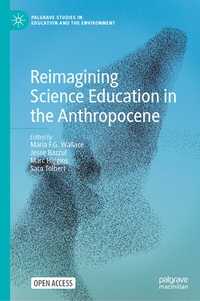
Reimagining Science Education in the Anthropocene
Description
This open access edited volume invites transdisciplinary scholars to re-vision science education in the era of the Anthropocene. The collection assembles the works of educators from many walks of life and areas of practice together to help reorient science education toward the problems and peculiarities associated with the geologic times many call the Anthropocene. It has become evident that science education-the way it is currently institutionalized in various forms of school science, government policy, classroom practice, educational research, and public/private research laboratories-is ill-equipped and ill-conceived to deal with the expansive and urgent contexts of the Anthropocene. Paying homage to myopic knowledge systems, rigid state education directives, and academic-professional communities intent on reproducing the same practices, knowledges, and relationships that have endangered our shared world and shared presents/presence is misdirected. This volume brings together diverse scholars to reimagine the field in times of precarity.
Reviews / Votes
"Situated in the era of the Anthropocene, this book volume recognizes the political urgency of re-envisioning science education with and for the community while dismantling the taken-for-granted deficit narratives of what science [education] is. Transcending disciplinary and geographical boundaries, the book calls us to reimagine science education in a more-than-human world, which places ecojustice, critical pedagogies, solidarity, and collectivity at the forefront. A timely, morally courageous, and indispensable reading."-Lucy Avraamidou, Associate Professor and Rosalind Franklin Fellow, University of Groningen, The Netherlands
"This inspiring collection showcases the kind of creative thinking-without-borders we would need to prepare our students to meet the challenges of the Anthropocene. It makes me wish I were back in grad school to begin my research career afresh with the help of the wonderful assortment of ideas, insights, and perspectives that this book so generously offers. A much-needed and long-overdue contribution to the field!"
-
Ajay Sharma
, Associate Professor, University of Georgia, USA
"This book takes seriously the charge that current ways of thinking-doing in science education are terribly inadequate for addressing the complexities of the Anthropocene. In response, the editors bring together global scholars across disciplines who generate creative, relational, anti-racist, decolonizing, and speculative alternatives offering tools to map different futures. As such, this volume is an exciting development for the field that will be of interest to a range of educational scholar-practitioners looking to reimagine science education."
-
Kathryn (Katie) Strom
, Assistant Professor, California State University, East Bay, USA
"This volume is a collection of diverse (post)critical analyses, dialogues, and practices that address reconceptualizations of science education in the Anthropocene. A timelyand significant contribution that takes justice-oriented science pedagogy beyond issues of representation by interrogating conventional episteme (know-what) and techne (know-how). Wallace, Bazzul, Higgins, and Tolbert have curated a phenomenal transdisciplinary exhibit for morally guided and praxis-oriented science education that can inform scholarship and transform teaching and learning."
-
Rouhollah Aghasaleh
, Assistant Professor, Humboldt State University, USA
More details
Other editions
Additional editions
Persons
Maria F.G. Wallace is Assistant Professor at the University of Southern Mississippi, USA.
Jesse Bazzul is Associate Professor of Science and Environmental Education at the University of Regina, Canada.
Marc Higgins is Assistant Professor in the Department of Secondary Education at the University of Alberta, Canada, where he is affiliated with the Faculty of Education's Aboriginal Teacher Education Program (ATEP).
Sara Tolbert is Associate Professor of Science and Environmental Education at Te Whare Wananga o Waitaha University of Canterbury, Aotearoa New Zealand.