

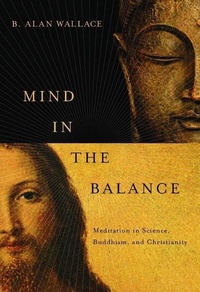
Mind in the Balance
Meditation in Science, Buddhism, and Christianity
Published on 2. September 2014
Book
Paperback/Softback
264 pages
978-0-231-14731-6 (ISBN)
Description
By establishing a dialogue in which the meditative practices of Buddhism and Christianity speak to the theories of modern philosophy and science, B. Alan Wallace reveals the theoretical similarities underlying these disparate disciplines and their unified approach to making sense of the objective world. Wallace begins by exploring the relationship between Christian and Buddhist meditative practices. He outlines a sequence of meditations the reader can undertake, showing that, though Buddhism and Christianity differ in their belief systems, their methods of cognitive inquiry provide similar insight into the nature and origins of consciousness. From this convergence Wallace then connects the approaches of contemporary cognitive science, quantum mechanics, and the philosophy of the mind. He links Buddhist and Christian views to the provocative philosophical theories of Hilary Putnam, Charles Taylor, and Bas van Fraassen, and he seamlessly incorporates the work of such physicists as Anton Zeilinger, John Wheeler, and Stephen Hawking.
Combining a concrete analysis of conceptions of consciousness with a guide to cultivating mindfulness and profound contemplative practice, Wallace takes the scientific and intellectual mapping of the mind in exciting new directions.
Combining a concrete analysis of conceptions of consciousness with a guide to cultivating mindfulness and profound contemplative practice, Wallace takes the scientific and intellectual mapping of the mind in exciting new directions.
Reviews / Votes
Wallace is a master, guiding our inquiry into consciousness in exciting new directions. Shift Thought-provoking and at times insightful, this volume raises many interesting philosophical issues and presents many useful references. Choice Anyone interested in understanding more about the mind and consciousness would enjoy reading this book. -- Marcia Howton Inquiring MindMore details
Series
Language
English
Place of publication
New York
United States
Target group
Professional and scholarly
Product notice
Paperback (trade)
Dimensions
Height: 228 mm
Width: 151 mm
Thickness: 20 mm
Weight
434 gr
ISBN-13
978-0-231-14731-6 (9780231147316)
Copyright in bibliographic data and cover images is held by Nielsen Book Services Limited or by the publishers or by their respective licensors: all rights reserved.
Schweitzer Classification
Other editions
Additional editions
Book
03/2009
Columbia University Press
€27.28
Shipment within 10-20 days
Previous edition
Book
03/2009
Columbia University Press
€27.28
Shipment within 10-20 days
Person
B. Alan Wallace spent fourteen years as a Buddhist monk, ordained by H. H. the Dalai Lama. His Columbia University Press books are Meditations of a Buddhist Skeptic: A Manifesto for the Mind Sciences and Contemplative Practice; Hidden Dimensions: The Unification of Physics and Consciousness; Contemplative Science: Where Buddhism and Neuroscience Converge; and Buddhism and Science: Breaking New Ground (editor). A prolific writer who has translated numerous Tibetan Buddhist texts, he is also the founder and president of the Santa Barbara Institute for Consciousness Studies (http://www.sbinstitute.com).
Content
Preface Part I: Meditation: Where It Started and How It Got Here 1. Who Am I? 2. The Origins of Contemplation 3. The Scientific Externalization of Meditation 4. Scientific Studies of Meditation Part II: Meditation in Theory and Practice 5. Practice: Attending to the Breath of Life 6. Theory: Coming to Our Senses 7. Practice: The Union of Stillness and Motion 8. Theory: Knowing and Healing the Mind 9. Practice: Behold the Light of Consciousness 10. Theory: Exploring the Nature of Consciousness 11. Practice: Probing the Nature of the Observer 12. Theory: The Ground State of Consciousness 13. Practice: Oscillating Awareness 14. Theory: Consciousness Without Beginning or End 15. Practice: Resting in the Stillness of Awareness 16. Theory: Worlds of Skepticism 17. Practice: The Emptiness of Mind 18. Theory: The Participatory Worlds of Buddhism 19. Practice: The Emptiness of Matter 20. Theory: The Participatory Worlds of Philosophy and Science 21. Practice: Resting in Timeless Consciousness 22. Theory: The Luminous Space of Pristine Awareness 23. Practice: Meditation in Action 24. The Universe as a Whole 25. What Shall We Become? Notes Bibliography Index
View this excerpt in >pdf format Copyright information
CHAPTER 10 [THEORY]: EXPLORING THE NATURE OF CONSCIOUSNESS
Christian Explorations
Directing awareness inward to illuminate itself is a practice that has been used for centuries in various contemplative traditions in the East and the West. Within Christianity, it can be traced back to the Desert Fathers meditating in Egypt during the early centuries of the Christian church. Hesychios the Priest (seventh century), for example, a priest and monk who lived in a monastery on Mount Sinai, commented on this form of meditation in his treatise On Watchfulness and Holiness. A central theme of this meditation manual is attentiveness, which he defined as "the heart's stillness, unbroken by any thought." "When the heart has acquired stillness," he wrote, "it will perceive the heights and depths of knowledge; and the ear of the still intellect will be made to hear marvelous things from God." This gives rise to a unique kind of spiritual well-being.
The meditative practice of turning awareness upon itself was preserved by Greek Orthodox hermits from the tenth to the fourteenth centuries. The monk Saint Symeon (949-1022), for instance, counseled aspiring contemplatives to first of all seek three things: to free themselves of all anxiety regarding both real and imaginary things; to strive for a pure conscience, with no lingering sense of self-reproach; and to be completely detached, so that one's thoughts are not drawn to anything worldly, not even to one's own body. Then, after withdrawing one's awareness from all worldly concerns, the attention is focused on one's heart and the practice continues as follows:
"To start with you will find there darkness and an impenetrable density. Later, when you persist and practice this task day and night, you will fi nd, as though miraculously, an unceasing joy. For as soon as the in
CHAPTER 10 [THEORY]: EXPLORING THE NATURE OF CONSCIOUSNESS
Christian Explorations
Directing awareness inward to illuminate itself is a practice that has been used for centuries in various contemplative traditions in the East and the West. Within Christianity, it can be traced back to the Desert Fathers meditating in Egypt during the early centuries of the Christian church. Hesychios the Priest (seventh century), for example, a priest and monk who lived in a monastery on Mount Sinai, commented on this form of meditation in his treatise On Watchfulness and Holiness. A central theme of this meditation manual is attentiveness, which he defined as "the heart's stillness, unbroken by any thought." "When the heart has acquired stillness," he wrote, "it will perceive the heights and depths of knowledge; and the ear of the still intellect will be made to hear marvelous things from God." This gives rise to a unique kind of spiritual well-being.
The meditative practice of turning awareness upon itself was preserved by Greek Orthodox hermits from the tenth to the fourteenth centuries. The monk Saint Symeon (949-1022), for instance, counseled aspiring contemplatives to first of all seek three things: to free themselves of all anxiety regarding both real and imaginary things; to strive for a pure conscience, with no lingering sense of self-reproach; and to be completely detached, so that one's thoughts are not drawn to anything worldly, not even to one's own body. Then, after withdrawing one's awareness from all worldly concerns, the attention is focused on one's heart and the practice continues as follows:
"To start with you will find there darkness and an impenetrable density. Later, when you persist and practice this task day and night, you will fi nd, as though miraculously, an unceasing joy. For as soon as the in