

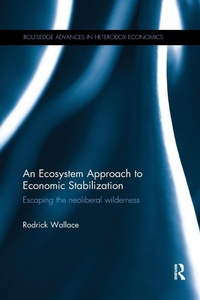
An Ecosystem Approach to Economic Stabilization
Escaping the Neoliberal Wilderness
1st Edition
Published on 30. June 2020
Book
Paperback/Softback
162 pages
978-0-367-59978-2 (ISBN)
Description
The creation of economic institutions that can function well under substantial uncertainties -- Black Swans -- is analogous to the dilemmas confronting our hunter-gatherer forefathers in the face of large-scale ecological unpredictability. The ultimate solution was not the development of a super hunter-gatherer technology that could ride out repeated catastrophe, but rather the invention, in neolithic times, of culturally-adapted 'farmed' ecosystems constructed to maximize food yield and minimize risks of famine.
Recent advances in evolutionary and ecosystem theory applied to economic structure and process may permit construction of both new economic theory and new tools for data analysis that can help in the design of more robust economic institutions. This may result in less frequent and less disruptive transitions, and enable the design of culturally-specific systems less affected by those that do occur.
This unique and innovative book applies cutting-edge methods from cognitive science and evolutionary theory to the problem of the necessary stabilization of economic processes. At the core of this book is the establishment of a statistics-like toolbox for the study of empirical data that is consistent with generalized evolutionary approaches. This toolbox enables the construction of both new economic theories and methods of data analysis that can help in the design of more robust economic institutions. This in turn will result in less frequent and less disruptive Black Swans, and enable as well the design of culturally-specific systems less affected by those that do occur.
Recent advances in evolutionary and ecosystem theory applied to economic structure and process may permit construction of both new economic theory and new tools for data analysis that can help in the design of more robust economic institutions. This may result in less frequent and less disruptive transitions, and enable the design of culturally-specific systems less affected by those that do occur.
This unique and innovative book applies cutting-edge methods from cognitive science and evolutionary theory to the problem of the necessary stabilization of economic processes. At the core of this book is the establishment of a statistics-like toolbox for the study of empirical data that is consistent with generalized evolutionary approaches. This toolbox enables the construction of both new economic theories and methods of data analysis that can help in the design of more robust economic institutions. This in turn will result in less frequent and less disruptive Black Swans, and enable as well the design of culturally-specific systems less affected by those that do occur.
More details
Series
Language
English
Place of publication
London
United Kingdom
Publishing group
Taylor & Francis Ltd
Target group
College/higher education
Postgraduate and Undergraduate
Dimensions
Height: 234 mm
Width: 156 mm
Weight
330 gr
ISBN-13
978-0-367-59978-2 (9780367599782)
Copyright in bibliographic data and cover images is held by Nielsen Book Services Limited or by the publishers or by their respective licensors: all rights reserved.
Schweitzer Classification
Other editions
Additional editions
E-Book
02/2015
1st Edition
Routledge
€58.99
Available for download
E-Book
02/2015
1st Edition
Routledge
€59.49
Available for download
Book
01/2015
1st Edition
Routledge
€231.20
Shipment within 10-20 days
Person
Rodrick Wallace is Research Scientist at Division of Epidemiology, The New York State Psychiatric Institute, USA
Content
1. The Crisis in Economic Theory 2. Evolutionary Economics 3. Black Swans and Red Queens 4. Lies and Deceit: `Niche Construction' 5. Farming an Economy 6. Cambrian Explosions and Mass Extinctions 7. Counterexample: The Pentagon Ratchet 8. Counterexample: Organized Hyperviolence 9. Counterexample: Farming Human Pathogens 10. Escaping the Howling Wilderness 11. Mathematical Appendix