

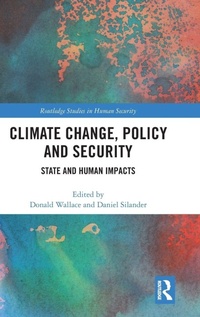
Climate Change, Policy and Security
State and Human Impacts
1st Edition
Published on 17. April 2018
Book
Hardback
270 pages
978-1-138-48133-6 (ISBN)
Description
This book examines the multiple strategies proposed by the international community for addressing global climate change (GCC) from both human and state-security perspectives.
It examines what is needed from major states working within the UN framework to engage with the multiple dimensions of a strategy that addresses GCC and its impacts, where such engagement promotes both human and state security. Two broad frameworks for approaching these issues provide the basis of discussion for the individual chapters, which discuss the strategies being undertaken by major state powers (the US, the EU, China, India, Japan, and Russia). The first framework considers the multiple strategies, mitigation, adaptation, and capacity-building required of the international community to address the effects of GCC. The second framework considers the differentiation of GCC policies in terms of security and how the efficacy of these strategies could be impacted by whether priority is given to state security over human security concerns.
This book will be of much interest to students of human security, climate change, foreign policy, and International Relations.
It examines what is needed from major states working within the UN framework to engage with the multiple dimensions of a strategy that addresses GCC and its impacts, where such engagement promotes both human and state security. Two broad frameworks for approaching these issues provide the basis of discussion for the individual chapters, which discuss the strategies being undertaken by major state powers (the US, the EU, China, India, Japan, and Russia). The first framework considers the multiple strategies, mitigation, adaptation, and capacity-building required of the international community to address the effects of GCC. The second framework considers the differentiation of GCC policies in terms of security and how the efficacy of these strategies could be impacted by whether priority is given to state security over human security concerns.
This book will be of much interest to students of human security, climate change, foreign policy, and International Relations.
More details
Series
Language
English
Place of publication
London
United Kingdom
Publishing group
Taylor & Francis Ltd
Target group
College/higher education
Professional and scholarly
Illustrations
1 s/w Tabelle
1 Tables, black and white
Dimensions
Height: 240 mm
Width: 161 mm
Thickness: 19 mm
Weight
575 gr
ISBN-13
978-1-138-48133-6 (9781138481336)
Copyright in bibliographic data and cover images is held by Nielsen Book Services Limited or by the publishers or by their respective licensors: all rights reserved.
Schweitzer Classification
Other editions
Additional editions
Book
11/2019
1st Edition
Routledge
€65.30
Shipment within 15-20 days
E-Book
04/2018
1st Edition
Routledge
€59.49
Available for download
E-Book
04/2018
1st Edition
Routledge
€59.49
Available for download
Persons
Don Wallace is Professor Emeritus of Criminal Justice at the University of Central Missouri, USA.
Daniel Silander is Associate Professor in Political Science at the Department of Political Science, Linnaeus University, Sweden.
Daniel Silander is Associate Professor in Political Science at the Department of Political Science, Linnaeus University, Sweden.
Content
1. Introduction: security and global climate change, Don Wallace 2. The UN regime on global climate change, Don Wallace 3. Geography of GCC: Asia Pacific-human and state security, Patrick Nunn & Carola Betzold 4. Geography of GCC: the climate-security nexus in Africa, Daniel Silander 5. The United States and global climate change, Niall Michelsen 6. The European Union and global climate change, Martin Nilsson 7. China and global climate change, Daniel Silander & Martin Nilsson 8. India and global climate change, John Janzekovic 9. Japan and global climate change, Darlene Budd 10. Russia and global climate change, Ana Karaman 11. Conclusion: state powers on global climate change-lessons learned, Daniel Silander & Don Wallace