

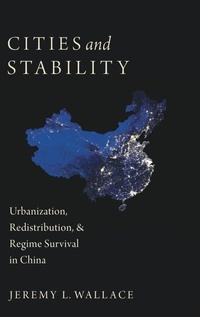
Cities and Stability
Urbanization, Redistribution, and Regime Survival in China
Published on 14. August 2014
Book
Hardback
266 pages
978-0-19-937898-2 (ISBN)
Description
Cities bring together masses of people, allow them to communicate and hide, and to transform private grievances into political causes, often erupting in urban protests that can destroy regimes. The Chinese Communist Party (CCP) has shaped urbanization via migration restrictions and redistributive policy since 1949 in ways that help account for the regime's endurance, China's surprising comparative lack of slums, and its curious moves away from urban bias over the past decade. Cities and Stability details the threats that cities pose for authoritarian regimes, regime responses to those threats, and how those responses can backfire by exacerbating the growth of slums and cities.
Cross-national analyses of nondemocratic regime survival link larger cities to shorter regimes. To compensate for the threat urban threat, many regimes, including the CCP, favor cities in their policy-making. Cities and Stability shows this urban bias to be a Faustian Bargain, stabilizing large cities today but encouraging their growth and concentration over time.
While attempting to industrialize, the Chinese regime created a household registration (hukou) system to restrict internal movement, separating urban and rural areas. China's hukou system served as a loophole, allowing urbanites to be favored but keeping farmers in the countryside. As these barriers eroded with economic reforms, the regime began to replace repression-based restrictions with economic incentives to avoid slums by improving economic opportunities in the interior and the countryside. Yet during the global Great Recession of 2008-09, the political value of the hukou system emerged as migrant workers, by the tens of millions, left coastal cities and dispersed across China's interior villages, counties, and cities. The government's stimulus policies, a combination of urban loans for immediate relief and long-term infrastructure aimed at the interior, reduced discontent to manageable levels and locales.
Cross-national analyses of nondemocratic regime survival link larger cities to shorter regimes. To compensate for the threat urban threat, many regimes, including the CCP, favor cities in their policy-making. Cities and Stability shows this urban bias to be a Faustian Bargain, stabilizing large cities today but encouraging their growth and concentration over time.
While attempting to industrialize, the Chinese regime created a household registration (hukou) system to restrict internal movement, separating urban and rural areas. China's hukou system served as a loophole, allowing urbanites to be favored but keeping farmers in the countryside. As these barriers eroded with economic reforms, the regime began to replace repression-based restrictions with economic incentives to avoid slums by improving economic opportunities in the interior and the countryside. Yet during the global Great Recession of 2008-09, the political value of the hukou system emerged as migrant workers, by the tens of millions, left coastal cities and dispersed across China's interior villages, counties, and cities. The government's stimulus policies, a combination of urban loans for immediate relief and long-term infrastructure aimed at the interior, reduced discontent to manageable levels and locales.
Reviews / Votes
How has China navigated the dangerous shoals of explosive growth with less urban unrest and brutal repression than other nations? In this lucid, convincing, study of the prevention of slums and the dispersal of dissent, backed by impressive comparative and historical evidence, Wallace has made a lasting contribution to our understanding of urbanization and political stability. * James C. Scott, Yale University *More details
Language
English
Place of publication
New York
United States
Target group
College/higher education
Dimensions
Height: 240 mm
Width: 161 mm
Thickness: 19 mm
Weight
567 gr
ISBN-13
978-0-19-937898-2 (9780199378982)
Copyright in bibliographic data and cover images is held by Nielsen Book Services Limited or by the publishers or by their respective licensors: all rights reserved.
Schweitzer Classification
Other editions
Additional editions
Book
08/2014
Oxford University Press Inc
€49.90
Shipment within 15-20 days
E-Book
06/2014
1st Edition
OUP eBook
€19.99
Available for download
E-Book
06/2014
1st Edition
OUP eBook
€19.99
Available for download
Person
Assistant Professor of Political Science, Ohio State University
Content
Chapter 1: Introduction ; Chapter 2: Urban Bias: A Faustian Bargain ; Chapter 3: Cities, Redistribution, and Regime Survival ; Chapter 4: China's Loophole to the Faustian Bargain of Urban Bias ; Chapter 5: The Fiscal Shift: Migration, Instability, & Redistribution ; Chapter 6: Return to Sender: Hukou, Stimulus, & the Great Recession ; Chapter 7: Under Pressure: Urban Bias and External Forces ; Chapter 8: Conclusion ; Bibliography ; Appendix