

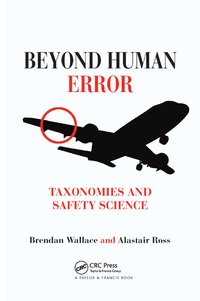
Beyond Human Error
Taxonomies and Safety Science
1st Edition
Published on 19. September 2019
Book
Paperback/Softback
288 pages
978-0-367-39103-4 (ISBN)
Description
A ground-breaking new book, Beyond Human Error: Taxonomies and Safety Science deconstructs the conventional concept of human error and provides a whole new way of looking at accidents and how they might be prevented. The majority of accidents and incidents are caused, at some level, by human error. This text provides an introduction to this key field as well as a broad background to the subject. Incorporating the sociology of disaster and accidents into a practical framework, it offers a new paradigm for the subject. The authors address the roots ofhuman error in the Western tradition and discuss the history of human error studies, human factors, and ergonomics, exploring hidden assumptions that have colored past research. They include current methodologies of experimental design, new paradigms, and outlines situated and distributed cognition models, and more useful intervention strategies.
More details
Language
English
Place of publication
London
United Kingdom
Publishing group
Taylor & Francis Ltd
Target group
Professional and scholarly
Academic and Professional Practice & Development
Dimensions
Height: 234 mm
Width: 156 mm
Weight
530 gr
ISBN-13
978-0-367-39103-4 (9780367391034)
Copyright in bibliographic data and cover images is held by Nielsen Book Services Limited or by the publishers or by their respective licensors: all rights reserved.
Schweitzer Classification
Other editions
Additional editions
E-Book
04/2016
1st Edition
CRC Press
€92.49
Available for download
E-Book
04/2016
CRC Press
€92.49
Available for download
Book
03/2006
1st Edition
CRC Press
€155.01
Shipment within 15-20 days
Persons
Wallace, Brendan; Ross, Alastair
Content
Safety and Science. Reflective Practice and Safety Practice. Abstraction and Safety Science. Causality and Accidents. Heinrich. The Myth of the Root Cause. Models of Accident Causation. References. Safety and Taxonomies. Introduction. The Purpose of a Database and a Taxonomy. The Privileged Classifier. The Correspondence Theory of Classification. Taxonomies and Safety. Applications of Taxonomy Theory. Conclusion. References. Taxonomic Consensus. Reliability and Validity. The Logic of Taxonomic Consensus. Approaches to Probability. Quantifying Taxonomic Consensus. Simple Conditional Probability for Taxonomic Consensus. Signal Detection Theory and Reliability Testing. Conclusion. References. Taxonomic Output and Validity. Traditional Analyses and Possible Alternatives. Probabilistic Risk Assessment. Problems with the Null Hypothesis Test. Hot Science. Working with Taxonomic Data. Conclusion. References. Psychology and Human Factors. Taxonomies and Psychology. The History of Cognitivism. Information Processing. Situated Cognition. Embodied Cognition. Distributed Cognition. Discursive Psychology. Conclusion. References. Cybernetics and Systems Theory. Second-Order Cybernetics. Cybernetics, Systems Theory, and Human Behavior. Cybernetics: Conclusion. Normal Accidents. Conclusion. References. Challenger and Columbia. The Challenger Disaster. Columbia. Conclusion. References. Rules and Regulations. Rules, Physics, and Cognition. Laws. Psychology. Rules and Regulations. Technical Rationality. Self-Organization. The Social View. Why Has the Accident Rate Gone Down? Interpreting Accident Statistics. Empowerment. Conclusion. References. Conclusion. Science, Etc. References. Appendix 1 Carrying Out a Reliability Trial. Related Titles.