

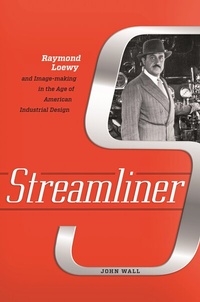
Streamliner
Raymond Loewy and Image-making in the Age of American Industrial Design
Published on 2. August 2022
Book
Paperback/Softback
344 pages
978-1-4214-4545-8 (ISBN)
Description
The true story of Raymond Loewy, whose designs are still celebrated for their unerring ability to advance American consumer taste.
Born in Paris in 1893 and trained as an engineer, Raymond Loewy revolutionized twentieth-century American industrial design. Combining salesmanship and media savvy, he created bright, smooth, and colorful logos for major corporations that included Greyhound, Exxon, and Nabisco. His designs for Studebaker automobiles, Sears Coldspot refrigerators, Lucky Strike cigarette packs, and Pennsylvania Railroad locomotives are iconic. Beyond his timeless designs, Loewy carefully built an international reputation through the assiduous courting of journalists and tastemakers to become the face of both a new profession and a consumer-driven vision of the American dream.
In Streamliner, John Wall traces the evolution of an industry through the lens of Loewy's eclectic life, distinctive work, and invented persona. How, he asks, did Loewy build a business while transforming himself into a national brand a half century before "branding" became relevant? Placing Loewy in context with the emerging consumer culture of the latter half of the twentieth century, Wall explores how his approach to business complemented-or differed from-that of his well-known contemporaries, including industrial designers Henry Dreyfuss, Walter Teague, and Norman Bel Geddes. Wall also reveals how Loewy tailored his lifestyle to cement the image of "designer" in the public imagination and why the self-promotion that drove Loewy to the top of his profession began to work against him at the end of his career. Streamliner is an important and engaging work on one of the longest-lived careers in industrial design.
Born in Paris in 1893 and trained as an engineer, Raymond Loewy revolutionized twentieth-century American industrial design. Combining salesmanship and media savvy, he created bright, smooth, and colorful logos for major corporations that included Greyhound, Exxon, and Nabisco. His designs for Studebaker automobiles, Sears Coldspot refrigerators, Lucky Strike cigarette packs, and Pennsylvania Railroad locomotives are iconic. Beyond his timeless designs, Loewy carefully built an international reputation through the assiduous courting of journalists and tastemakers to become the face of both a new profession and a consumer-driven vision of the American dream.
In Streamliner, John Wall traces the evolution of an industry through the lens of Loewy's eclectic life, distinctive work, and invented persona. How, he asks, did Loewy build a business while transforming himself into a national brand a half century before "branding" became relevant? Placing Loewy in context with the emerging consumer culture of the latter half of the twentieth century, Wall explores how his approach to business complemented-or differed from-that of his well-known contemporaries, including industrial designers Henry Dreyfuss, Walter Teague, and Norman Bel Geddes. Wall also reveals how Loewy tailored his lifestyle to cement the image of "designer" in the public imagination and why the self-promotion that drove Loewy to the top of his profession began to work against him at the end of his career. Streamliner is an important and engaging work on one of the longest-lived careers in industrial design.
Reviews / Votes
This book adds another important chapter to the legendary work of the man who essentially created the field of industrial design, thus making the corpus of his career's work available to a new generation of readers.-Ed Garten, Society of Automotive Historians Journal
More details
Language
English
Place of publication
Baltimore, MD
United States
Target group
Professional and scholarly
Product notice
Paperback (trade)
Illustrations
49 s/w Abbildungen
49 Illustrations, black and white
Dimensions
Height: 229 mm
Width: 152 mm
Thickness: 21 mm
ISBN-13
978-1-4214-4545-8 (9781421445458)
DOI
10.1353/book.59491
Copyright in bibliographic data and cover images is held by Nielsen Book Services Limited or by the publishers or by their respective licensors: all rights reserved.
Schweitzer Classification
Other editions
Additional editions
Book
10/2018
Johns Hopkins University Press
€46.00
Article not available at the moment
Person
John Wall, a former journalist, spent 23 years as a higher education public relations specialist at Penn State University and Juniata College.
Content
Acknowledgments
Introduction
Chapter 1. New Shores: Creating a Biography on the Fly
Chapter 2. Portrait of the Young Engineer as an Artist
Chapter 3. The Artist (and Others) Shape the Things to Come
Chapter 4. Birth of a Salesman: Cold Calls, Clients, and Creativity
Chapter 5. Big Engines: Emergence of a Design Genius
Chapter 6. Constructing an Image while Building a Business
Chapter 7. Engines of Industry: Tractors, Tour Buses, and Ships
Chapter 8. Studebaker Beginnings: Internal Combustion, Internal Dissention, External Design
Chapter 9. The Starliner Coupe: Studebaker's Breakthrough Design
Chapter 10. Avanti: Car Design Leaps Forward
Chapter 11. Becoming a Businessman: Building an Industry
Chapter 12. The Sales Curve Wanes
Chapter 13. The Long Road Down
Chapter 14. Legacy
Notes
Bibliography
Index
Introduction
Chapter 1. New Shores: Creating a Biography on the Fly
Chapter 2. Portrait of the Young Engineer as an Artist
Chapter 3. The Artist (and Others) Shape the Things to Come
Chapter 4. Birth of a Salesman: Cold Calls, Clients, and Creativity
Chapter 5. Big Engines: Emergence of a Design Genius
Chapter 6. Constructing an Image while Building a Business
Chapter 7. Engines of Industry: Tractors, Tour Buses, and Ships
Chapter 8. Studebaker Beginnings: Internal Combustion, Internal Dissention, External Design
Chapter 9. The Starliner Coupe: Studebaker's Breakthrough Design
Chapter 10. Avanti: Car Design Leaps Forward
Chapter 11. Becoming a Businessman: Building an Industry
Chapter 12. The Sales Curve Wanes
Chapter 13. The Long Road Down
Chapter 14. Legacy
Notes
Bibliography
Index