

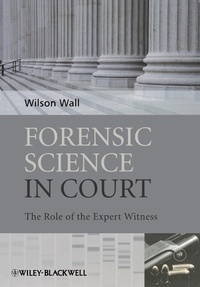
Forensic Science in Court
The Role of the Expert Witness
1st Edition
Published on 27. November 2009
Book
Paperback/Softback
176 pages
978-0-470-98577-9 (ISBN)
Description
Forensic Science in Court: The Role of the Expert Witness is a practical handbook aimed at forensic science students, to help them prepare as an expert witness when presenting their evidence in court. Written in a clear, accessible manner, the book guides the student through the legal process and shows them how to handle evidence, write reports without ambiguity through to the more practical aspects of what to do when appearing in court. The book also offers advice on what to expect when working with lawyers in a courtroom situation. An essential text for all students taking forensic science courses who are required to take modules on how to present their evidence in court. The book is also an invaluable reference for any scientist requested to give an opinion in a legal context.
Integrates law and science in an easy to understand format
Inclusion of case studies throughout
Includes straightforward statistics essential for the forensic science student
An invaluable, practical textbook for anyone appearing as an expert witness in court
Unique in its approach aimed at forensic science students in a courtroom environment
Integrates law and science in an easy to understand format
Inclusion of case studies throughout
Includes straightforward statistics essential for the forensic science student
An invaluable, practical textbook for anyone appearing as an expert witness in court
Unique in its approach aimed at forensic science students in a courtroom environment
More details
Language
English
Place of publication
New York
United States
Target group
College/higher education
Product notice
Paperback (trade)
Unsewn / adhesive bound
Dimensions
Height: 244 mm
Width: 170 mm
Thickness: 10 mm
Weight
319 gr
ISBN-13
978-0-470-98577-9 (9780470985779)
Copyright in bibliographic data and cover images is held by Nielsen Book Services Limited or by the publishers or by their respective licensors: all rights reserved.
Schweitzer Classification
Other editions
Additional editions
Book
11/2009
1st Edition
Wiley
€142.50
Article not available at the moment
E-Book
09/2009
1st Edition
Wiley
€41.99
Available for download
Person
Wilson Wall is the author of Forensic Science in Court: The Role of the Expert Witness, published by Wiley.
Content
INTRODUCTION: Forensic science and the justice system.
CHAPTER ONE: Where the law comes from: You don't mess about with The People.
CHAPTER TWO: The legal system and how it works.
The legal justification for expert witnesses.
The structure of civil and criminal courts.
Who sits and the correct form of address.
The unusual: coroners courts, courts martial and human rights. CHAPTER THREE: Rules of evidence as they apply to expert witnesses.
The expert as advocate.
The expert as arbiter.
Appointment of experts by disputing sides and by the court.
CHAPTER FOUR: The first point of contact, dealing with solicitors.
The written report, structure and content.
CHAPTER FIVE: The expert in court.
What makes an expert.
What you will be expected to contribute to the of the court.
How to make the most of your appearance in court.
CHAPTER SIX: Statistics and statistical inferences.
What traditional statistical methodology can and cannot tell us.
The statistical nature of databases.
Different types of databases: Anonymous and named.
CHAPTER SEVEN: Ethical considerations for the forensic scientist.
APPENDIX: Nomenclature for citing law reports.
GLOSSARY OF COMMONLY USED TERMS AND PHRASES
INDEX
CHAPTER ONE: Where the law comes from: You don't mess about with The People.
CHAPTER TWO: The legal system and how it works.
The legal justification for expert witnesses.
The structure of civil and criminal courts.
Who sits and the correct form of address.
The unusual: coroners courts, courts martial and human rights. CHAPTER THREE: Rules of evidence as they apply to expert witnesses.
The expert as advocate.
The expert as arbiter.
Appointment of experts by disputing sides and by the court.
CHAPTER FOUR: The first point of contact, dealing with solicitors.
The written report, structure and content.
CHAPTER FIVE: The expert in court.
What makes an expert.
What you will be expected to contribute to the of the court.
How to make the most of your appearance in court.
CHAPTER SIX: Statistics and statistical inferences.
What traditional statistical methodology can and cannot tell us.
The statistical nature of databases.
Different types of databases: Anonymous and named.
CHAPTER SEVEN: Ethical considerations for the forensic scientist.
APPENDIX: Nomenclature for citing law reports.
GLOSSARY OF COMMONLY USED TERMS AND PHRASES
INDEX