

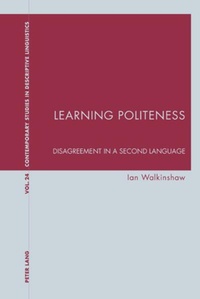
Learning Politeness
Disagreement in a Second Language
Published on 4. February 2009
Book
Paperback/Softback
304 pages
978-3-03911-527-3 (ISBN)
Description
This book examines how Japanese learners of English learned about managing politeness while they were studying at language schools in New Zealand. Specifically, it investigates how they learned to produce and interpret a range of disagreement strategies during oppositional talk with native speakers of English. Employing a combined qualitative and quantitative approach to data analysis, the book discusses the initial pragmatic competence of the learners, and describes how their competence developed over a ten-week period.
The book outlines some points of cultural divergence which may have influenced the direction and the extent of the learners' pragmatic development. It also sheds light on the language-acquisition strategies utilised by the learners during their tenure in the host culture. Most crucially, the book illuminates patterns of directness and indirectness in the learners' selected disagreement strategies. These patterns challenge the generally accepted theory that politeness always increases with social distance.
Reviews / Votes
<<This is an original, meticulously structured and well-written longitudinal study. It makes a valid contribution to the development of pragmatic competence - an area where very little research exists.>> (Professor Dr Juliane House, University of Hamburg)More details
Series
Edition
New edition
Language
English
Place of publication
Oxford
United Kingdom
Publishing group
Peter Lang Group AG, International Academic Publishers
Edition type
New edition
Illustrations
num. tables and graphs
Dimensions
Height: 21 cm
Width: 14.8 cm
Weight
430 gr
ISBN-13
978-3-03911-527-3 (9783039115273)
Schweitzer Classification
Person
The Author: Ian Walkinshaw has an M.A. in TES/FL from the University of Birmingham, UK, and a Ph.D. in applied linguistics from Victoria University of Wellington, NZ. His research interests are cross-cultural and interlanguage pragmatics, second language acquisition and ELT methodology. He has been involved in English language teaching in New Zealand, Japan, Britain and Vietnam, where he currently works as an EFL teacher, teacher-trainer and curriculum designer.
Content
Contents: Japanese learners of English - Disagreement speech acts - Theories of politeness - Face-threat - Individualism and collectivism - Power distance - Second language/Culture acquisition - Shifts in production of disagreements - Utterance length - Shifts in recognising and interpreting disagreements - Enryo-based assessments of pragmatic variation - Power-risk assessments of pragmatic variation - Environmental and pedagogical factors influencing pragmatic acquisition.