

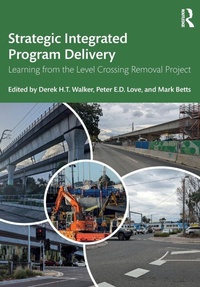
Strategic Integrated Program Delivery
Learning from the Level Crossing Removal Project
1st Edition
Will be published approx. on 22. June 2026
Book
Paperback/Softback
238 pages
978-1-032-48455-6 (ISBN)
Description
This book outlines a cutting-edge form of program delivery which the authors term SIP-Form or Strategic Integrated Program delivery. Using the Melbourne Level Crossing Removal Program (LXRP), consisting of the removal of 85 dangerous level crossings throughout metropolitan Melbourne, including rail station upgrades, signalling and track work, and other associated capital works, as an exemplar, the book sets out four features that the authors argue define the SIP-form concept as follows:
The organisation delivers a program of projects, many using an IPD contract variant form such as a Project Alliance Agreement (PAA) in Australia and numerous other countries, or the Integrated Form of Agreement (IFoA) in North America
The contract form adopted is used and has been strategically designed to accommodate the project's risk and uncertainty profile, as is the case with the LXRP
Projects within the program are integrated with some being concurrently delivered with coordination across the projects in a coherent and highly purposeful manner. Projects are not included that do not strategically fit the overall program delivery strategy
There is a strategy for learning and innovation diffusion across projects, concurrently and sequentially. Lessons to be learned are learned through designed-in governance mechanisms
The LXRP is a potentially unique program of projects, and the book takes the reader on a journey through this complex program and after giving the background and relevant context covers topics such as strategy, governance, procurement, collaboration, program alliance, HRM, leadership, digital innovation, continuous improvement, community engagement, and performance measurement. This detailed analysis of such a complex program of projects makes this book essential reading for project managers, engineers, and advanced students of project delivery and management.
The organisation delivers a program of projects, many using an IPD contract variant form such as a Project Alliance Agreement (PAA) in Australia and numerous other countries, or the Integrated Form of Agreement (IFoA) in North America
The contract form adopted is used and has been strategically designed to accommodate the project's risk and uncertainty profile, as is the case with the LXRP
Projects within the program are integrated with some being concurrently delivered with coordination across the projects in a coherent and highly purposeful manner. Projects are not included that do not strategically fit the overall program delivery strategy
There is a strategy for learning and innovation diffusion across projects, concurrently and sequentially. Lessons to be learned are learned through designed-in governance mechanisms
The LXRP is a potentially unique program of projects, and the book takes the reader on a journey through this complex program and after giving the background and relevant context covers topics such as strategy, governance, procurement, collaboration, program alliance, HRM, leadership, digital innovation, continuous improvement, community engagement, and performance measurement. This detailed analysis of such a complex program of projects makes this book essential reading for project managers, engineers, and advanced students of project delivery and management.
More details
Language
English
Place of publication
London
United Kingdom
Publishing group
Taylor & Francis Ltd
Target group
College/higher education
Professional and scholarly
Academic, Postgraduate, and Professional Reference
Product notice
Paperback (trade)
Unsewn / adhesive bound
Illustrations
38 s/w Photographien bzw. Rasterbilder, 38 s/w Abbildungen
38 Halftones, black and white; 38 Illustrations, black and white
Dimensions
Height: 244 mm
Width: 170 mm
Thickness: 14 mm
Weight
422 gr
ISBN-13
978-1-032-48455-6 (9781032484556)
Copyright in bibliographic data and cover images is held by Nielsen Book Services Limited or by the publishers or by their respective licensors: all rights reserved.
Schweitzer Classification
Other editions
Additional editions
Derek H.T. Walker | Peter E.D. Love | Mark Betts
Strategic Integrated Program Delivery
Learning from the Level Crossing Removal Project
E-Book
10/2024
1st Edition
Routledge
€89.99
Available for download
Derek H.T. Walker | Peter E.D. Love | Mark Betts
Strategic Integrated Program Delivery
Learning from the Level Crossing Removal Project
Book
10/2024
1st Edition
Routledge
€116.40
Shipment within 10-20 days
Derek H.T. Walker | Peter E.D. Love | Mark Betts
Strategic Integrated Program Delivery
Learning from the Level Crossing Removal Project
E-Book
10/2024
1st Edition
Routledge
€89.99
Available for download
Persons
Derek H. T. Walker is Emeritus Professor, RMIT University, School of Property, Construction and Project Management in Melbourne Australia.
Peter E.D. Love is a John Curtin Distinguished Professor of Infrastructure and Engineering Informatics at Curtin University and is a Fellow of the Royal Institute of Chartered Surveyors and a Chartered Building Professional.
Mark Betts has held the position of Director Project Management and Continuous Improvement with the LXRP since early 2016 and so has invaluable insights into its early days, and all projects within the program. He also had over eight years senior management experience with Metro Trains Melbourne. Metro Trains was a major partner with the Regional Rail Link Alliance (RRLA) which was a program of projects, mainly Alliance projects that significantly influenced the LXRP concept.
Peter E.D. Love is a John Curtin Distinguished Professor of Infrastructure and Engineering Informatics at Curtin University and is a Fellow of the Royal Institute of Chartered Surveyors and a Chartered Building Professional.
Mark Betts has held the position of Director Project Management and Continuous Improvement with the LXRP since early 2016 and so has invaluable insights into its early days, and all projects within the program. He also had over eight years senior management experience with Metro Trains Melbourne. Metro Trains was a major partner with the Regional Rail Link Alliance (RRLA) which was a program of projects, mainly Alliance projects that significantly influenced the LXRP concept.
Content
1. Introduction
2. Context of the LXRP
3. LXRP From Strategy to Governance
4. LXRP Delivery Choices
5. LXRP Project-Program Integration
6. LXRP Project-Program Collaboration
7. Delivering Through High-Performance Workplace Culture
8. LXRP Human Resource Development
9. LXRP Continuous Improvement and Innovation Diffusion
10. LXRP, Digital Engineering and Technological Innovation
11. LXRP and Community Engagement
12. LXRP and Program Value Generation Performance
2. Context of the LXRP
3. LXRP From Strategy to Governance
4. LXRP Delivery Choices
5. LXRP Project-Program Integration
6. LXRP Project-Program Collaboration
7. Delivering Through High-Performance Workplace Culture
8. LXRP Human Resource Development
9. LXRP Continuous Improvement and Innovation Diffusion
10. LXRP, Digital Engineering and Technological Innovation
11. LXRP and Community Engagement
12. LXRP and Program Value Generation Performance