

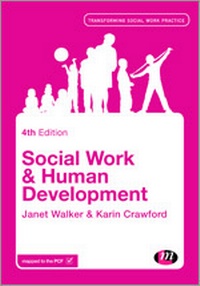
Social Work and Human Development
4th Edition
Published on 22. April 2014
Book
Hardback
216 pages
978-1-4462-8733-0 (ISBN)
Description
Social work students must develop a sound and critical understanding of human development and the processes and stages of growth through the life-course. Even more important however is how students apply this knowledge to their assignments and their practice. This text achieves this in several ways. It introduces the key concepts of human development and growth from childhood through adolescence and older age and then uses various pedagogical features to help students apply social and human development theories to practical day-to-day case examples. With this knowledge, students will be able to build and maintain successful relationships with service users, carers and other health and social care professionals.
Key updates:
More material on Life Story work
More material on Wellbeing
Greater emphasis on the links between theory and practice
This book is in the Transforming Social Work Practice series. All books in the series are affordable, mapped to the Social Work Curriculum, practical with clear links between theory & practice and written to the Professional Capabilities Framework.
Key updates:
More material on Life Story work
More material on Wellbeing
Greater emphasis on the links between theory and practice
This book is in the Transforming Social Work Practice series. All books in the series are affordable, mapped to the Social Work Curriculum, practical with clear links between theory & practice and written to the Professional Capabilities Framework.
More details
Series
Edition
4th Revised edition
Language
English
Place of publication
Exeter
United Kingdom
Publishing group
Sage Publications Ltd
Target group
College/higher education
Edition type
Revised edition
Dimensions
Height: 246 mm
Width: 171 mm
Weight
515 gr
ISBN-13
978-1-4462-8733-0 (9781446287330)
Copyright in bibliographic data and cover images is held by Nielsen Book Services Limited or by the publishers or by their respective licensors: all rights reserved.
Schweitzer Classification
Other editions
New editions
Janet Walker
Social Work and Human Development
Book
06/2017
5th Edition
Learning Matters Ltd
€114.09
Article exhausted; check for reprint
Persons
Janet Walker is Senior Lecturer in Social Work at the University of Lincoln. She has a particular interest in the development of social care training, having managed local authority social services training prior to joining the University. Janet also has considerable experience of working in children's services as a social worker and a manager. Karin Crawford is a Principal Teaching Fellow in the School of Health and Social Care and Director of Teaching and Learning for the Faculty of Health, Life and Social Sciences at the University of Lincoln.
Content
Introduction
Understanding Human Development Through the Life Course
An Introduction to Theoretical Models for Understanding Human Life Course Development
Using Life Course Development Knowledge in Social Work Practice with Infants, Young Children and Their Families
Using Life Course Development Knowledge in Social Work Practice with Older Children and Their Families
Using Life Course Development Knowledge in Social Work Practice with Adolescents
Using Life Course Development Knowledge in Social Work Practice with Adults
Using Life Course Development Knowledge in Social Work Practice with Older Adults
Conclusion
Understanding Human Development Through the Life Course
An Introduction to Theoretical Models for Understanding Human Life Course Development
Using Life Course Development Knowledge in Social Work Practice with Infants, Young Children and Their Families
Using Life Course Development Knowledge in Social Work Practice with Older Children and Their Families
Using Life Course Development Knowledge in Social Work Practice with Adolescents
Using Life Course Development Knowledge in Social Work Practice with Adults
Using Life Course Development Knowledge in Social Work Practice with Older Adults
Conclusion