

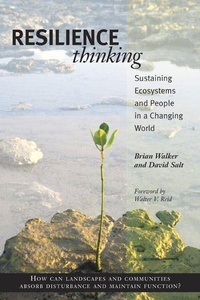
Resilience Thinking
Sustaining Ecosystems and People in a Changing World
Published on 22. August 2006
Book
Paperback/Softback
192 pages
978-1-59726-093-0 (ISBN)
Description
Increasingly, cracks are appearing in the capacity of communities, ecosystems, and landscapes to provide the goods and services that sustain our planet's well-being. The response from most quarters has been for "more of the same" that created the situation in the first place: more control, more intensification, and greater efficiency. "Resilience thinking" offers a different way of understanding the world and a new approach to managing resources. It embraces human and natural systems as complex entities continually adapting through cycles of change and seeks to understand the qualities of a system that must be maintained or enhanced in order to achieve sustainability. It explains why greater efficiency by itself cannot solve resource problems and offers a constructive alternative that opens up options rather than closing them down. In "Resilience Thinking", scientist Brian Walker and science writer David Salt present an accessible introduction to the emerging paradigm of resilience. The book arose out of appeals from colleagues in science and industry for a plainly written account of what resilience is all about and how a resilience approach differs from current practices.
Rather than complicated theory, the book offers a conceptual overview along with five case studies of resilience thinking in the real world. It is an engaging and important work for anyone interested in managing risk in a complex world.
Rather than complicated theory, the book offers a conceptual overview along with five case studies of resilience thinking in the real world. It is an engaging and important work for anyone interested in managing risk in a complex world.
Reviews / Votes
"This is one of those books that barely mentions planning as such, but has lots of implications for it. It's short but will repay some extra quiet time...Their goal is to get us to look at the world and its systems in a fresh new way." * Planning * "Resilience Thinking is an impressive and highly successful effort to explain complex ecological and social interactions and changes in a unified framework and in language accessible to a wide audience. This book should stimulate extensive discussions on these critical issues and innovative ways to approach them."---Harold Mooney, Achilles Professor of Environmental Biology, Stanford University "Resilience Thinking provides a much-needed accessible entree into a concept that holds the key to our future.... Full of wisdom, sophisticated science, and practical guidance, this book provides profound ideas, insights, and hope to scientists, students, managers, and planners alike."---Jane Lubchenco, Distinguished Professor of Zoology, Oregon State University "Resilience Thinking is an essential guidebook to a powerful new way of understanding our world-and of living resiliently within it-developed in recent decades by an international team of ecologists. With five clear and compelling case studies drawn from regions as diverse as Florida, Sweden, and Australia, this book shows how all highly adaptive systems-from ecologies to economies-go through regular cycles of growth, reorganization, and renewal and how our failures to understand the basic principles of resilience have often led to disaster. Resilience Thinking gives us the conceptual tools to help us cope with the bewildering surprises and challenges of our new century."---Thomas Homer-Dixon, Professor of political science, University of Toronto "...a clear, readable, non-academic explanation of the difference between an optimization mindset and a resilience mindset." * GreenSpirit *More details
Language
English
Place of publication
United States
Publishing group
Princeton University Press
Target group
College/higher education
Product notice
Paperback (trade)
Illustrations
figures, photos, maps, boxes
Dimensions
Height: 230 mm
Width: 153 mm
Thickness: 10 mm
Weight
268 gr
ISBN-13
978-1-59726-093-0 (9781597260930)
Copyright in bibliographic data and cover images is held by Nielsen Book Services Limited or by the publishers or by their respective licensors: all rights reserved.
Schweitzer Classification
Persons
Brian Walker is past chief of Australia's CSIRO Division of Wildlife and Ecology and is currently science program director of the Resilience Alliance. David Salt is a science writer and editor with 18 years' experience writing and producing popular science magazines and newsletters for a wide range of audiences.